A woman I know spent four years writing a novel. She wrote every morning before her children woke up. Four-thirty alarm. Coffee in the dark kitchen. Two hours of sentences, deletions, restructuring. She revised it eleven times. She queried forty-seven literary agents. She received forty-seven rejections. On the forty-eighth query she got a request for the full manuscript, waited three months for a response, and received a two-sentence pass.
She put the manuscript in a drawer and started a food blog.
The blog took off in six months. Brand deals within a year. A cookbook contract within two. By conventional measures the novel was wasted effort and the blog was the smart move. She disagrees. She told me the novel taught her how to write, how to revise, how to tolerate uncertainty. Without those four predawn years, the blog would have been mediocre. But she said it with the particular flatness of someone who has mostly convinced themselves.
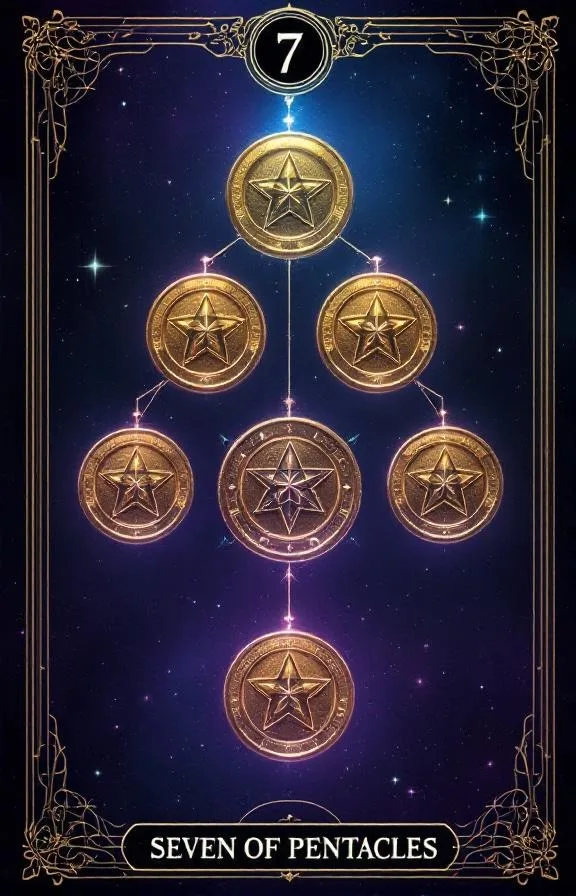
The Seven of Pentacles reversed lives in that flatness. In the gap between the effort and the payoff, where you start to wonder if the payoff is coming at all.
In short: The Seven of Pentacles reversed signals impatience with results, wasted investment, or the painful realization that what you have been cultivating may not bear fruit. Angela Duckworth's research on grit — the intersection of passion and perseverance — shows that long-term achievement requires tolerating extended periods without visible reward. This card appears when that tolerance collapses, either because your patience has genuinely run out or because what you are growing was never going to thrive in this soil.
Why the Seven of Pentacles appears reversed
The upright Seven of Pentacles shows a farmer leaning on his hoe, gazing at a bush heavy with golden pentacles. He has planted, tended, waited. Now he evaluates. The pause is contemplative, not anxious. He can see the fruit. The work is clearly paying off.
Reverse this card and the contemplation turns bitter.
The bush is sparse. The fruit is small or absent. The farmer has been working for months — years — and there is nothing proportionate to show for it. The question is no longer "is this growing?" but "was I a fool to plant here?"
This is the hardest question the reversed Seven asks, because there are two possible answers and they lead in opposite directions. Answer one: you planted well, but you are judging too early. The harvest is coming. Your impatience is the problem, not your strategy. Answer two: you planted in bad soil. The strategy itself is flawed, and no amount of patience will change that. More waiting will only compound the loss.
Duckworth's research on grit is relevant but also potentially misleading here. Grit — defined as passion and perseverance for long-term goals — predicts success across domains. West Point cadets, National Spelling Bee finalists, rookie teachers in tough schools: the grittier ones persist and the less gritty ones quit. But Duckworth herself acknowledges a crucial nuance: grit is only valuable when applied to a worthy goal. Persevering at the wrong thing is not grit. It is stubbornness. The Seven of Pentacles reversed sits exactly at the boundary between these two, and the card alone will not tell you which side you are on. That requires honesty.
Seven of Pentacles reversed in love and relationships
In love readings, this card carries an uncomfortable heaviness.
The most common pattern: you have invested enormously in a relationship — time, energy, patience, forgiveness — and the returns are not materializing. Your partner was going to change. They said they would. You gave them space to grow. You adjusted your expectations. You attended couples therapy. You read the books. And now, months or years later, the same arguments happen, the same patterns repeat, the same promises get made and broken.
The Seven of Pentacles reversed does not tell you whether to stay or leave. It tells you to stop pretending the current strategy is working. Because whatever you are doing — waiting, hoping, accommodating, ignoring — it has produced the results you are currently looking at. If those results are insufficient, the approach must change. Not your patience. Your approach.
For newer relationships, the card sometimes indicates a different dynamic: premature evaluation. You have been dating for eight weeks and you are already calculating whether this person is "the one." You are scrutinizing their texts for commitment level. You are comparing them to an imaginary ideal and finding them lacking. The Seven of Pentacles reversed in this context says: you cannot evaluate a harvest before the plant has had time to grow. Some things genuinely need patience, and romantic connection is one of them.
For single people who have been working on themselves — therapy, self-improvement, healing from past relationships — this card can feel especially cruel. You have done the work. You have grown. You are a better person than you were. And you are still alone. The card is not mocking that effort. It is naming the reality that personal growth and romantic outcomes do not operate on the same timeline. The growth is real. The harvest is just late.
Seven of Pentacles reversed in career and finances
This is the card of the sunk cost fallacy made visible.
You have invested in something — a degree, a business, a career path, a financial strategy — and the returns are disappointing. The question is whether to keep investing or cut your losses. Every financial advisor, every business book, every rational framework says the same thing: sunk costs should not influence future decisions. What you have already spent is gone. The only relevant question is whether the future investment will produce future returns.
The Seven of Pentacles reversed laughs at this advice. Not because the advice is wrong, but because humans do not work that way. You spent four years on that degree and you are going to use it, even if the field pays badly, because otherwise those four years were "wasted." You have been in this career for a decade and starting over feels like admitting a decade of failure. The rational mind knows better. The emotional mind does not care.
Financially, the card frequently appears during stagnant investments. The savings account earning 0.01 percent. The retirement fund that has been flat for three years. The rental property that breaks even after maintenance but never generates real profit. The card is not always telling you to sell or pull out. Sometimes it is telling you to reallocate — to examine whether your resources would grow better somewhere else.
Duckworth's concept of "grit" has a dark side that her research acknowledges more readily than her popular writing does: people with extremely high grit sometimes stay too long in situations that will never reward their effort. They persist past the point of diminishing returns because quitting feels like personal failure. The Seven of Pentacles reversed is the card that gives you permission to reassess without framing reassessment as weakness.
Here is the hard truth this card delivers in career readings: effort does not equal results. Hard work does not guarantee success. You can do everything right and still fail. The question the card poses is not "did you work hard enough?" — you did — but "are you working on the right thing?"
Seven of Pentacles reversed as personal growth
The growth dimension of this card is about your relationship with time and expectation.
Modern culture has a pathological need for quick results. Thirty-day transformations. Ten-step programs. Before-and-after photos taken twelve weeks apart. The Seven of Pentacles reversed appears for people who have internalized this timeline so deeply that anything taking longer feels like evidence of personal deficiency. If therapy has not fixed me in six months, maybe I am unfixable. If meditation has not produced enlightenment in a year, maybe it does not work.
Some things take a long time. Healing from childhood trauma takes years, not sessions. Building genuine expertise takes a decade, not a bootcamp. Becoming the person you want to be is a lifelong project with no completion date. The Seven of Pentacles reversed sometimes appears to remind you of this — not as consolation but as recalibration.
There is another growth angle to this card that is less comfortable: the possibility that you have been putting effort into the wrong area of growth. Working on your career when your relationships need attention. Working on your body when your mind needs care. Optimizing the wrong variable. This is not a character flaw. It is usually a defense mechanism — you work on the thing that feels manageable to avoid the thing that feels overwhelming. The Seven of Pentacles reversed says: look at the garden you have been neglecting, not the one you have been tending.
How to work with Seven of Pentacles reversed energy
Conduct a brutal honest assessment of your current investments — financial, professional, relational, personal. For each one, answer two questions. First: based on current trajectory, what will this produce in one year? Not your hope. Your honest prediction. Second: if you were starting fresh today with no history, would you invest in this same thing? If the answer to both questions makes you uncomfortable, the card has done its job.
Separate patience from denial. Patience is continuing to water a plant that shows signs of growth, even if the growth is slow. Denial is continuing to water a plant that has been dead for months because admitting it died means admitting you failed. The Seven of Pentacles reversed frequently appears for people who have confused one for the other.
Give yourself permission to pivot without calling it failure. The novelist who became a food blogger did not fail. She reallocated. The skill transferred. The effort was not wasted — it was redirected. If you need to change course, the Seven of Pentacles reversed is not laughing at your previous investment. It is releasing you from the obligation to justify it forever. Walk away from the dead garden. Plant something new. You know more about gardening now than you did when you started.
Frequently asked questions
Does the Seven of Pentacles reversed mean my efforts have been wasted?
Not necessarily. The card indicates that the current return on investment is poor, but "poor return" and "wasted effort" are not the same thing. Skills transfer. Lessons compound. The four years you spent on something that did not work taught you things that nothing else could have. The card asks you to evaluate the future honestly, not to regret the past.
How do I know if I should keep going or give up?
Look for signs of life. Not dramatic success — small, incremental indicators that your investment is producing something. If the signs exist, even faintly, persistence may be warranted. If you are honest with yourself and the signs are genuinely absent — no growth, no improvement, no movement in any direction — the card is giving you permission to stop.
What is the difference between the Seven of Pentacles reversed and the Five of Pentacles?
The Five of Pentacles is about acute hardship — loss, poverty, exclusion. The Seven reversed is about chronic disappointment — sustained effort with insufficient reward. The emotional quality is different. The Five carries desperation and grief. The Seven reversed carries exhaustion and disillusionment. The Five asks: how do I survive? The Seven reversed asks: is this worth continuing? Both are painful, but in fundamentally different ways. The Five usually resolves through external help arriving, while the Seven reversed resolves through an internal decision — either recommitting with new strategy or walking away with hard-won clarity.
Explore the Seven of Pentacles' full meaning, see what it reveals as feelings, or discover the Seven of Pentacles as a person. Ready for deeper insight? Try a free reading.