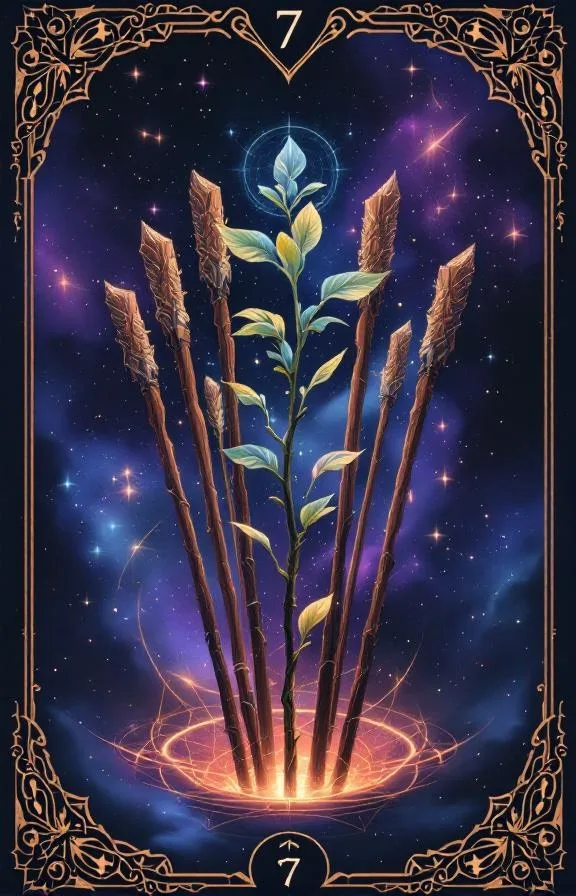
A teacher I know spent four years fighting her school administration. The curriculum changes they mandated were, in her professional judgment, harmful to students. She presented research. She organized other teachers. She spoke at board meetings. She filed formal objections. She was articulate, prepared, and right — on the evidence, she was right. The administration proceeded anyway.
By year five she stopped fighting. Not because she changed her mind. Because she ran out of fuel. She described it in a way I have never forgotten: "I still know I'm right. I just don't have the energy to care anymore." She transferred to a different school the following year. Smaller, quieter, no battles. She told me she was happier. She did not look happier.
That is the Seven of Wands reversed — not losing the argument, but losing the will to make it.
In short: The Seven of Wands reversed points to the collapse of the will to defend what you have earned, believe, or stand for. It is the exhaustion that follows sustained resistance, the moment when holding your position feels more costly than surrendering it. Albert Bandura's concept of self-efficacy — the belief in your own ability to influence outcomes — is directly relevant. When self-efficacy erodes through repeated challenge or insufficient support, even a person who objectively possesses the skills and the position abandons the fight. The card captures that erosion in progress.
Why the Seven of Wands appears reversed
Upright, the Seven of Wands shows a figure on higher ground, defending against six wands thrust upward from below. The position is advantageous. The defender has earned the high ground. The card says: you have something worth defending, and you are capable of defending it. Hold your position.
Reverse it and the figure steps back from the edge. The higher ground is still there — that is important. The advantage has not disappeared. What has disappeared is the confidence to use it.
This reversal operates on two levels simultaneously. The external level is straightforward: opposition is overwhelming you. Too many fronts. Too many critics. Too many demands. You are outnumbered, and the practical reality of sustained defense has ground you down.
The internal level is more insidious. You have begun to doubt whether the position is worth defending. The beliefs you once held with certainty now feel less certain. The career you fought to build, the relationship you worked to protect, the boundary you set — was it worth it? Were you right? The Seven of Wands reversed introduces doubt not through logic but through attrition.
Bandura demonstrated that self-efficacy is not a fixed trait. It fluctuates based on four sources: mastery experiences (past successes), vicarious experiences (watching others succeed), social persuasion (encouragement from others), and physiological states (energy, health, mood). The Seven of Wands reversed typically appears when multiple sources have degraded simultaneously. You have not won recently. You see others in similar positions giving in. Nobody is encouraging you to keep going. You are exhausted. Each source reinforces the others in a downward spiral.
Seven of Wands reversed in love and relationships
In love, this card appears when someone has stopped defending the relationship — not to an external threat, but to the internal voice that says it is not working.
Every long-term relationship faces periods where one or both partners have to actively choose to stay. Active choice. Not passive drift — active, conscious, sometimes difficult commitment to continuing. The Seven of Wands reversed says that active choice has collapsed into passive resignation. You are still technically in the relationship, but you have stopped fighting for it. You no longer advocate for date nights, for intimacy, for the difficult conversations that keep connection alive. The relationship continues on momentum alone, and momentum is a finite resource.
For people dealing with outside interference — disapproving families, complicated ex-partners, friends who undermine the relationship — the Seven of Wands reversed signals surrender to that pressure. You know your relationship is good. You know the criticism is unwarranted. And you are too tired to keep explaining, justifying, defending. So you start distancing. You stop bringing your partner to family events. You minimize the relationship in public. You give ground inch by inch.
If you are single and pulled this card, it often points to a collapse in your willingness to advocate for your own needs in dating. You settle for less than you want because asking for more feels like too much effort. You tolerate behavior you should not tolerate because drawing a line requires energy you do not have. The card is not saying your standards are too high. It is saying your tank is empty.
Seven of Wands reversed in career and finances
The workplace version of this card is burnout. Full stop.
Not the glamorized version of burnout that gets posted on LinkedIn with hashtag-hustle-culture commentary. The real version. The one where you stare at your inbox and feel nothing. Where you have been carrying a workload designed for three people and you have stopped telling anyone because telling them never changed anything. Where your expertise is routinely ignored by managers who make decisions based on politics rather than evidence.
The Seven of Wands reversed in a career reading is the most direct card in the deck about professional capitulation. You had a position, you defended it, the defense was not rewarded, and now you are considering whether to keep the position or trade it for peace. The card does not judge this consideration. Knowing when to stop fighting is sometimes wisdom. But it wants you to be honest about the reason. Wisdom is one thing. Exhaustion masquerading as wisdom is another.
Financially, the card can signal giving up ground on compensation. Accepting a salary you know is below your value because negotiating feels futile. Not pursuing the raise because the last time you asked, you were made to feel ungrateful. Watching your financial position erode through inaction because action requires a fight you cannot face.
Here is the difficult truth: sometimes the Seven of Wands reversed is right. Sometimes the fight is not worth it. Sometimes the position you are defending is not as strong as you think, or the cost of defending it genuinely exceeds its value. The card does not automatically mean you should keep fighting. It means you should examine why you stopped.
Seven of Wands reversed as personal growth
Bandura's self-efficacy research contains a finding that most people overlook: the single most powerful source of self-efficacy is mastery experience. Not encouragement from others. Not watching others succeed. Direct, personal experience of overcoming a challenge. Nothing else comes close.
The Seven of Wands reversed often appears for people who have not had a mastery experience in a long time. They have been on defense for so long — defending their job, their relationship, their choices, their identity — that they have forgotten what it feels like to go on offense. To initiate rather than react. To build rather than protect.
The growth path here is counterintuitive. It is not about fighting harder. Fighting harder when your self-efficacy is depleted is like sprinting on a broken leg. It makes things worse. The path is about finding a small arena where you can win. Not where you can survive — where you can win. Complete a small project. Master a small skill. Solve a problem that has a clear solution. These micro-victories rebuild the self-efficacy that sustained defense has drained.
The card also asks you to examine your support system. Bandura found that social persuasion — genuine encouragement from credible sources — can bolster self-efficacy even when mastery experiences are scarce. Are you surrounded by people who believe in your ability to hold your ground? Or are you surrounded by people who think you should give up, who call surrender "being realistic," who frame your exhaustion as maturity? Your environment is not neutral. It is either restoring your capacity to fight or accelerating its depletion.
How to work with Seven of Wands reversed energy
Rest before you decide. This is non-negotiable. The Seven of Wands reversed produces decisions made from exhaustion, and decisions made from exhaustion are almost always regretted. Do not quit the job, end the relationship, or abandon the project while you are in this state. Take a week. Take two. Reduce your exposure to the stressor if possible. Sleep. Then decide. The decision you make from a rested state will be different from the one you make right now, and it will be better.
Identify the hill worth dying on. When you are overwhelmed on multiple fronts, the instinct is to defend everything or abandon everything. Both are mistakes. Pick the one position that matters most. The non-negotiable. The thing you will not surrender under any circumstances. Let the rest go. Not permanently — temporarily. Consolidate your forces. The military principle applies: a small force concentrated on one position is stronger than a large force spread across many.
Ask for reinforcement. Not advice — reinforcement. The difference matters. Advice says "here is what I think you should do." Reinforcement says "I am standing next to you while you do it." If you have people in your life who can offer the second kind, call them. If you do not, that absence is itself significant, and building those alliances becomes a priority that ranks alongside whatever you are defending.
Frequently asked questions
Does the Seven of Wands reversed mean I should stop fighting and walk away?
Not automatically. The card indicates that your will to fight has been compromised, but it does not prescribe a response. Sometimes walking away is the wisest choice — when the position is genuinely not worth the cost, or when fighting has become self-destructive. Other times, the card is simply naming your exhaustion so you can address it. Rest and reassess before making permanent decisions.
Can this card indicate that my opponents are too strong?
It can, but the emphasis is usually on your perception of their strength rather than their actual strength. Bandura's research shows that self-efficacy affects how people perceive obstacles — low self-efficacy makes challenges appear larger and more threatening than they are. The Seven of Wands reversed often exaggerates the opposition's power because your confidence in your own power has eroded.
What is the relationship between this card and the Nine of Wands?
They are sequential stages of the same process. The Nine of Wands shows someone wounded but still standing — battered, bruised, but refusing to yield. The Seven of Wands reversed shows the step before that: the moment of choosing whether to keep standing or sit down. If you pull the Seven reversed now, the Nine may follow later — suggesting that you will find the resilience to continue, but it will cost you. Alternatively, the absence of the Nine in a spread alongside the Seven reversed can suggest that the fight is ending, one way or another.
Explore Seven of Wands' full meaning, see what it reveals as feelings, or discover Seven of Wands as a person. Ready for deeper insight? Try a free reading.