She ran a bakery, managed the social media, handled the accounts, made every birthday cake herself, coached her daughter's volleyball team, and hosted Thanksgiving for twenty-two people every year. When I asked how she was doing, the answer was always "busy." Not good. Not tired. Busy. As if the volume of activity was itself an identity — proof of value, evidence of importance, the only acceptable answer to the question of who she was.
She sold the bakery last March. Not because she wanted to. Because her body forced her to. Three panic attacks in two weeks. A doctor who said the words "you have to stop." She cried when she told me, and what she said was revealing: "I don't know who I am if I'm not carrying everything."
I asked her what she was most afraid of. Not the panic attacks. Not the health consequences. Her answer: "Being useless." She would rather be hospitalized than idle. She would rather collapse than sit still. The weight was not something imposed on her. It was something she chose, over and over, because setting it down meant confronting an emptiness she had been filling with productivity since she was fourteen years old.
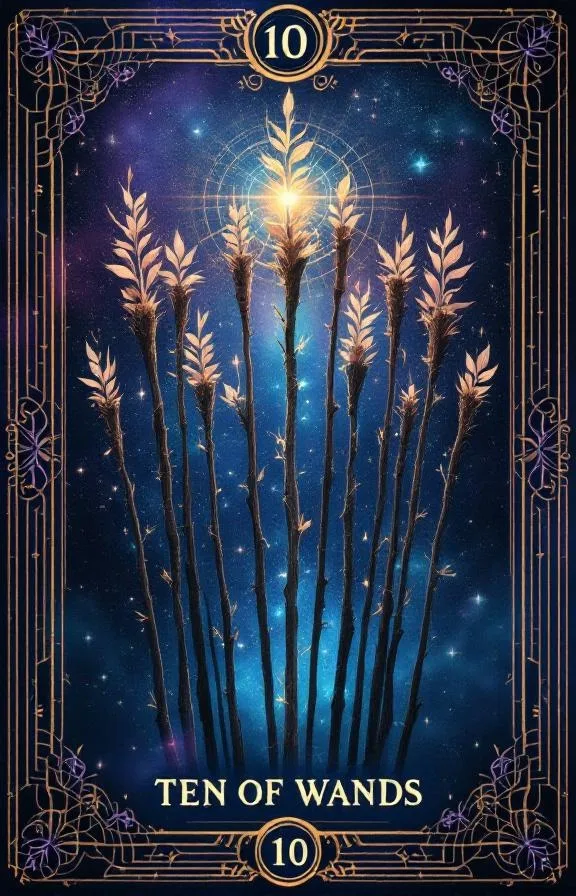
That sentence is the Ten of Wands reversed.
In short: The Ten of Wands reversed represents the moment when carrying everything is no longer sustainable — either you consciously release the burden, or it crushes you. Christina Maslach's groundbreaking research on burnout identified three dimensions: emotional exhaustion, depersonalization (cynicism about your work and the people in it), and reduced personal accomplishment. This card often appears when all three are present simultaneously, and the only honest question left is whether you will put the wands down voluntarily or wait until you drop them.
Why Ten of Wands appears reversed
Upright, the Ten of Wands shows a figure staggering under ten heavy wands, pushing forward through sheer will. It is the card of taking on too much but somehow managing. Reversed, that "somehow" breaks down.
This is not a card about being a little stressed. It is a card about structural overload — the kind that cannot be fixed by a weekend off or a nice bath. The system itself is overtaxed. You said yes to too many things, and the compound weight has exceeded your capacity to function well at any of them.
Maslach's research, conducted primarily with healthcare and social service workers, revealed that burnout is not simply exhaustion. It is a syndrome. The exhaustion comes first, yes. But then comes the cynicism — you stop caring about work you used to love. And finally, the creeping sense that nothing you do makes a difference anyway, so why bother trying. The Ten of Wands reversed maps onto this progression with uncomfortable precision.
There is a second reading of this reversal that is more hopeful. Sometimes the Ten of Wands reversed does not indicate collapse — it indicates release. You finally said no. You delegated the thing you were hoarding. You quit the committee, cancelled the project, admitted you cannot do everything. This version of the card feels like setting down a backpack you have been wearing so long you forgot it was there. The sudden lightness is disorienting.
Ten of Wands reversed in love and relationships
In relationships, this card tells a specific and often uncomfortable story: one person is carrying far more than their share.
Maybe it is emotional labour — the partner who plans every date, remembers every birthday, initiates every difficult conversation, manages the household calendar, monitors the emotional temperature of the relationship. Maybe it is financial — one person earning while the other spends. Maybe it is simply attention: one partner is fully invested while the other coasts on that investment.
The Ten of Wands reversed asks whether the imbalance is acknowledged. Often it is not. The overburdened partner has normalized the weight to the point where they do not even name it as unfair. They just feel tired all the time and cannot figure out why.
Here is something most tarot interpretations will not say directly: this card sometimes means you need to stop being a martyr. Carrying everything is not noble if you never asked for help. It is not selfless if part of you resents it. And it is definitely not sustainable if you are pulling Ten of Wands reversed in a reading about your relationship.
If you are single, this card can indicate that past relationship patterns of over-giving are preventing you from entering a new partnership. You are exhausted before anything even begins. The memory of carrying someone else's weight makes the prospect of a new relationship feel like signing up for more labour rather than gaining a genuine companion.
Ten of Wands reversed in career and finances
The career reading for this card is almost always about delegation. Or rather, the refusal to delegate.
You are doing everything yourself. You know you should hand off tasks, but you do not trust anyone else to do them correctly. Or you cannot afford to hire help. Or — and this is the one people rarely admit — you derive identity from being the person who handles everything, and delegating would mean confronting the terrifying question of what you are worth when you are not indispensable.
Maslach's third dimension of burnout, reduced personal accomplishment, is particularly relevant here. You are working harder than ever and producing less. The quality has dropped. The creativity has dried up. You are not doing your best work because your best work requires focus, and focus is impossible when you are juggling seventeen responsibilities simultaneously.
Financially, the Ten of Wands reversed can indicate debt pressure — the accumulated weight of obligations that individually seemed manageable but collectively have become suffocating. It can also mean finally paying something off, clearing a financial burden, experiencing the relief of a load lifted.
One of the things that makes this card difficult to work with in career readings is the reinforcement loop. The harder you work, the more people depend on you. The more people depend on you, the harder it feels to stop. You become the person everyone goes to because you never say no, and then your inability to say no becomes structural — the team literally cannot function without your overwork, because it has been designed around your overwork. You built the trap. You are also the only one maintaining it.
Ten of Wands reversed as personal growth
Most people who pull this card already know they are overloaded. They do not need the card to tell them that. What they need the card to tell them is this: the overload is a choice you are making, and the reason you keep making it is worth examining.
People who chronically over-commit usually have a core belief driving the behaviour. "If I am not useful, I am not valuable." "Resting is lazy." "Other people cannot handle what I can handle." "If I slow down, everything will fall apart." These beliefs feel like reality. They are not. They are stories you learned, probably early, and they are running your life on autopilot.
Maslach found that burnout is not purely an individual problem. It is a systemic one. The organizations that burn people out are designed to burn people out — they reward overwork, punish boundary-setting, and treat exhaustion as a badge of honour. If you are in a system like that, individual self-care is necessary but insufficient. You also need to evaluate whether the system itself is compatible with your survival.
The growth invitation of the Ten of Wands reversed is deceptively simple: put something down. Not everything. One thing. The PTA committee. The side project that lost its spark two years ago. The friendship that drains you. The obligation you agreed to out of guilt rather than genuine desire. Put it down and notice that the world does not end.
The fear underneath this card is usually that putting something down will reveal your dispensability. If the committee runs fine without you, what does that say about your contribution? If the project continues after you leave it, were you ever essential? These are not comfortable questions. But the Ten of Wands reversed insists you face them, because the alternative — carrying everything until your body or mind forces you to stop — is not a strategy. It is a countdown.
How to work with Ten of Wands reversed energy
Make a list of everything you are currently responsible for. Everything. Work tasks, household tasks, emotional responsibilities, social obligations, projects, commitments. Write them all down. Now circle the ones that only you can do. Really — only you. Not "only you because you don't trust anyone else" but genuinely, structurally, only you.
The circled items are probably fewer than you expected.
For everything else, you have three options: delegate it, defer it, or drop it entirely. This framework is not original, but the Ten of Wands reversed demands that you actually use it instead of nodding at the concept and then continuing to carry everything.
Practice saying no without an explanation. "I can't take that on right now" is a complete sentence. You do not owe anyone a reason for protecting your capacity. The guilt you feel when you say no is not evidence that you should have said yes. It is evidence that your boundary-setting muscles are atrophied from disuse.
Track your energy, not just your time. The productivity culture obsesses over time management, but the Ten of Wands reversed is not a time problem. It is an energy problem. Some tasks take thirty minutes but drain you for the rest of the day. Others take two hours and leave you energized. Knowing the difference — and structuring your commitments around energy rather than hours — is the practical application of this card's deepest teaching: not all burdens weigh the same, and the heaviest ones are not always the largest.
Frequently asked questions
Is the Ten of Wands reversed telling me to quit my job?
Not necessarily. It is telling you that something in your current workload is unsustainable and needs to change. That might mean quitting. It might mean renegotiating your role, delegating responsibilities, or simply stopping the voluntary extras that are depleting you. The card identifies the problem. The solution depends on your specific circumstances.
What does the Ten of Wands reversed mean in a health reading?
Stress-related health issues. Exhaustion that is not resolved by sleep. The kind of fatigue that shows up in your body because your mind has been ignoring the signals for too long — back pain, headaches, insomnia, digestive problems. This is one of the strongest "take care of yourself" cards in the deck, and in a health context, it should be taken literally.
How is the Ten of Wands reversed different from the Nine of Wands reversed?
The Nine is about defensive exhaustion — fighting too long, trusting too little, hypervigilance. The Ten is about labour exhaustion — carrying too much, doing too much, refusing to share the load. Nine is the soldier who cannot stop scanning for threats. Ten is the workhorse who cannot stop working. Both lead to burnout, but the path there is different, and so is the remedy. The Nine needs to lower the guard. The Ten needs to put the burden down.
Explore Ten of Wands' full meaning, see what it reveals as feelings, or discover Ten of Wands as a person. Ready for deeper insight? Try a free reading.