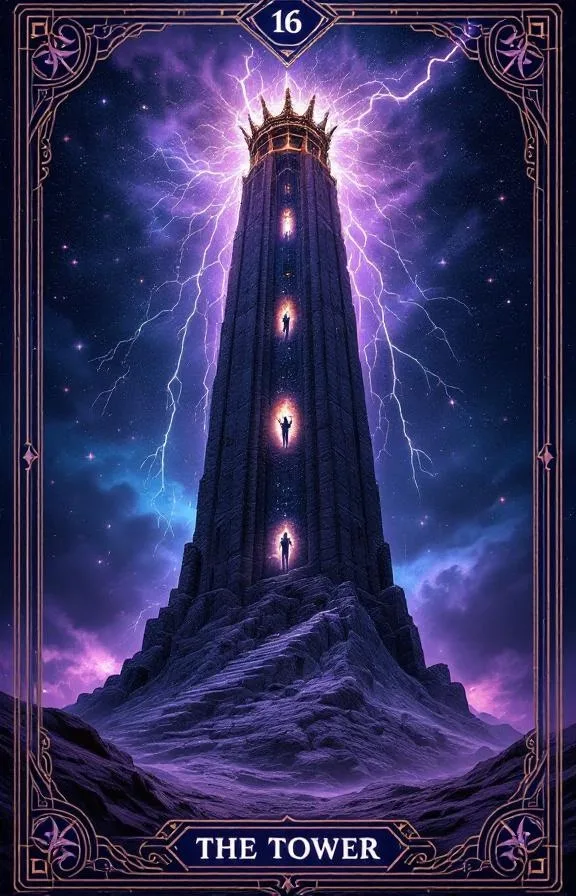
The building was condemned two years before it fell. Everyone in the neighborhood knew. The cracks ran from foundation to roofline, visible from the street. Tenants received notices, attended meetings, signed petitions for repair funding that never came. Then the east wall collapsed on a Thursday afternoon while most people were at work, and the news reported it as sudden. It was not sudden. It was ignored. The Tower reversed is the condemned building before the wall gives way — the destruction that is already happening, silently, while you debate whether to acknowledge it.
In short: The Tower upright shatters structures violently and visibly — the breakup, the firing, the revelation that rewrites everything. Reversed, the same destructive energy turns inward or gets delayed. Tedeschi and Calhoun's research on post-traumatic growth found that transformation does not require catastrophe — but it does require honest engagement with what is breaking. The Tower reversed asks whether you are transforming quietly or simply postponing the collapse.
Why The Tower appears reversed
Two completely different readings live inside this card, and the difference between them matters enormously.
The first reading: you are undergoing internal demolition. The structures collapsing are beliefs, identities, assumptions — things that cannot be photographed but that held your world together just as surely as steel beams hold up a building. From outside, nothing has changed. You still go to work. You still answer texts. You still look like yourself. But internally, the architecture is being dismantled floor by floor. This is the quiet crisis, the one that happens in bed at 3 AM while your partner sleeps next to you unaware that you are reconsidering everything.
The second reading: you are resisting necessary destruction. You see the cracks. You know the structure is unsound. And you are patching, reinforcing, propping up — doing everything possible to avoid the collapse that your own instincts are telling you is required. This is not strength. It is fear wearing the costume of perseverance.
The distinction between these two interpretations is not academic. One leads to growth. The other leads to a bigger explosion later.
Tedeschi and Calhoun coined the term "post-traumatic growth" in the mid-1990s after studying people who had experienced severe adversity — bereavement, combat, life-threatening illness, assault. Their finding challenged the dominant narrative that trauma only damages: a significant percentage of their subjects reported that the experience, while devastating, ultimately catalyzed positive changes they could not have achieved otherwise. Deepened relationships. Revised priorities. A sense of personal strength they did not know they possessed.
But here is the part most people skip when citing their work. Post-traumatic growth does not come from the trauma itself. It comes from the cognitive processing afterward — the difficult, sustained work of rebuilding meaning from wreckage. People who avoided this processing, who patched the cracks and insisted on returning to "normal," did not experience growth. They experienced chronic stress. The trauma stayed in the walls.
The Tower reversed is where this choice lives. Are you doing the work of processing, even though it is invisible from outside? Or are you refusing the demolition that would make real rebuilding possible?
The Tower reversed in love and relationships
Relationships are structures. They have foundations (shared values, trust, early experiences together) and load-bearing walls (communication patterns, conflict resolution habits, sexual dynamics). The Tower reversed in a love reading says the structure has significant damage, and the question is what happens next.
The scenario I encounter most: both people know something is fundamentally wrong, and neither will say it. Conversations circle the real issue without landing. Arguments recycle the same surface complaints while the actual grievance sits underneath, growing roots. The relationship has been condemned. The notices have been served. And everyone involved is pretending the cracks are cosmetic.
This card is not subtle about what it asks: stop pretending.
Sometimes the honest reckoning saves the relationship. Two people who can say "this foundation is cracked, and we need to tear it up and pour a new one" have a chance. That means therapy, uncomfortable conversations, the temporary loss of certainty about whether the relationship will survive the renovation. It means being willing to lose what you have in order to build something that can actually hold weight.
Sometimes the honest reckoning ends the relationship. And that is the ending most people are trying to avoid by keeping the Tower upright through sheer force of will. The dirty secret: the relationship is already over. It ended months or years ago. What continues is maintenance of the appearance of a relationship, fueled by fear, inertia, or the financial and social complexity of separation.
For single people, The Tower reversed often points to the slow crumbling of a belief about love itself. The story you told yourself about what you needed in a partner. The conviction that being single meant failure. The fantasy of a relationship that would fix the parts of yourself you find unacceptable. These beliefs are structures too, and they can fall just as hard as any relationship.
There is tenderness in this card, despite its violence. The Tower, even reversed, is not punishment. It is the universe's insistence that you deserve a structure that can stand. Everything it brings down was already failing. You just had not admitted it yet.
The Tower reversed in career and finances
In career readings, The Tower reversed typically appears during the period of knowing that precedes acting.
You know the company is going under. You know the industry is shifting beneath you. You know your role has been hollowed out until what remains is title and routine without substance. You know. And you are not moving.
The card asks why. The answer is almost never simple laziness. It is usually one of three things: financial fear (the mortgage, the insurance, the lifestyle built on a specific income), identity attachment (if I am not a [job title], who am I?), or the sunk cost fallacy operating at full power (I have given twelve years to this company, I cannot leave now as though those years meant nothing).
All three are understandable. None of them are reasons to stay in a structure that is failing.
The financial reading of The Tower reversed is blunter. A financial structure you have built — savings strategy, business model, investment approach, spending habits — has a flaw you are aware of but not addressing. The market has shifted. The math does not work anymore. The "sure thing" is no longer sure. This card does not predict financial ruin. It predicts the continuation of denial that makes financial ruin more likely.
There is a constructive reading here too. The Tower reversed can describe someone who is deliberately deconstructing their career to rebuild it. Leaving a lucrative specialty to retrain. Closing a successful business because it no longer aligns with who they have become. Choosing a pay cut for work that matters. These are controlled demolitions — painful, expensive, and ultimately the most courageous professional decisions a person can make.
The Tower reversed as personal growth
Tedeschi and Calhoun identified five domains of post-traumatic growth: new possibilities, relating to others, personal strength, spiritual change, and appreciation of life. Notice that none of these are about returning to who you were before the tower fell. Growth means becoming someone different. Not better in some simplistic way. Different. The person you were before is gone. The question is who emerges from the rubble.
The Tower reversed as personal growth is specifically about the choice to engage with destruction rather than flee from it. It is meditation practice that brings up rage instead of peace. Therapy sessions that leave you feeling worse for weeks before anything shifts. Journaling that reveals beliefs about yourself so fundamental you did not know they were beliefs — you thought they were facts.
This kind of growth is invisible and largely unrewarded. Nobody throws you a party for realizing your relationship with your mother has shaped every romantic choice you have ever made. Nobody promotes you for recognizing that your ambition was compensation for a childhood where love was conditional on achievement. The demolition happens in private. The rebuilding happens in private. And the people around you may not understand why you seem different — quieter, maybe, or less willing to participate in conversations that used to energize you.
One warning. The Tower reversed can also describe spiritual bypassing — using the language of growth to avoid the actual pain of collapse. "Everything happens for a reason" is not processing. It is wallpaper over a crack. Real growth from The Tower reversed is ugly, specific, and resistant to platitudes. If your engagement with the destruction feels clean and resolved, you probably have not gone deep enough.
How to work with The Tower reversed energy
Stop reinforcing what needs to fall. This is the hardest instruction and the most important one. Identify the structure in your life that you are propping up through willpower, denial, or habit. Ask yourself: if I stopped maintaining this, what would happen? If the answer terrifies you, that is information. The terror is not proof that the structure must stay. It is proof of how much energy you are spending to keep something alive that wants to die.
Accept the timeline. Internal demolition takes longer than external collapse. A lightning strike brings the tower down in seconds. Quiet structural failure takes months, sometimes years. You cannot rush this process without creating new damage. Do the work. Let it take the time it takes.
Distinguish between patience and paralysis. Patience says: I know this is changing, and I am moving through it deliberately. Paralysis says: I know this needs to change, and I am doing nothing while telling myself I am being patient. The difference is action, however small. Patience involves choices. Paralysis involves waiting for choices to be made for you.
Document what you are learning. The Tower reversed destroys, but it also reveals. Foundations you thought were solid turn out to be hollow. Walls you thought were load-bearing turn out to be decorative. Write down what the demolition is showing you. These revelations are building materials for whatever comes next.
Find one person who can witness. Not fix. Not advise. Witness. The Tower reversed is isolating because the destruction is internal and therefore invisible. Having someone who knows what is happening — who can say "I see that you are going through something real" — is not weakness. It is the difference between processing and suffering.
Frequently asked questions
Does The Tower reversed mean I can avoid a major upheaval?
No. It means the upheaval is happening differently — internally rather than externally, or in slow motion rather than all at once. The energy of The Tower cannot be cancelled, only redirected. Think of it as the difference between a controlled demolition and an unplanned collapse. Reversed, you may have the opportunity to take the structure down deliberately, on your terms. But the structure is still coming down.
Is The Tower reversed better or worse than upright?
Neither, in the way people usually mean. Upright is faster and more visible — the crisis happens, the old structure falls, and you are forced to deal with the aftermath immediately. Reversed is slower and harder to detect, which can be either an advantage (you have time to prepare, to process, to choose) or a trap (you have time to deny, to delay, to pretend). Tedeschi and Calhoun's research suggests that the outcome depends less on the nature of the disruption and more on the quality of the cognitive engagement afterward. A person who fully engages with a slow internal collapse can grow as much as someone who survives sudden catastrophe. A person who avoids engaging with either one does not grow at all.
What should I do if The Tower reversed keeps appearing in my readings?
Repetition in tarot is emphasis. The card is not repeating because the deck is stuck. It is repeating because you are stuck. Something in your life requires demolition and you have not yet begun — or you have begun but keep pausing, re-patching, second-guessing. Sit with one question: what am I maintaining that I know, in my most honest moments, cannot be saved? You already have the answer. The card keeps appearing because you have not acted on it yet.
Explore The Tower's full meaning, see what it reveals as feelings, or discover The Tower as a person. Ready for deeper insight? Try a free reading.