She launched the online store in October. Handmade ceramics — mugs, bowls, the kind of stuff that photographs well on a wooden table with morning light. She had spent six months building inventory, learning product photography, writing descriptions that did not sound like every other Etsy listing. October first: the store went live. She posted on Instagram. She told her friends. She waited.
November brought three sales. All from people she knew. December: one sale. January: nothing. By February she was checking the analytics dashboard compulsively, refreshing a page that showed the same flat line every time. The work was good. The execution was competent. The ships she had sent out were simply not coming back, and she could not figure out why.
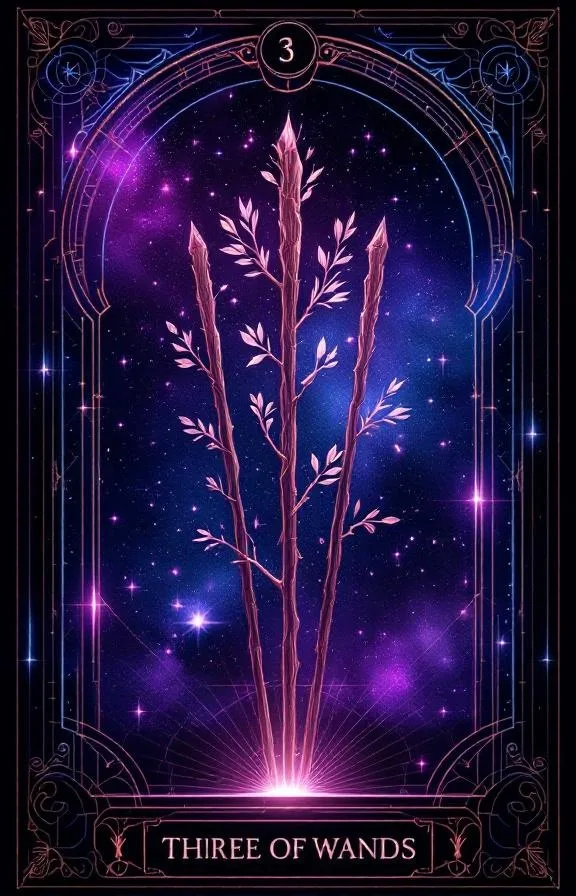
That flat line on the dashboard — that is the Three of Wands reversed.
In short: The Three of Wands reversed speaks to the painful gap between effort expended and results received. Plans that should be bearing fruit are stalling. Expansion feels blocked. The horizon you were counting on remains stubbornly empty. Carol Dweck's distinction between growth and fixed mindsets becomes acutely relevant here: in the face of setbacks, a growth mindset asks "what can I adjust?" while a fixed mindset concludes "I must not be good enough." This card often appears at the precise moment when that choice between mindsets is being made.
Why the Three of Wands appears reversed
The upright Three of Wands shows a figure on a cliff watching ships sail toward the horizon. The plans have been made. The investment has been committed. Now comes the waiting — but it is hopeful waiting, expectant, rooted in confidence that the ships will return laden with goods. It is the entrepreneur who has done the work and trusts the market. The student who has studied and trusts the exam.
Reverse this card and the ships are delayed. Or lost. Or they come back empty. The figure on the cliff is still watching, but the posture has shifted from anticipation to anxiety. Hope has curdled into something closer to dread.
This is not the same as failure. Failure is definitive. The Three of Wands reversed is the worse thing — indefinite delay. You cannot grieve and move on because the outcome has not arrived yet. You cannot celebrate because there is nothing to celebrate. You are suspended between investment and return, and the suspension is eroding your confidence.
Dweck's research on mindset illuminates a critical fork that this card represents. When effort does not produce expected results, humans tend to fall into one of two interpretive frames. The first says: the strategy was wrong, let me adjust. The second says: I was wrong, I should not have tried. The Three of Wands reversed is not telling you which frame is correct. It is telling you the moment of choosing between them is now.
Three of Wands reversed in love and relationships
In relationship readings, the Three of Wands reversed often appears when a relationship is not progressing at the pace one or both partners expected.
You have been together a year and the conversation about moving in together keeps getting deferred. You discussed marriage and then the topic mysteriously evaporated. You talked about having children "someday" and someday has been receding like a horizon you are walking toward but never reaching. The card does not necessarily mean the relationship is doomed. What it means is that the natural momentum of partnership has stalled, and neither person is quite willing to examine why.
For people in long-distance relationships, this card carries particular weight. The Three of Wands upright is practically the patron card of long-distance love — waiting for someone across water, trusting in reunion. Reversed, it suggests the reunion keeps getting postponed. Visa issues. Job commitments. Financial constraints. Each delay is individually reasonable. Collectively, they form a pattern that is harder to explain away.
If you are single, the Three of Wands reversed sometimes points to the frustration of investing in dating — the apps, the first dates, the vulnerability — without seeing returns. You are doing the things you are supposed to do and it is not working, and the temptation to conclude that something is fundamentally wrong with you is almost overwhelming. Resist that temptation. The card is about circumstances and timing, not about your inherent lovability.
Three of Wands reversed in career and finances
This is the card that makes entrepreneurs want to throw their laptops into the ocean.
You did the work. You built the product, the portfolio, the pitch deck. You sent the proposals, attended the networking events, followed up with the contacts. And the response is... silence. Or worse — polite interest that never converts to action. "We'll get back to you" emails that never get back to you. The Three of Wands reversed in a career reading is the universe's way of saying: the timeline you had in mind was wrong.
Not the goal. The timeline.
This distinction matters enormously. Most people who pull this card interpret it as "my plan has failed." But the card is a Three — it sits in the early expansion phase of the Wands suit. It has not reached the completion stages. The message is usually not that the plan is wrong but that it will take longer than you budgeted for, cost more than you estimated, and require more persistence than you thought you had.
Financially, the reversed Three can indicate returns delayed on investments, business ventures that are burning cash longer than projected, or income that has plateaued when you expected growth. The practical response is to check your runway. How long can you sustain the current trajectory before you need to adjust? That is not pessimism. That is arithmetic.
One thing the Three of Wands reversed exposes: the difference between patience and denial. Patient people adjust while they wait. They tweak the strategy, explore new channels, seek feedback on what is not working. People in denial wait identically — same approach, same effort, same timeline — expecting different results because they believe harder wishing will change the outcome. The card does not reward either approach automatically. But it does ask: are you waiting with your eyes open, or are you waiting with them closed?
Three of Wands reversed as personal growth
Dweck's work reveals something that most people find uncomfortable: praise for talent creates fixed mindsets, while praise for effort creates growth mindsets. Children told "you are so smart" develop fragile confidence that shatters at the first setback. Children told "you worked really hard" develop resilience that bends but holds.
The Three of Wands reversed often appears for adults who were praised for talent. They built their identity on being naturally gifted — the kid who did not need to study, the prodigy who made it look easy. And now, facing a situation that does not yield to natural ability, they are experiencing something unfamiliar: the requirement to persist without positive feedback.
This is the card's deepest teaching. Growth is not linear. Competence is not a straight line from investment to return. The gap between effort and reward is where character is built, and the Three of Wands reversed lives inside that gap.
The question the card poses is simple: can you keep going when the evidence suggests you should stop? Not blindly — blind persistence is its own pathology. But with the kind of strategic stubbornness that looks at a flat line and says "I will try a different approach" rather than "I will try a different life."
Most people have a threshold — a duration of unrewarded effort beyond which they quit. The Three of Wands reversed is asking you to examine where your threshold is and whether it is serving you or limiting you.
Dweck found that people with growth mindsets do not simply endure failure better — they process it differently at a neurological level. Brain imaging studies show that growth-oriented individuals spend more time processing errors, extracting information from them, while fixed-mindset individuals show a spike of threat response and then disengage. The Three of Wands reversed is the card that sits in that split second between engagement and disengagement. Which direction your brain goes determines whether the delay becomes data or defeat.
How to work with Three of Wands reversed energy
First, separate what you can control from what you cannot. You can control the quality of your work, the consistency of your effort, and your willingness to adapt. You cannot control market timing, other people's decisions, or the speed at which the universe processes your requests. The Three of Wands reversed feeds on the conflation of these two categories.
Second, look for feedback loops you might be missing. The ceramicist I mentioned at the start? Her work was good but her SEO was nonexistent. Her product photography was beautiful but she was posting at times when her audience was asleep. The ships were not coming back because she had launched them in the wrong direction, and no amount of patience would fix a navigation error. Sometimes the Three of Wands reversed is not about waiting longer — it is about waiting smarter.
Third — and this requires honesty — ask yourself whether the vision you are waiting for was ever realistic. Not to crush your ambition, but to calibrate it. Expecting a handmade ceramics business to replace a full-time salary within four months is not ambition. It is a fantasy wearing ambition's clothing. The Three of Wands reversed sometimes appears simply to say: your expectations were out of proportion to the timeline, and adjusting them is not defeat.
Frequently asked questions
Does the Three of Wands reversed mean I should give up on my plans?
Almost never. The card points to delays and the need for adjustment, not termination. Think of it as a weather delay rather than a cancellation — the destination has not changed, but the route or timing needs revision.
How is the Three of Wands reversed different from the Seven of Pentacles reversed?
The Seven of Pentacles reversed relates to questioning whether the investment was worth it after sustained effort — a harvest-time doubt. The Three of Wands reversed sits earlier in the process. You have just begun to expand and the early returns are not matching expectations. The Seven asks "was this worth it?" The Three asks "why is nothing happening yet?"
Can this card indicate that I need to scale back my ambitions?
Sometimes, yes. But "scale back" does not mean "abandon." The Three of Wands reversed often suggests that the scope was right but the pace was wrong, or that you tried to expand in too many directions at once. Concentrating your energy on one ship rather than sending out an armada with a skeleton crew can transform the reading from frustrating to actionable. Dweck would frame this as switching from performance goals — which are about proving ability — to learning goals, which are about developing it.
Explore Three of Wands' full meaning, see what it reveals as feelings, or discover Three of Wands as a person. Ready for deeper insight? Try a free reading.