I watched a man spend forty-five minutes choosing a sandwich. This was at a deli in Brooklyn — the kind with a chalkboard menu that lists thirty-seven options, each with a clever name. He would step to the counter, open his mouth, pause, step back. Read the menu again. Ask what other people were having. He asked the woman behind the counter which was her favorite, then rejected her answer because it had pickles. The line grew behind him. Eventually he ordered a turkey club — the most generic thing on the board — and ate it with visible disappointment.
This is a trivial story. But scale it up and it stops being funny. Replace the sandwich with a career, a city, a partner, a life direction. The mechanism is identical. Too many options collapse into no action, and the final choice — if it ever comes — feels like a defeat rather than a decision.
Barry Schwartz would recognize that man immediately.
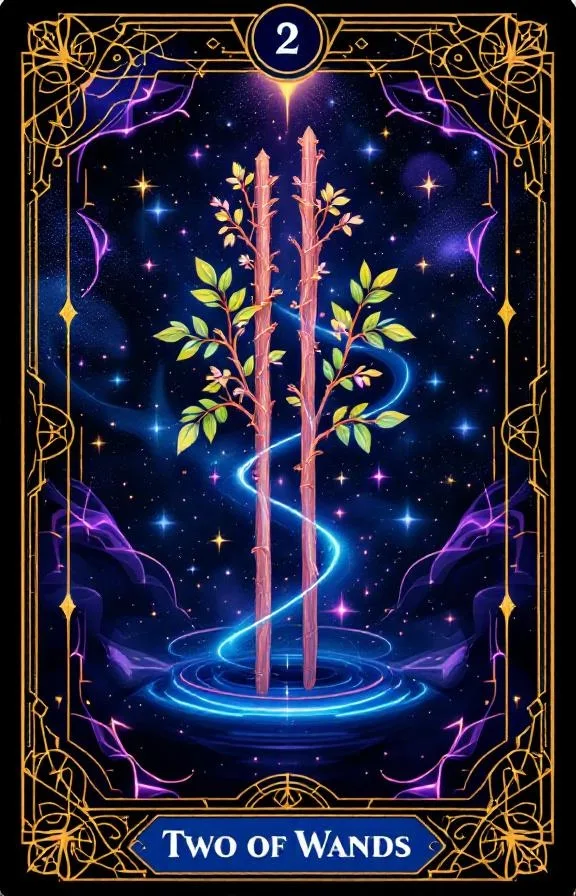
In short: The Two of Wands reversed represents planning paralysis — the state where having options becomes a prison rather than a freedom. Where the upright card shows someone holding the world in their hands, the reversed version shows someone so terrified of choosing the wrong world that they hold nothing at all. Schwartz's "paradox of choice" research demonstrates that beyond a threshold, more options produce more anxiety, more regret, and less satisfaction with whatever is eventually chosen.
Why the Two of Wands appears reversed
The upright Two of Wands depicts a figure standing on a castle wall, holding a globe, looking out at the horizon. They have already made an initial decision — they chose to climb the wall, to look outward. The card sits between intention and action. One foot in the known world, one reaching toward the unknown.
Reverse this and both feet cement themselves to the castle floor. The globe becomes a burden rather than a promise. The horizon — previously full of possibility — now represents everything that could go wrong.
There are two distinct flavors of this reversal. The first is paralysis. Overthinking every variable until the variables multiply beyond management. Spreadsheets that grow columns but never produce conclusions. Pro-con lists where every pro generates a counter-argument. This is the person who cannot choose between two job offers, so they decline both and stay in the job they hate.
The second flavor is small thinking. Instead of facing the anxiety of a big decision, you shrink the decision until it no longer frightens you. Move to a new country becomes take a vacation. Start a business becomes buy a domain name. Leave the relationship becomes suggest couples counseling. These are not bad actions in themselves, but when they serve as permanent substitutes for the actual decision, they become a different kind of trap — the trap of perpetual half-measures.
Schwartz would add a third mechanism worth naming: anticipated regret. The Two of Wands reversed is often powered not by fear of a bad outcome but by fear of regretting the choice itself. "What if I pick this and wish I had picked that?" This preemptive regret is uniquely paralyzing because it cannot be resolved through information. You cannot experience the counterfactual. You will never know what the other choice would have held. The only way through anticipated regret is accepting that some uncertainty is permanent — and choosing anyway.
Two of Wands reversed in love and relationships
In love, this card points to the person who keeps one foot out the door. Always.
They are in the relationship. Technically. But they are also still browsing dating apps "just to see." They introduce their partner as "someone I'm seeing" at six months in. They resist defining the relationship not because they believe labels are oppressive but because a label would require them to stop considering alternatives.
Schwartz calls these people "maximizers" — individuals who cannot accept a choice unless they are certain it is the best possible choice. Applied to dating, this creates an impossible standard. There is always someone potentially better on the next swipe, at the next party, in the next city. The Two of Wands reversed in a love reading says: you will never have enough data to make this decision with certainty. The question is whether you can act without it.
For established couples, the reversal often signals a failure to plan a shared future. You are together day to day, but conversations about next year, about moving in, about what you actually want this to become — those conversations keep getting postponed. Not because of conflict. Because of a mutual, unspoken agreement to avoid anything that would force a commitment to one version of the future.
If you are single and pull this card, it may be telling you something you do not want to hear. Your standards might not be high — they might be a wall. A protection against the vulnerability of choosing someone and being wrong. There is a difference between knowing what you want and using an impossible checklist to ensure you never have to risk getting it.
Two of Wands reversed in career and finances
This is the card of the person with seven tabs open — business ideas, graduate programs, job listings in three different industries — who closes the laptop at midnight having applied to nothing.
The Two of Wands reversed in career readings almost always points to a fear of commitment that masquerades as thoroughness. You are not researching because you need more information. You are researching because research feels productive without requiring you to do the terrifying thing, which is to choose one path and walk down it knowing you might be wrong.
Financially, this reversal can show up as scattered investments, small bets in too many directions, or the inability to commit to a financial strategy. The person who switches retirement fund allocations every quarter based on whatever article they read last. The freelancer who keeps their rates low because raising them would mean committing to a professional identity they are not sure they deserve.
Here is the genuinely uncomfortable truth this card delivers: most indecision is not about the options. It is about the decider. The Two of Wands reversed is not saying your options are bad. It is saying your relationship with choosing is broken. Fix that, and the options sort themselves out faster than you expect.
Two of Wands reversed as personal growth
Schwartz found something counterintuitive in his research: people with fewer options consistently report greater satisfaction with their choices than people with many options. Not because the choices themselves are objectively better, but because the absence of alternatives eliminates the mental torture of comparison.
The Two of Wands reversed often appears for people living in abundance who experience it as scarcity. They have options — good ones — and the having of those options paralyzes them. This is a distinctly modern problem. Previous generations chose from limited menus. You got the career available in your town, the partner available in your social circle, the life that circumstance handed you. Contentment was easier not because life was better but because the illusion of infinite alternatives did not exist.
Growth through this card means developing what Schwartz calls "satisficing" — the ability to choose something good enough and invest fully in it, rather than holding out for the theoretically perfect option that does not exist. This is not settling. Settling implies resignation. Satisficing is an active decision to pour your energy into depth rather than breadth.
The practical work looks like this: make a reversible decision quickly. Pick the restaurant in under a minute. Choose the color without agonizing. Buy the first acceptable option rather than the optimal one. These micro-practices rewire the decision-making circuitry. They teach your nervous system that choosing imperfectly is survivable — that the world does not end when you commit.
There is also something worth examining about the stories we tell ourselves when we do not choose. "I'm keeping my options open" sounds wise. It sounds strategic. But Schwartz demonstrated that option-preservation has a real cognitive cost — every unchosen possibility occupies mental bandwidth, draining the very energy you would need to commit to any one of them. The Two of Wands reversed is not a person with abundant possibilities. It is a person being slowly consumed by them.
How to work with Two of Wands reversed energy
Give yourself a deadline. Arbitrary is fine. "I will decide by Friday" is more useful than "I will decide when I have enough information," because you will never have enough information. The deadline externalizes the pressure and removes the fiction that more time will produce more clarity.
Limit your options deliberately. If you are choosing between five possibilities, eliminate three immediately — not after careful analysis, but by gut instinct. Research shows that decisions made from smaller sets produce better outcomes and less regret. Your rational mind will protest. Let it.
Talk to someone who has made the decision you are avoiding. Not for advice — for evidence. You need to see that someone chose imperfectly and survived. That they chose the "wrong" city and built a life there anyway. That they picked the "wrong" career and course-corrected later. The Two of Wands reversed feeds on the fantasy that wrong choices are permanent. They almost never are.
Finally, notice your body when you think about each option. Paralysis lives in the head. The body usually has an opinion. Your stomach tightens at one choice and loosens at another. Your breathing changes. These are not mystical signals — they are somatic markers, well-documented in neuroscience, and they carry information that your overthinking mind has been drowning out. Put down the spreadsheet for five minutes. Close your eyes. Think about Option A and notice what your body does. Then Option B. The body does not agonize. It responds.
Frequently asked questions
Is the Two of Wands reversed telling me not to plan?
Not at all — it is telling you that your planning has become a substitute for action. Planning is valuable when it leads somewhere. When it becomes a permanent activity that never produces a decision, it has stopped being planning and started being avoidance.
What if I genuinely cannot tell which option is better?
Then the options are probably close enough in value that either one will work. Schwartz's research suggests that when two options are genuinely difficult to distinguish, the difference in long-term satisfaction between them is negligible. Flip a coin if you have to. The cost of not choosing almost always exceeds the cost of choosing wrong.
Does this card mean I should rush into decisions?
No, and this is an important distinction. The Two of Wands reversed is not prescribing impulsiveness — that would be a different card's problem. What it asks is that you set a boundary on deliberation. Choose a timeframe, gather what information you can within it, then commit. The card targets chronic indecision, not careful thought. The difference between the two is honesty: careful thought has an endpoint, chronic indecision does not.
Explore Two of Wands' full meaning, see what it reveals as feelings, or discover Two of Wands as a person. Ready for deeper insight? Try a free reading.