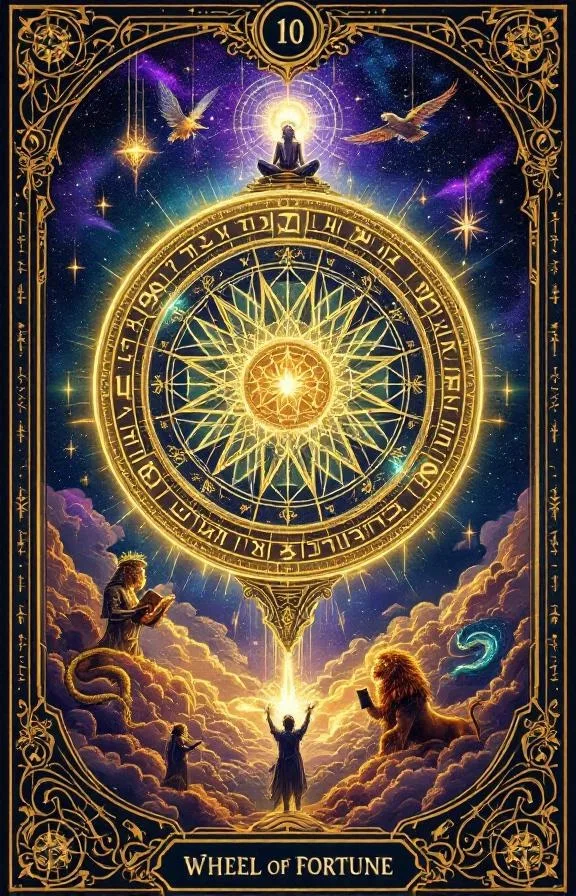
He had been passed over for promotion three times. His car was broken into twice in one year. His last relationship ended when his partner left for someone they met at a conference he had encouraged her to attend. When the Wheel of Fortune appeared reversed in his reading, he laughed — not with humor but with the grim satisfaction of someone whose worldview had just been confirmed. "See? Even the cards agree. I am unlucky."
That interpretation was wrong. But it revealed exactly why the card had appeared.
In short: The Wheel of Fortune reversed does not mean bad luck has found you — it means you have adopted bad luck as an identity. Upright, the Wheel represents natural cycles, change, and the understanding that fortune rotates. Reversed, it signals resistance to those cycles: clinging to control when surrender is required, or surrendering agency when action is needed. Julian Rotter's locus of control theory provides the framework — people with an external locus believe outcomes are determined by fate, luck, or forces beyond their influence. The Wheel reversed often appears when that belief has calcified into a self-fulfilling prophecy.
Why Wheel of Fortune appears reversed
The Wheel upright is movement. Things change, seasons turn, what goes down comes back up. It is the most dynamic card in the Major Arcana — pure kinetic energy, the universe in rotation.
Reversed, the Wheel jams. Not because the universe has stopped turning, but because you have mentally stepped off the wheel and are watching it spin without you.
This happens through two opposite mechanisms, and recognizing which one applies to you matters enormously.
The external locus trap. Rotter developed his locus of control theory in the 1950s, and six decades of subsequent research have confirmed its central insight: people who believe they control their outcomes behave differently than people who believe they do not. Those with an internal locus of control take action, persist through setbacks, and treat failure as feedback. Those with an external locus wait, blame circumstances, and treat failure as confirmation that the game is rigged.
The Wheel of Fortune reversed frequently appears in people who have drifted toward an external locus. They describe their lives using passive language: things happen to them. They are unlucky. The timing is never right. Other people get the breaks. This is not laziness — it is a genuine perceptual shift. They have stopped seeing themselves as agents in their own story and started seeing themselves as objects that the story acts upon.
The control grip. The opposite pattern, equally common. Some people respond to the Wheel's natural chaos by gripping tighter. They micromanage, over-plan, refuse to accept outcomes they did not engineer. When life introduces uncertainty — which it does constantly — they experience it as a personal affront. The Wheel reversed for these people is not about passivity but about rigidity. They are fighting the current instead of navigating it.
A third pattern shows up with painful regularity: the person caught in a repeating cycle they cannot seem to break. Same type of partner, same career dead end, same financial crisis, different year. The Wheel reversed here suggests the cycle is not bad luck but unexamined pattern. Something in how you respond to circumstances keeps producing the same outcome, and until you examine that response, the wheel will keep returning you to the same position.
Wheel of Fortune reversed in love and relationships
In love readings, this card exposes a specific emotional posture: the belief that romantic happiness is something that happens to you rather than something you participate in creating.
The person represented by the Wheel of Fortune reversed is often stuck in a narrative about timing, fate, or luck that conveniently absolves them of responsibility. "I just haven't met the right person." "Relationships never work out for me." "I always attract the wrong type." These statements feel true. They are also suspiciously convenient — they frame the speaker as a passive recipient of romantic misfortune rather than an active participant in patterns they could choose to change.
For couples, the Wheel reversed points to stagnation. The relationship has stopped evolving. You are going through the same arguments, the same routines, the same unspoken disappointments on a loop. Neither person is creating the disruption necessary for growth because disruption feels dangerous. Better the familiar dissatisfaction than the unknown alternative.
Here is what makes the Wheel reversed particularly tricky in relationship readings: the person often has evidence for their pessimism. They have been hurt. They have been unlucky in love by any reasonable measure. The question is not whether their past experiences were real — they were — but whether those experiences have been allowed to calcify into a permanent worldview that now prevents new experiences from landing differently.
Rotter found that locus of control is not fixed. It shifts over time, influenced by experience but also by conscious reframing. The Wheel reversed in love is an invitation to that reframing: what if your romantic history is not a prophecy? What if the wheel turns?
Wheel of Fortune reversed in career and finances
Professionally, the Wheel reversed describes the person who feels stuck in ways that seem entirely circumstantial but are partially self-created.
They did not get the promotion — true. The market crashed right when they were about to launch — true. Their industry is being disrupted by AI and their skills are becoming obsolete — also true. Each individual setback is real. The pattern of interpreting every setback as external and uncontrollable is the problem.
The most insidious career manifestation of this card is learned helplessness. Martin Seligman's research — adjacent to Rotter's — demonstrated that organisms exposed to uncontrollable negative events eventually stop trying to improve their situation even when control becomes available. The cage door opens and they stay inside.
Financially, the Wheel reversed warns against two extremes. The first is the gambler's mentality: belief that fortune will eventually turn, that the next investment or opportunity or lottery ticket will reverse the pattern. This is external locus dressed in optimism. The second is financial paralysis: the belief that planning is pointless because the universe will sabotage any plan. Both represent a broken relationship with agency.
What the Wheel reversed asks you to do in career and financial contexts is both simple and difficult: separate what you can control from what you cannot, then act on the former and accept the latter. You cannot control market conditions, company politics, or whether your startup idea hits at the right cultural moment. You can control your skills, your network, your response to setbacks, and your willingness to try again after failure.
That distinction sounds obvious. Most people who draw this card are not making it.
Wheel of Fortune reversed as personal growth
Growth under the Wheel reversed requires confronting a question most people avoid: how much of what you call luck is actually pattern?
This is not victim-blaming. Genuine misfortune exists. Some people face systemic disadvantages that are real and structural. The Wheel reversed does not deny that. What it does is ask whether, in addition to the external factors, there are internal patterns amplifying the problem.
The person who "always attracts narcissists" may be unconsciously selecting partners whose intensity feels familiar because their parent was similar. The person who "always gets fired" may be unconsciously sabotaging relationships with authority figures. The person whose "investments always tank" may be making decisions from fear at exactly the moments that require courage.
These are not moral failings. They are patterns, and patterns can be changed once they are seen.
The deepest growth opportunity in the Wheel of Fortune reversed is developing what psychologists call an "internal locus of control with realistic boundaries." You accept that you cannot control everything. You also accept that you are not controlling nothing. The truth is in the middle, and finding that middle ground — agency without grandiosity, acceptance without passivity — is the mature relationship with fortune that this card demands.
Practically, this means tracking your own narratives. When you catch yourself saying "I always" or "it never" or "that is just my luck," pause. These absolutist statements are red flags for an externalized locus. They feel like observations about reality. They are actually beliefs that shape reality.
How to work with Wheel of Fortune reversed energy
Audit your language. For one week, notice how often you describe your circumstances using passive constructions or external attributions. "I got stuck in traffic" versus "I left too late." "The project failed" versus "I did not adjust my approach when early signals suggested problems." This is not about self-blame. It is about reclaiming the agency that passive language erodes.
Break one cycle deliberately. Identify a pattern that keeps repeating — in relationships, at work, in your health habits — and change one variable. Not the whole pattern. One variable. If you always date people who are emotionally unavailable, do not swear off dating. Go on a date with someone who texts back promptly and see how it feels. If you always quit projects at the 60% mark, push one project to 80% and observe what happens internally.
Practice small bets. The Wheel reversed often produces an all-or-nothing relationship with risk: either total avoidance or reckless gambling. Neither works. Small, reversible risks — applying for a job you probably will not get, sharing an opinion you usually keep private, investing a small amount in something you have been "researching" for months — rebuild the muscle of agency without catastrophic downside.
Accept the cycle you are in. Sometimes the most productive response to the Wheel reversed is not fighting the downturn but moving through it with awareness. Winters end. Recessions end. Grief ebbs. The wheel will turn again. Your job during the low point is not to force the wheel upward but to be ready when it moves on its own. Preparation is agency. Despair is not.
Frequently asked questions
Does Wheel of Fortune reversed mean bad luck?
Not quite. It means your relationship with luck has become distorted — either you are blaming luck for outcomes that involve your choices, or you are trying so hard to eliminate luck that you have become rigid and controlling. The card is less about what is happening to you and more about how you are interpreting what is happening to you.
How long does a Wheel of Fortune reversed period last?
There is no fixed duration, which is both the honest answer and the frustrating one. The Wheel reversed describes a stuck state, and stuck states persist until something shifts — either externally (a change in circumstances you did not initiate) or internally (a change in your response pattern). Most people who draw this card can accelerate the shift by examining the patterns that are keeping them stuck rather than waiting for circumstances to change on their own. The waiting is the trap. Rotter's research consistently showed that people who act — even imperfectly, even from a position of disadvantage — produce better outcomes than people who wait for the wheel to turn by itself. Action does not guarantee the outcome you want. Passivity nearly guarantees the one you do not.
Can Wheel of Fortune reversed indicate a positive turning point?
Yes — paradoxically, it can signal that a negative cycle is about to end. The reversal of the reversal is built into the card's meaning: what goes down comes back up. If surrounding cards are optimistic (The Star, Six of Wands, Ace of Pentacles), the Wheel reversed may indicate that you are at the very bottom of the cycle, which means the only direction left is up. The key indicator is whether you are still fighting the cycle or beginning to understand it. Understanding is what unlocks the next rotation.
Explore Wheel of Fortune's full meaning, see what it reveals as feelings, or discover Wheel of Fortune as a person. Ready for deeper insight? Try a free reading.