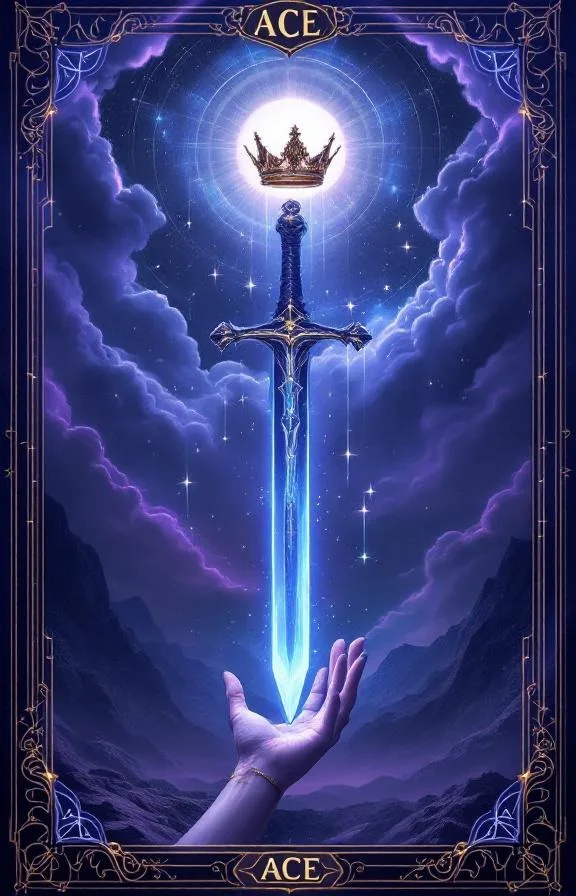
There is a specific kind of relief that comes from finally understanding something you have been struggling to articulate. Not a slow dawning. A cut. Clean and sudden, like stepping out of fog into air so clear it almost stings. The Ace of Swords as feelings is that moment — the emotional experience of mental clarity arriving all at once.
The core feeling
Clarity sounds like a thinking word, not a feeling word. But anyone who has spent weeks tangled in emotional confusion and then suddenly seen the truth of their situation knows better. The relief is physical. Shoulders drop. Breathing deepens. The mental noise that had been running on a loop — analyzing, second-guessing, catastrophizing — goes quiet, replaced by a single, sharp understanding that makes everything else irrelevant.
Neuroscientist Antonio Damasio's work on somatic markers demonstrated what tarot readers have intuited for centuries: that cognition and emotion are not separate systems but a single integrated process. The Ace of Swords captures feelings that emerge specifically from intellectual breakthrough. You do not just know something new. You feel differently because you know it. The knowledge changes your emotional landscape the way turning on a light changes a room.
What makes this card's emotional signature distinct is its edge. This is not the warm glow of the Ace of Cups or the excited charge of the Ace of Wands. The Ace of Swords cuts away. Some of what it cuts away you will miss. The comfortable illusions. The plausible excuses. The stories you told yourself because the truth was harder to carry. Clarity is liberation, but it is not always gentle.
Ace of Swords upright as feelings
Upright, the Ace of Swords represents feelings powered by a breakthrough in understanding. The person has broken through a wall of confusion, denial, or ambiguity, and what they feel on the other side is a fierce, almost aggressive certainty. They see things as they are. Not as they wish things were. Not as they fear things might be. As they are.
This emotional state carries a distinctive confidence — not the warm confidence of self-acceptance but the cold confidence of someone who has stopped lying to themselves. There is exhilaration in it. Also loneliness, because once you see clearly, you cannot unsee, and the people around you may still be deep in the fog you just walked out of.
The person feeling the upright Ace of Swords is often in a communicative mood. The clarity wants expression. They want to name what they have discovered, to speak it aloud, to test it against the world. They are not asking for permission or validation. They are declaring.
Ace of Swords reversed as feelings
Reversed, the sword is still there but it is pointing at the person holding it. The clarity exists as a possibility they are actively resisting — not because they cannot see the truth, but because they suspect the truth will require them to act in ways they are not ready for. So they stay in the fog on purpose. They ask more questions instead of sitting with the answer they already have.
This produces a very specific emotional texture: the anxiety of knowing something you pretend not to know. It manifests as mental loops that feel productive but lead nowhere, conversations that circle the same point without landing, research that delays decision rather than informing it. The reversed Ace of Swords does not indicate stupidity. It indicates intelligence weaponized against itself.
There is also the possibility of harsh or cutting feelings directed outward — using intellectual sharpness as a defense mechanism. Sarcasm instead of vulnerability. Critique instead of connection. The blade is real, but the person is swinging it to keep others at a distance rather than to cut through to truth.
Ace of Swords as feelings in love
In romantic contexts, the Ace of Swords as feelings represents the moment when someone sees a relationship — or a potential relationship — with absolute clarity. The rationalizations fall away. The "maybe they will change" narratives dissolve. What remains is a clean assessment: this is what I want, or this is what I need to leave, or this person is exactly who I thought they were but was afraid to admit.
When someone feels this way about you, expect honesty. Radical, possibly uncomfortable honesty. They are done with ambiguity and subtext. They want to tell you what they think, what they feel, what they need. This can be thrilling if the clarity leads to declaration. It can be devastating if the clarity leads to departure. Either way, the Ace of Swords does not hedge.
For couples navigating conflict, this card suggests one partner has arrived at an insight that changes the dynamic. A pattern they finally named. A boundary they finally recognized. The emotional tone is "I see this now and I cannot go back to pretending I do not." Whether that insight heals or fractures the relationship depends on what the truth actually is.
Ace of Swords as feelings about you
When the Ace of Swords describes someone's feelings about you, you represent an intellectual awakening for them. Something about you — the way you think, the way you challenge assumptions, the way you refuse to accept easy answers — has cut through their usual defenses. They find you stimulating in the most literal sense. You activate their mind.
This is a compliment, but a specific one. They may not find you comfortable. They may not find you soothing. What they find you is clarifying. Being around you forces them to think more precisely, to speak more honestly, to examine beliefs they had accepted without scrutiny. Not everyone enjoys that. The ones who do will value you intensely.
Ace of Swords as feelings in career
Professionally, the Ace of Swords as feelings indicates someone who has just had a strategic breakthrough. The confusion about what to prioritize, which opportunity to pursue, how to solve a persistent problem — it cleared. The solution arrived not gradually but as a single sharp insight that made everything else click into place.
Most people who build remarkable careers will tell you the same thing: progress was not linear. It arrived in sudden jumps separated by long plateaus of grinding effort. The Ace of Swords is the emotional experience of that jump. The person feeling it is energized, decisive, and slightly impatient with anyone who wants to slow down and reconsider what now feels obvious.
Frequently asked questions
What does Ace of Swords mean as feelings?
The Ace of Swords represents the feeling of sudden mental clarity — a breakthrough moment where confusion gives way to sharp, clean understanding. It signals emotions driven by truth and honest perception, the relief and power that come from finally seeing things as they are.
Does Ace of Swords represent positive or negative feelings?
Mostly positive, though its positivity has an edge. Upright, clarity and breakthrough feel liberating, but what you see clearly may be difficult to accept. Reversed, intellectual sharpness turns defensive or self-defeating, and the person may be avoiding a truth they already sense. Even at its most challenging, this card indicates the capacity for genuine insight.
What does Ace of Swords reversed mean as someone's feelings?
Someone feeling the reversed Ace of Swords is resisting their own clarity. They sense the truth of a situation but are avoiding it because acting on that truth would require courage they have not yet gathered. Expect overthinking, mental loops, and conversations that avoid the real point — not because they cannot see it, but because seeing it would change everything.
Curious what Ace of Swords means as feelings in YOUR situation? Try a free AI tarot reading and explore the emotional landscape of your cards.