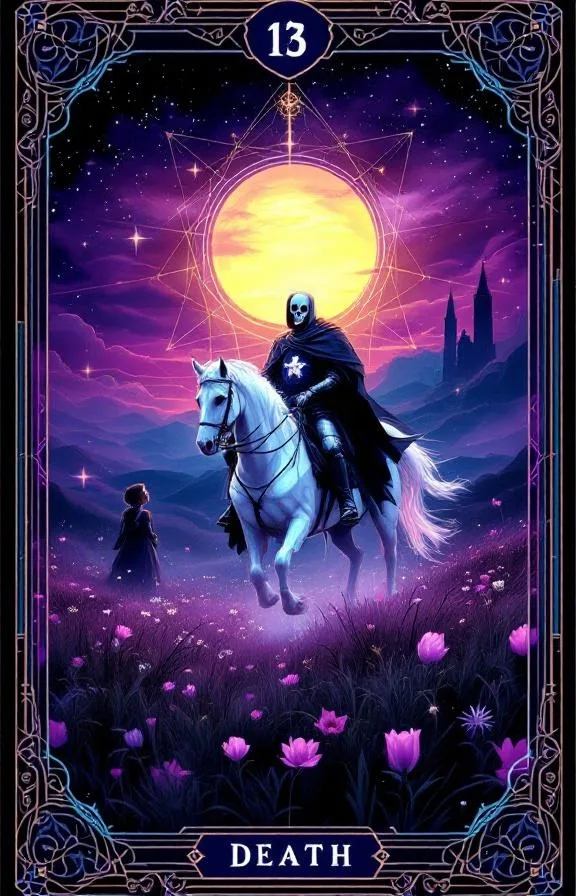
Nobody wants this card. Even experienced readers feel a small contraction when Death turns face-up on the table. That reaction is honest and worth examining — not because the card predicts physical death (it almost never does), but because your resistance to it reveals exactly what you are clinging to that needs to go.
The advice
Let go. Not eventually. Now.
Death's advice is the most direct in the Major Arcana: something in your life has completed its natural cycle, and your refusal to release it is the primary source of your current suffering. The card does not negotiate. It does not offer a compromise where you keep 60% of the old thing while gradually transitioning to the new. It says the ending is already happening, with or without your cooperation, and the only variable you control is how gracefully you participate.
This sounds brutal. It is also profoundly liberating once you stop fighting it. The energy you have been spending to maintain something that has expired — a relationship past its expiration, a self-image you have outgrown, a career path that stopped fitting years ago — that energy becomes available for what comes next. And what comes next is always, without exception, a beginning. Death is card XIII specifically because it sits in the middle of the Major Arcana's journey. The story is not over. You are not at the end. You are at a threshold.
Death upright advice
Upright, Death says the transformation is necessary, timely, and ultimately beneficial — even though it does not feel that way right now.
The card advises you to actively participate in the ending rather than being dragged through it. There is a significant difference between releasing something and having it torn away. Both arrive at the same destination, but one preserves your dignity and the other does not. Death upright is giving you the chance to choose release.
What are you holding that has already died? A version of yourself from five years ago? An expectation about how your life was supposed to unfold? A connection that stopped growing long before it technically ended? Elisabeth Kubler-Ross identified five stages of grief, but Death skips straight to the final one: acceptance. The bargaining phase — the phase where you negotiate with reality, offering partial changes in exchange for keeping the core of the old structure — is over. The card says accept what is and build from there.
Practically, Death upright often appears during major life transitions: career changes, relationship endings, geographic moves, identity shifts. The advice is consistent across all of these: move through the transition fully. Do not try to carry the old life into the new one. Let the chapter close so the next one can begin with a clean page.
Death reversed advice
You already know what needs to end. You have known for months. You keep not doing it.
Death reversed is procrastinated transformation. The ending that was supposed to happen naturally has been artificially prolonged — by fear, by comfort, by the seductive lie that if you just wait long enough the situation will fix itself without requiring you to lose anything.
It will not fix itself. And the longer you delay, the more painful the eventual transition becomes. What could have been a clean amputation six months ago is now a slow decay that affects everything around it. Your energy is being consumed by the maintenance of something dead, and that consumption is visible in your exhaustion, your stagnation, your inability to feel excited about anything because all your vitality is being redirected into preservation.
The reversed card's advice is urgent: stop resuscitating. Let it end. The grief you are avoiding by postponing the ending is not going anywhere. You will feel it eventually regardless. The only question is whether you feel it now, while you still have the energy to rebuild, or later, when the delay has compounded the loss.
Death advice in love
A relationship — or a way of relating — is ending. Death does not say that casually.
If you are in a partnership, the card does not automatically mean breakup. Sometimes Death refers to the end of a dynamic within the relationship rather than the relationship itself. The pattern of one person always pursuing while the other withdraws. The habit of avoiding difficult conversations. The unspoken agreement to never discuss money, sex, or the future honestly. That pattern is dying, and the relationship will either transform around its absence or it will not survive.
For relationships that have genuinely run their course: grieve it fully. Do not jump into something new to avoid the emptiness. Do not rewrite history to make the ending easier. Honor what the relationship was. Acknowledge what it taught you. Then close the door completely. Half-open doors create drafts that chill every room in the house.
Single? Death says you are still carrying an old love, an old wound, or an old version of yourself that makes genuine connection impossible. Put it down. You cannot hold something new with full hands.
Death advice in career
The job, the role, the industry, or the professional identity — one of these has expired and continuing to inhabit it is costing you more than leaving would.
Death in career readings terrifies people because professional identity in modern culture is personal identity. Losing your job title feels like losing yourself. The card says that conflation is the problem. You are not your resume. Your worth is not your output. The sooner you separate who you are from what you do for money, the faster you can evaluate your career situation honestly.
If you are being laid off, restructured, or forced out: Death says resist the urge to frantically replicate what you had. The universe is not punishing you. It is redirecting you. Take the disruption as data — what about the old role was no longer working, honestly? — and use that data to inform what comes next.
If you are voluntarily considering a change: stop considering and start executing. Death has no respect for extended deliberation about transitions that are already overdue. Calculate your runway, make your plan, and move.
Financially, Death sometimes signals the end of a source of income. Prepare practically, but do not catastrophize. Every ending in the tarot carries a corresponding beginning. The financial landscape will restructure. Your job is to be positioned to take advantage of the new terrain rather than mourning the old.
Action steps
- Name what has already ended. Write it down. Be specific. Not "things need to change" but "my friendship with X ended when Y happened" or "my passion for this career died when I started dreading Monday mornings." Naming it makes it real, and real things can be grieved and released.
- Complete one ritual of closure. Return the borrowed item. Send the final message. Delete the dating profile of someone you will never contact again. Box up the objects from a chapter that is over. Physical closure supports emotional closure.
- Create space for the new. Clear a physical space — a drawer, a shelf, a room. The emptiness will feel uncomfortable. That discomfort is the point. You are practicing the tolerance for not-knowing that every genuine new beginning requires.
- Set a deadline for the transition you have been delaying. Choose a date within the next 30 days. Tell one person about the deadline. Accountability accelerates what willpower alone cannot.
FAQ
What does the Death card advise?
Death advises complete release of whatever has finished its natural cycle in your life. The card says that an ending is already in progress and your resistance to it is causing unnecessary suffering. By actively participating in the conclusion — rather than fighting it or pretending it is not happening — you free the energy currently trapped in maintenance of the old to fuel the creation of something new.
Does the Death card mean something bad is going to happen?
No. Death is a transformation card, not a disaster card. It indicates that something is ending, which is a neutral event that your interpretation makes positive or negative. The endings Death describes are almost always things that have already functionally concluded — you just have not formally acknowledged it yet. The card's advice is to acknowledge it, grieve it if necessary, and move forward. People consistently report that the changes Death preceded turned out to be among the most important and beneficial of their lives.
How do I follow Death's advice if I am scared of the change?
Fear is expected and the card does not ask you to be fearless. It asks you to act despite the fear. Start with the smallest possible step toward the transition — one conversation, one application, one honest admission to yourself. The fear diminishes with each step because it feeds on avoidance and starves on action. You do not need to see the entire path. You just need to take the first step and trust that the next one will become visible once you do.