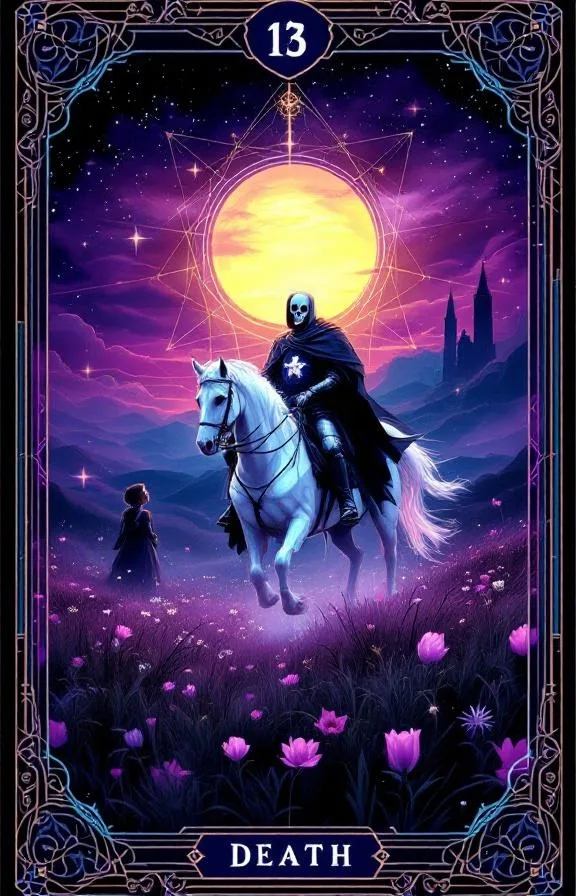
You have a friend who moved across the country and cut off every person from their old life except you. Then they did it again three years later. Different city, different career, different wardrobe, different politics. Same eyes. The Death person is the one who treats reinvention not as a crisis response but as a lifestyle — someone who sheds old selves the way other people shed winter coats when spring arrives. They do not cling. They do not look back with longing. They burn the bridge and build something better on the other side, and they do this so naturally that it terrifies people who need continuity to feel safe.
The personality profile
The Death archetype produces a person with an extraordinary tolerance for endings. Where most people experience the end of a relationship, a career, or an era as a wound that needs healing, the Death person experiences it as a door opening. This is not denial. They feel the loss. They just feel the possibility more.
Their relationship to change is fundamentally different from most people's, and this difference is visible early. The Death person was the kid who was excited about moving to a new city when their siblings were devastated. The teenager who ended friendships cleanly when they became toxic instead of dragging them out for years. The adult who quit a good job because it had stopped growing them, even though nothing better was lined up.
This capacity for transformation has a cost that is easy to miss from the outside. The Death person rarely says this aloud, but they know what it is like to stand in the gap between one life and the next with absolutely nothing to hold onto. They have done it multiple times. They know the vertigo. They know the night sweats at 3 AM when the old life is gone and the new one has not materialized. They keep doing it anyway, which is either courage or compulsion depending on who you ask.
Death upright as a person
The upright Death person is a catalyst. Things change when they enter a room, a relationship, an organization. Not because they force change — though they sometimes do — but because their presence makes the unsustainable unsustainable faster. They are the person who says the thing everyone is thinking but no one wants to say: this marriage is over, this company is dying, this friendship has been dead for a year and we are just performing the funeral.
They strip away pretense with surgical efficiency. Small talk does not interest them. Surface-level relationships do not interest them. They want to know what is real, what is alive, and what is being kept on life support out of fear or habit. When they identify something in the second category, they say so. This honesty is devastating and sometimes exactly what was needed.
The upright Death person also has a remarkable ability to help others through transitions. Because they have navigated so many endings themselves, they have an intuitive understanding of the emotional landscape — the denial phase, the bargaining phase, the moment when grief finally gives way to something that feels dangerously close to excitement. They do not rush the process for other people, even though they move through it quickly themselves.
Death reversed as a person
Reversed, the Death person becomes someone who is terrified of the very transformations they were born to navigate. They cling. To relationships that ended years ago. To identities that no longer fit. To grudges and grievances and old stories about who wronged them and how.
This version of the Death person hoards. Objects, memories, connections, resentments — all of it accumulates because letting go has become impossible. Their apartment is cluttered. Their phone contains contacts they have not spoken to in a decade. Their emotional landscape is a museum of preserved experiences, each one under glass, none of them alive anymore but all of them carefully maintained.
The reversed Death person is also capable of a particularly destructive form of stagnation: they know they need to change and they refuse to. The awareness sits in them like a splinter. They can describe exactly what needs to end, exactly what needs to begin, and they cannot make themselves do either. This is different from the Hanged Man's deliberate pause. This is paralysis born from a terror that the next transformation might be the one they do not survive.
Death as a person in love
In love, the Death person is intense. Full stop. They do not do casual well. Every relationship is, for them, an encounter with the possibility of transformation — and they want to be transformed. They pursue partners who change them, challenge them, break open assumptions they did not know they held. Comfortable love bores them. Predictable love suffocates them.
The psychiatrist Irvin Yalom wrote extensively about how confronting mortality deepens the capacity for intimacy — that people who have genuinely faced endings love with a specificity and urgency that others lack. The Death person embodies this principle. They love like someone who knows this particular configuration of circumstances will never exist again. Because it won't.
Their romantic challenge is sustainability. They are magnificent at beginnings and transformative middles and clean, honest endings. They are less skilled at the long, flat stretches where nothing is changing and the relationship requires maintenance rather than metamorphosis. The Death person sometimes ends things that could have survived if they had been willing to tolerate a few months of ordinary.
Death as a person at work
The Death person thrives in roles that involve transformation: turnaround specialists, crisis counselors, emergency responders, hospice workers, organizational change consultants. They are the person you bring in when something needs to die so something else can live. Restructuring. Rebranding. Letting go of the product line that everyone loves but that is losing money every quarter.
They are terrible at maintenance roles. Keeping a well-functioning system running exactly as it is will make them restless within weeks. They need endings. They need beginnings. The middle part, the stable part, is someone else's job.
Death as someone in your life
You recognize the Death person by their past. Count the reinventions. Count the cities, the careers, the relationships, the belief systems they have cycled through. If the number seems impossibly high for one lifetime, you are probably looking at a Death archetype.
Relating to them means accepting that they will not stay the same. The person you befriended last year may be substantially different next year — same core, different expression. If you need your people to be predictable, this friendship will frustrate you. If you can appreciate watching someone continuously become, they will be one of the most fascinating people in your life. They will also push you to examine what in your own life has died but has not yet been buried.
Frequently asked questions
What kind of person does Death represent?
Death represents a transformer — someone who moves through life in cycles of endings and beginnings, shedding old identities and building new ones with unusual ease. They are catalysts who accelerate change in the people and systems around them, often by naming truths that others are avoiding.
Is Death as a person positive or negative?
Upright, overwhelmingly positive. The Death person's willingness to let go of what no longer serves them — and to help others do the same — is a rare and valuable capacity. Reversed, the same archetype becomes someone paralyzed by the fear of change, clinging to dead things and calling it loyalty. The difference between the two is the willingness to actually walk through the door.
How do you recognize a Death person?
Track their history. Multiple major life changes — careers, cities, identities — that they initiated rather than had imposed on them. They speak about past versions of themselves with fondness but no nostalgia. They travel light, emotionally and sometimes literally. And they have an uncanny ability to spot when something in your life has expired, whether you are ready to hear it or not.