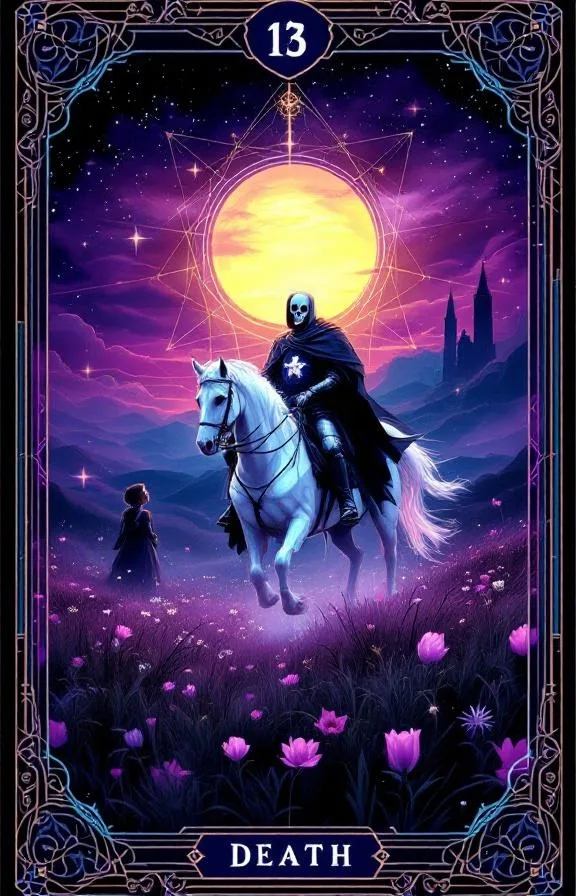
Everyone rushes to say "it does not mean actual death." Fine. But the reason people flinch when this card appears is not because they think they are going to die — it is because they recognize the feeling it represents. The exhale after holding your breath for months. The door closing behind you with a sound that is final. The strange, raw openness of a life that just lost a load-bearing wall and has not yet figured out what holds the roof up now. Death as feelings is the emotional experience of something ending completely, and the terrifying lightness that follows.
The core feeling
Release is the word, but it undersells the intensity. The Death card's emotional signature is not the gentle release of dropping a worry or finishing a task. It is structural. Something foundational has shifted, and the person's entire emotional architecture is reorganizing around the absence. An identity they built over years, dissolved. A belief about how their life would unfold, proven wrong in a way that cannot be walked back.
What makes this card's feeling distinct from grief — though grief is often present — is the element of forward motion embedded in it. Grief alone is static. It sits with what was lost. Death's emotional energy already contains the seeds of what comes next, even when the person cannot see them yet. There is a quality of inevitability here that operates below conscious awareness. The old version of yourself is already gone. The new version has not fully arrived. You are in the gap, and the gap is not comfortable, but it is alive in a way the old situation had stopped being.
The psychoanalyst James Hollis writes about necessary losses — the deaths of our provisional identities that must occur for genuine growth. Death as feelings represents exactly this threshold: the recognition, usually felt before it is understood, that continuing to be who you were is no longer possible.
Death upright as feelings
Upright, Death as feelings indicates someone in the active process of letting go. Not thinking about letting go. Not planning to eventually let go. Doing it. Right now. The emotional experience is a combination of grief, relief, and a raw vulnerability that does not fit neatly into either category.
The person may feel stripped bare. Defenses they relied on for years have been removed — not by choice, necessarily, but by the force of whatever has ended. A relationship that defined them. A role they confused with their identity. A story about their future that no longer matches reality. The old scaffolding is gone, and they are discovering what, if anything, stands without it.
This is not depression, though it shares some surface features. Depression is characterized by numbness and stasis. Death upright as feelings is characterized by heightened sensation and transformation. Everything feels more vivid, more immediate, more raw. Tastes are sharper. Music hits harder. Small kindnesses from strangers produce unexpected tears. The emotional volume has been turned up because the mechanisms that normally regulate it have been temporarily dismantled.
Death reversed as feelings
Reversed, Death becomes the feeling of refusing to let something die that is already dead. The relationship ended six months ago but the person still checks their ex's social media every morning. The career pivot is obviously necessary but the person keeps showing up to a job that hollowed out years ago. The friendship has become purely performative but neither party will name it.
This emotional state is exhausting. Maintaining the fiction of something alive requires constant energy — propping up routines, avoiding conversations that might expose the truth, performing feelings that have been gone for longer than the person can comfortably admit. The reversed Death person knows. Somewhere beneath the performance, they absolutely know. The knowing is what makes it so tiring.
There is also fear here. Significant fear. The reversed position suggests that whatever needs to die feels essential to the person's identity. Letting it go means becoming someone they have never been, and that unknown version of themselves is more frightening than the slow drain of maintaining what is already over. So they choose the familiar pain. Millions of people do this. It is among the most common forms of human suffering, and one of the least acknowledged.
Death as feelings in love
In romantic contexts, Death as feelings is the emotional earthquake of a relationship transforming beyond recognition. Sometimes this means ending. Often it means something more nuanced — the death of a particular dynamic, a specific version of the partnership, the illusions that carried the relationship through its early stages.
Most relationship advice treats this as a problem to solve. Get back to where you were. Rekindle what you had. Death as feelings pushes back against that entire framework with force. You cannot go back. The couple who existed before this transformation no longer exists. The only question that matters is whether the two people standing in the aftermath want to build something new together, or whether the ending of the old form was also the ending of the connection itself.
Someone feeling Death energy in a new attraction is experiencing something unusually intense. The connection threatens to reorganize their life, and part of them wants that reorganization while another part is terrified of what they would have to give up to make room for it.
Death as feelings about you
When Death represents how someone feels about you, your presence in their life has changed them irreversibly. Not damaged — changed. You have catalyzed a transformation that was probably overdue, and their feelings about you are tangled up with their feelings about the person they are becoming because of your influence.
This can feel overwhelming for both parties. You did not ask to be someone's catalyst. They did not ask to be transformed. But here you are, and the old version of them that existed before they met you is not coming back. Their feelings toward you carry a gravity that lighter connections do not — an awareness that this matters in a way that will leave marks regardless of what happens next.
Death as feelings in career
Professionally, Death as feelings means someone has emotionally detached from a career chapter that defined them. The job, the industry, the professional identity — it is dying or already dead, and the person is processing that loss while simultaneously sensing the vacuum it creates.
The feeling produces either paralysis or radical action, with very little middle ground. Some people experiencing Death energy at work hand in their resignation with no backup plan and feel immediately lighter. Others sit at their desk every day performing a role that stopped being real months ago, waiting for someone else to make the decision they cannot make themselves. Both responses are valid. Both come from the same place: the recognition that what was is no longer what is, and the gap between those two realities has become impossible to ignore.
Frequently asked questions
What does Death mean as feelings?
Death represents the feeling of profound release — the emotional experience of something ending completely and the raw, disoriented openness that follows. It signals transformation, not destruction. The person feeling this card is in the process of becoming someone new, whether they chose that process or not.
Does Death represent positive or negative feelings?
It represents necessary feelings. Upright, the release is active and ultimately liberating, even when it hurts. Reversed, the refusal to let go creates sustained suffering that can feel much worse than the loss itself. The card does not promise the transformation will be pleasant — only that it will be real, and that resisting it costs more than moving through it.
What does Death reversed mean as someone's feelings?
Reversed, Death indicates someone who is emotionally clinging to something that has already ended — a relationship, an identity, a way of being that no longer functions. They feel stuck between the life they had and the life that is trying to emerge, and their resistance to the transition is the primary source of their pain. They know the change is inevitable. They are not ready.
Curious what Death means as feelings in YOUR situation? Try a free AI tarot reading and explore the emotional landscape of your cards.