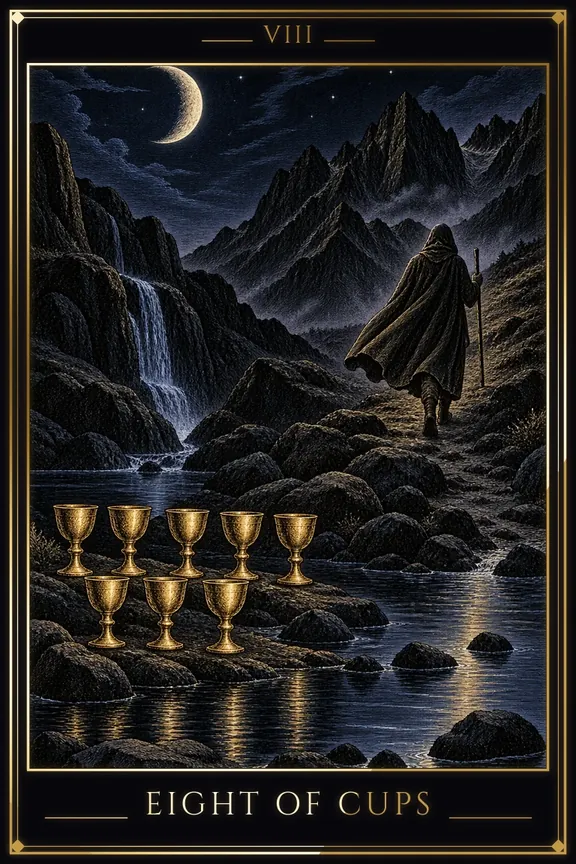
One day they are here. The next, their desk is cleared, their lease is broken, and their phone goes straight to voicemail. No fight. No dramatic exit. Just a quiet, decisive departure that leaves everyone else staring at the space where a person used to be. The Eight of Cups person does not announce that they are leaving. They simply leave.
The personality profile
The seeker is often confused with someone who is running away. The distinction matters enormously. A person running away moves in panic, without direction, driven by what they are escaping. The Eight of Cups person moves with purpose. They know exactly what they are leaving. They have weighed it. And they have decided — calmly, painfully — that staying would cost more than going.
This is a person who has done the math on their own happiness and found the numbers unsatisfying. Not catastrophically bad. That would be easier. The Eight of Cups person is not fleeing disaster — they are walking away from something that is merely adequate. From the relationship that is comfortable but no longer alive. The career that pays well but hollows them out. The city that was perfect at twenty-five and suffocating at thirty-three. The courage this requires is consistently underestimated, because leaving something bad is understandable while leaving something okay looks like ingratitude.
Viktor Frankl argued that meaning, not happiness, is the primary human drive — and that people will endure enormous suffering as long as they can locate purpose within it. The Eight of Cups person has internalized this at a cellular level. They will sacrifice comfort, security, even love, if they believe the sacrifice is in service of something more meaningful. That "something more" may be undefined when they start walking. But they trust that the act of seeking will eventually reveal the destination.
Eight of Cups upright as a person
Upright, this person has an extraordinary ability to let go. Objects, relationships, identities — they can release what no longer serves them with a finality that awes some people and terrifies others. They are not heartless about it. The leaving costs them. Every time. But they do it anyway because they have learned that the pain of staying in the wrong place is worse than the pain of departure.
They travel. Not in the Instagram sense — not the curated vacation with the sunset selfie. They travel to displace themselves, to crack open their assumptions, to be confused and uncomfortable in a productive way. A new country is not a destination for them but a catalyst for internal change. They come back different, and sometimes they do not come back at all.
Their life story tends to have chapters rather than a continuous narrative. Each chapter is complete in itself — a career, a relationship, a city, a belief system — and when it ends, they close it with the same deliberateness with which they opened it. There is remarkably little sentimentality in their rearview mirror. They honor what was without pretending it should have been permanent.
Eight of Cups reversed as a person
Reversed, the seeking becomes compulsive. They leave before they have actually learned what a situation had to teach them. They mistake restlessness for wisdom and chronic dissatisfaction for depth. Every job is abandoned after eighteen months. Every relationship ends at the two-year mark. The pattern is so consistent that it stops being a pattern and becomes a prison — they are as trapped by their inability to stay as anyone else is by their inability to leave.
Fear of commitment is part of it, but the deeper issue is a fear of ordinariness. The Eight of Cups person reversed cannot tolerate the long middle of anything — the part where things are stable and uneventful and require daily maintenance rather than dramatic pivots. That quiet stretch feels like death to them, so they create exits before they have to endure it.
They may also develop a superiority complex around their departures. "I am not like those people who settle." "I refuse to live an ordinary life." But the constant leaving produces its own kind of ordinariness — a predictable cycle of excitement, disillusionment, and departure that is just as formulaic as the routine they are trying to escape.
Eight of Cups as a person in love
In love, the Eight of Cups person is the most terrifying partner imaginable for someone who needs security. They are fully present — until they are not. And the transition can happen with alarming speed. One week they are planning the future, the next they are talking about how they need to "find themselves," and within a month they are gone.
This is not cruelty. That is the part their ex-partners usually miss. The Eight of Cups person does not leave because they stopped caring. They leave because the relationship no longer aligns with the trajectory of their inner growth, and they value that trajectory above almost everything else. It is a cold calculus, and it wounds the people left behind, but it is sincere.
The partner who keeps them is the one who grows alongside them. If both people are evolving — individually and together — the Eight of Cups person has no reason to leave. They need a relationship that is itself a form of seeking, a partnership of mutual exploration rather than mutual settling.
Eight of Cups as a person at work
Professionally, their resume looks like a series of non sequiturs. Teaching, then software development, then farming, then nonprofit management. Each role was pursued with genuine commitment and left with genuine conviction that the next thing was calling. They excel in project-based work, consulting, or any field where natural endpoints exist. Asking them to spend thirty years climbing a corporate ladder is asking them to slowly suffocate.
Eight of Cups as someone in your life
If you have an Eight of Cups person in your life, love them loosely. Hold them with open hands. They will leave eventually — or they will surprise you by staying, which means you are offering something truly extraordinary.
Do not take their departures personally, even when they feel personal. The Eight of Cups person is not rejecting you. They are responding to a signal that only they can hear, and trying to talk them out of following it is like trying to convince a migrating bird to stay through winter. They might delay, but they will not settle. And the resentment of a caged seeker is worse than the grief of a clean goodbye.
Frequently asked questions
What kind of person does Eight of Cups represent?
The Eight of Cups represents a seeker — someone driven by an inner compass that prioritizes meaning over comfort. They are willing to leave behind what is adequate in pursuit of what is authentic, and their life is characterized by deliberate departures and courageous beginnings.
Is Eight of Cups as a person positive or negative?
Depends on whether the seeking is genuine or compulsive. Upright, their willingness to prioritize growth over security is admirable and often leads to a rich, if unconventional, life. Reversed, the constant leaving becomes avoidance dressed up as wisdom, and they end up perpetually starting over without ever building anything lasting.
How do you recognize an Eight of Cups person?
Their biography has gaps and pivots that seem dramatic from the outside but make perfect sense when they explain them. They have lived in multiple cities or countries. They speak about past chapters of their life with affection but zero interest in returning to them. They travel light, literally and emotionally. And when you ask them about their plans, there is always a quality of openness — they know the direction but not the destination, and they are completely at peace with that.