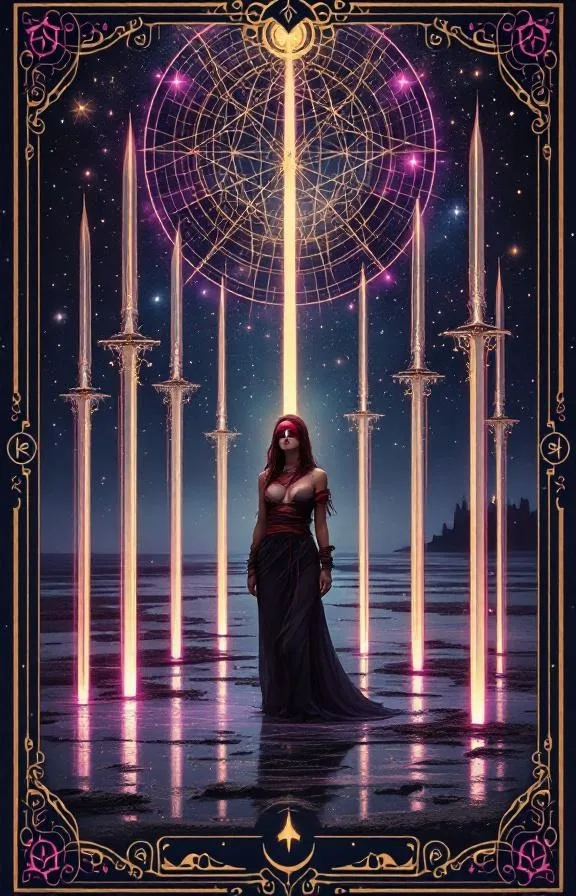
Blindfolded. Bound. Surrounded by swords. And yet — look closer at the traditional image — the bindings are loose, the cage has gaps, and the ground beneath her feet is solid. The Eight of Swords as feelings represents the most disorienting kind of trapped: the kind where the prison is largely constructed by the person standing inside it, and knowing that fact does absolutely nothing to make it feel less real.
The core feeling
Helplessness is not the same as powerlessness, though the person experiencing it cannot tell the difference. Powerlessness means the walls are real and the locks are physical. Helplessness means the walls might be real, might not be, but the person has been blindfolded for so long they have stopped checking. They assume confinement. They plan around it. Their entire emotional architecture is built on the premise that movement is impossible, and that premise has become self-reinforcing.
Martin Seligman's famous experiments on learned helplessness showed that organisms repeatedly exposed to inescapable negative outcomes eventually stop trying to escape even when escape becomes possible. The Eight of Swords is the tarot's version of this finding — someone who has internalized the belief that their situation is inescapable, not because they have tested every exit but because earlier experiences taught them that exits do not work.
The cruelty of this card is that the person often knows, on some level, that their cage has openings. They have been told. Friends have pointed at the gaps. Therapists have gently suggested that the bindings could be loosened. But knowing intellectually that you are not as trapped as you feel does not change the feeling. Feelings do not update as fast as information.
Eight of Swords upright as feelings
Upright, the Eight of Swords indicates someone in the grip of self-imposed limitation so thorough it has become indistinguishable from reality. They feel incapable of making decisions, taking action, or changing their circumstances — not because options do not exist but because anxiety, self-doubt, or past trauma has convinced them that every option leads to worse pain.
The emotional landscape is claustrophobic. Thoughts loop. Every potential action generates a cascade of imagined consequences, each worse than the last, until inaction feels like the only safe choice. The person is not lazy. They are not weak. They are terrified, and the terror has been running for so long that it has worn grooves into their thinking deep enough to trap any thought that tries to escape.
What outsiders rarely understand about Eight of Swords energy is how coherent the trapped person's reasoning sounds from inside. They can explain exactly why they cannot leave the job, the relationship, the city, the pattern. Their logic is airtight. The problem is that the logic was constructed to justify the helplessness rather than to solve it. The conclusion came first. The arguments were built backward from there.
Eight of Swords reversed as feelings
Reversed, something shifts. The blindfold slips. One binding loosens. The person does not immediately feel free — the Eight of Swords reversed is not a triumphant escape but a tentative first step, like testing whether the floor will hold your weight after being told for years that it was made of glass.
The feelings during this reversal are paradoxically more frightening than the feelings of being trapped. Captivity is familiar. Freedom is not. The person may experience surges of anxiety that feel counterintuitive: I should be relieved, why am I panicking? Because the cage, however miserable, was at least predictable. Whatever lies outside it is unknown, and the unknown has been rebranded as dangerous by the same thought patterns that built the cage in the first place.
Some people in the reversed Eight of Swords position take the step forward. Others retreat back into the cage because the moment of possibility was more than they could handle. Neither response is permanent. The reversal indicates that the door has been seen, and once seen, it cannot be completely forgotten.
Eight of Swords as feelings in love
In love readings, the Eight of Swords as feelings describes someone who feels trapped in a romantic situation but paralyzed about doing anything to change it. They might be staying in a relationship that makes them unhappy because the alternatives — being alone, starting over, hurting someone they care about — feel worse than the status quo. The status quo is at least a known quantity of suffering.
When this card represents someone's feelings toward you, the picture is complex. They may feel controlled by you or by the relationship, but the control they experience may be largely self-generated. They have decided they cannot survive without you, or cannot survive telling you what they actually need, or cannot survive the conflict that honesty would create. These beliefs feel absolute to them. From the outside, they are debatable.
Here is what no one wants to hear about the Eight of Swords in love: sometimes the person prefers the trapped feeling because it eliminates responsibility. If you are a prisoner, you do not have to make choices. You do not have to risk rejection. You do not have to face the terrifying possibility that the relationship is exactly what you chose and you have the power to choose differently.
Eight of Swords as feelings about you
When the Eight of Swords reflects how someone feels about you, they feel constrained by the dynamic between you — unable to be fully themselves, unable to express what they want, unable to act on their own desires. Whether you are actually constraining them or whether they have constructed a mental model of you as constraining is the central question.
Their feelings toward you are filtered through a lens of perceived powerlessness. They may idealize you, fear you, or resent you — often all three — because in their internal narrative, you hold the power and they do not.
Eight of Swords as feelings in career
Professionally, the Eight of Swords captures the feeling of being stuck in a role, company, or career path that no longer fits but seems impossible to leave. The golden handcuffs. The sunk cost fallacy wearing a business-casual disguise. The person has convinced themselves that their skills are not transferable, that the market would not want them, that starting over at this age is unrealistic.
The most liberating thing anyone can tell an Eight of Swords person in their career is also the thing they are least equipped to hear: you are not trapped. You are choosing to stay. And understanding the difference between those two statements is the beginning of everything.
Frequently asked questions
What does Eight of Swords mean as feelings?
The Eight of Swords represents helplessness — the suffocating feeling of being trapped in a situation with no viable way out. The trap is often largely mental, built from fear, self-doubt, and past experiences that taught the person escape is pointless. The feelings are real even when the prison is not.
Does Eight of Swords represent positive or negative feelings?
The Eight of Swords represents restrictive, anxious feelings — the experience of being emotionally caged. Reversed, the card shifts toward cautious hope as the person begins to recognize that their constraints may not be as absolute as they believed. The card's hidden gift is its implicit message: the bindings are loose. Freedom is closer than it feels.
What does Eight of Swords reversed mean as someone's feelings?
Someone feeling the reversed Eight of Swords is beginning to question the beliefs that have kept them stuck. The blindfold is slipping, and they are catching glimpses of possibilities they had convinced themselves did not exist. This is a fragile, anxious moment — liberation mixed with the terror of unfamiliar freedom — but it marks the beginning of genuine emotional movement.
Curious what Eight of Swords means as feelings in YOUR situation? Try a free AI tarot reading and explore the emotional landscape of your cards.
