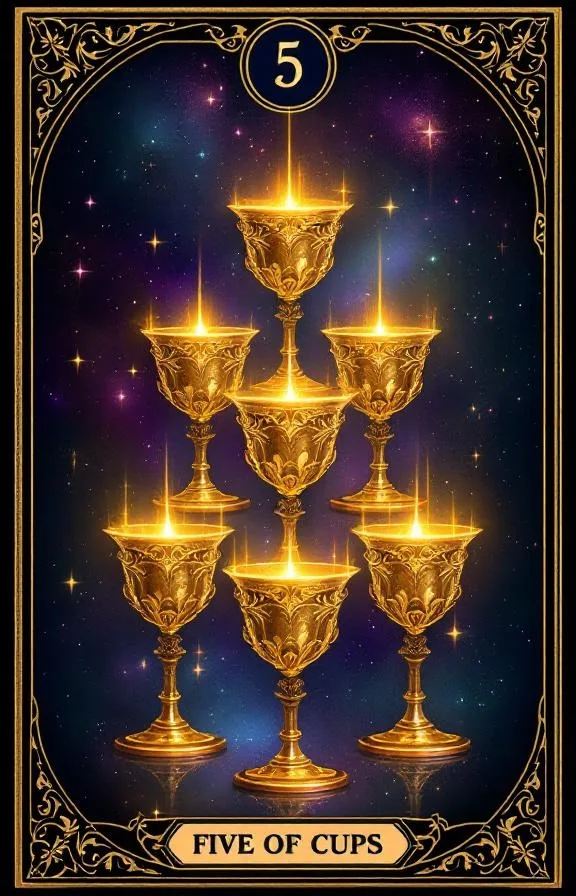
Three cups spilled. Two still standing behind you. And you are staring at the three. The Five of Cups knows exactly what you are doing because grief has a way of commanding all available attention, leaving none for what survived.
The advice
Grieve. Fully. Then move.
Those three words contain the entire instruction and most people only hear two of them. Either they skip straight to "move" — powering through loss with toxic productivity and positive affirmations — or they set up permanent residence in "grieve," building an identity around their pain until it becomes more familiar than the person they were before the loss.
The Five of Cups demands both steps in sequence. The grief is non-negotiable. You lost something that mattered — a relationship, a dream, a version of yourself, a plan you organized your life around. Pretending that loss does not hurt is not strength. It is delayed explosion.
But grief is meant to be a passage, not a destination. Psychologist George Bonanno spent decades studying how people respond to loss and found that the majority of people are naturally resilient — not because they feel less, but because they process the feeling and gradually redirect attention toward what remains. The Five of Cups is asking you to trust that process. Feel the loss completely, and then turn around and notice the two cups that did not fall.
Five of Cups upright advice
Upright, the card says you are in the grief and that is exactly where you should be. For now.
The advice is permissive first: do not rush this. Whatever you lost — do not minimize it to make other people comfortable. Do not compare your loss to someone else's to determine whether you are "allowed" to be this upset. You are upset. That is sufficient qualification.
But the upright Five of Cups adds a time element that gets ignored. How long have you been staring at the spilled cups? If the answer is days, the card says stay. If the answer is months, the card says look behind you. If the answer is years, the card says the grief has become something else — an avoidance strategy, an excuse, a shield against future risk — and that something else needs addressing more than the original loss does.
Practically, the advice is to let yourself feel the worst of it without narrating it. Grief does not need your analysis. It does not need to be understood to be processed. It needs to be felt, physically and emotionally, until the intensity naturally reduces. And it will reduce. Not to zero. But to a level that allows you to function, create, love, and engage again. The Five of Cups has seen this happen thousands of times. Trust the card on this one.
Five of Cups reversed advice
Reversed, the figure in the card is starting to turn around. Finally.
The reversed Five of Cups marks the beginning of recovery — not the end of grief, but the moment where grief stops being the only thing you can see. You are becoming aware that something survived the loss. A relationship. A skill. A part of your identity that the loss could not touch. The advice is to follow that awareness without guilt.
Guilt is the specific trap here. Moving forward after loss often feels like betrayal — of the person you lost, the relationship you mourn, the dream you abandoned. The reversed Five says this guilt is understandable and also wrong. Continuing to live fully is not a betrayal of what you lost. Refusing to live fully is a betrayal of what remains.
The practical advice: do one thing today that has nothing to do with the loss. Not as denial. As evidence that you are more than your grief. Cook something elaborate. Call someone who makes you laugh. Start a project that excites you even slightly. The reversed Five of Cups is giving you permission to want things again, and wanting things after loss feels strange for a while. Let it feel strange. Do it anyway.
Five of Cups advice in love
In love readings, the Five of Cups addresses heartbreak with more honesty than most cards are capable of.
If you are mourning a relationship, the card says: yes, it hurts this much. No, there is no shortcut. The advice is not to get over it but to get through it, which means feeling the loss without building a case against love itself. One relationship failing does not mean relationships fail. One person leaving does not mean people leave. The specific grief is valid. The generalization is not.
For people in relationships experiencing disappointment — a fight, a betrayal, a disillusionment — the Five of Cups asks what survived. Not what was damaged. After the worst conversation, after the revelation, after the thing that changed how you see your partner — is there still something worth turning around for? If yes, turn around. If genuinely no, the card gives permission to grieve the relationship while still in it, which is its own specific kind of pain.
Singles carrying old heartbreak into new connections: the Five of Cups sees you. The advice is to stop using past pain as evidence about future outcomes. That person who hurt you was a specific individual making specific choices. The next person is not them. Treating them as though they are is punishing someone for a crime they did not commit.
Five of Cups advice in career
The Five of Cups in career readings shows up after professional losses — a layoff, a failed project, a promotion that went to someone else, a business that did not survive.
The advice mirrors the emotional guidance: feel the professional grief without letting it rewrite your self-assessment. Losing a job does not make you unemployable. A failed venture does not make you a failed entrepreneur. A missed promotion does not mean your work lacks value. These are events, not identities.
What makes this card's career advice distinct is the emphasis on remaining resources. After the professional loss, what skills, connections, and capabilities do you still have? The answer is almost always "more than you think," because grief narrows the inventory. You are counting what spilled and ignoring what is still in your hands.
The card also advises against the revenge narrative. Using professional failure as fuel for proving everyone wrong can produce short-term results and long-term bitterness. A better fuel is genuine interest in the next thing, untethered from the last one. Let the failure teach you what it has to teach and then put it down. It is not a backpack you have to carry into every future meeting.
Action steps
- Set a grief boundary. Give yourself explicit permission to grieve for a defined period each day — fifteen minutes, an hour, whatever feels right. When the time ends, do something else. This is not suppression. It is containment.
- List what survived. Write down three things the loss did not take from you. Skills, people, qualities, opportunities. Look at the list when the spilled cups command all your attention.
- Tell someone the truth about how you feel. Not the composed version. The messy one. Grief processed in isolation tends to distort. Another person's presence keeps it honest.
- Do one forward-facing thing. Apply for something. Start something. Reach out to someone. Not as recovery theater. As genuine evidence that the future still has your attention.
FAQ
How long should I grieve before following the Five of Cups advice to move on?
There is no correct timeline, and anyone who gives you one is guessing. The Five of Cups does not specify duration — it specifies sequence. Grieve first, move second. For some losses, the grieving phase is days. For others, months. The question to ask yourself is not "have I grieved long enough?" but "am I still processing, or am I hiding?" Processing feels active even when it is painful. Hiding feels static and increasingly comfortable. When grief becomes comfortable, it has probably become something else.
What are the two remaining cups supposed to represent?
They represent whatever the loss did not destroy — and they are deliberately unspecified because only you know what survived your particular situation. For some people, the remaining cups are relationships that endured. For others, skills or self-knowledge gained from the experience. For others still, simple physical health or financial stability. The card asks you to identify your specific remaining cups rather than giving you a generic answer, because the whole point is that you have stopped looking at them.
Can the Five of Cups indicate that a lost relationship will return?
Occasionally, but that is not the card's focus. The Five of Cups is about how you process loss, not about whether the lost thing comes back. If you are pulling cards hoping for a specific answer about reconciliation, the Five of Cups would advise you to stop — because the hope of return is preventing the grief processing that the card considers essential. Whether the relationship returns or not, the work is the same: feel the loss, notice what remains, and move forward. If the person comes back, you will be healthier for having done that work. If they do not, you will be healthier anyway.