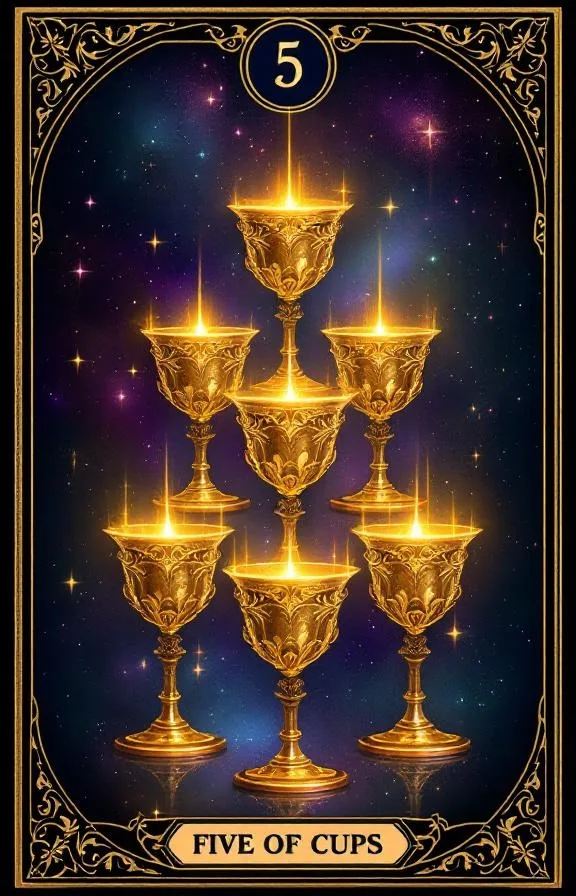
They carry their losses like luggage they refuse to set down. You can see it in the way they talk about the past — with a specificity that suggests they revisit it daily, polishing every detail of what went wrong until it gleams with a terrible clarity. The Five of Cups person is defined not by what they have, but by what they have lost.
The personality profile
Grief is supposed to be temporary. Every self-help book, every well-meaning friend, every therapist with a stages-of-grief poster on the wall says the same thing: process it and move on. The Five of Cups person did not get that memo. Or they got it and disagreed.
Their relationship with loss is not pathological — or at least, it does not start that way. It begins as depth of feeling. They loved something or someone with genuine intensity, and when it was taken, the wound went deep enough to become structural. The loss is not something that happened to them. It became part of who they are.
Elisabeth Kubler-Ross introduced the five stages of grief as a framework for understanding, not as a prescription for recovery. But her model assumed a linear progression toward acceptance. The Five of Cups person lives in a loop. They oscillate between anger and depression with occasional detours through bargaining, but acceptance remains stubbornly out of reach — not because they cannot imagine it, but because part of them believes that letting go of the grief means letting go of whatever they lost. The pain is the last connection.
Five of Cups upright as a person
Upright, this person possesses an emotional depth that is genuinely rare. They understand suffering in a way that makes them extraordinary companions for other people who are in pain. They will not try to fix your grief or rush you through it. They will sit in it with you. Silently, if needed. For as long as it takes.
They are honest about hard things. While everyone else is offering platitudes — "everything happens for a reason," "time heals all wounds" — the Five of Cups person tells the truth: "This is terrible, and I am sorry." That honesty, that refusal to coat reality in sugar, is a gift that people in genuine crisis remember forever.
Their sensitivity to loss also makes them deeply appreciative of what they have, when they can access that awareness. They do not take relationships for granted because they know firsthand how quickly things can be taken away. The moments when a Five of Cups person is present and grateful — really present, not lost in retrospection — are luminous precisely because they are hard-won.
Five of Cups reversed as a person
Reversed, the mourning becomes an identity. They are no longer a person who experienced loss — they are a person who is their loss. Every conversation circles back to it. Every new experience is measured against the old one and found wanting. "This is nice, but it is not what I had before." Nothing can compete with a memory that has been idealized past recognition.
Self-pity replaces genuine grief. The distinction matters: grief is love with nowhere to go, while self-pity is a performance of suffering that serves to keep others at a distance and excuse inaction. The reversed Five of Cups person uses their pain as a shield. You cannot ask anything of someone who is suffering this much. You cannot hold them accountable. You cannot expect them to show up.
They may also develop a pattern of preemptive mourning — grieving relationships before they end, sabotaging good things because the anticipated loss feels less painful than the surprise of an unexpected one. They leave before they can be left. Break things before they can be broken. The logic is self-defeating but internally consistent: if everything ends in loss, better to control the timing.
Five of Cups as a person in love
The Five of Cups person in love is a paradox. They want intimacy desperately and are terrified of it completely. They have been hurt before — that much is obvious from the first date — and the scar tissue is visible in the way they flinch at certain topics, avoid certain questions, keep certain rooms in their emotional house permanently locked.
When they trust enough to let someone in, the love they offer is profound. They do not love casually. They cannot. Everything is high stakes for them because they have felt the cost of losing what they cared about. This makes them intensely loyal partners, but also anxious ones. A missed call is not just a missed call — it is the beginning of an abandonment narrative that takes hours to talk down.
Their partner needs to understand that the competition is not another person. It is a ghost. The Five of Cups person is often still in love with someone or something from their past, and the new relationship exists in the shadow of that loss whether anyone acknowledges it or not.
Five of Cups as a person at work
Professionally, they struggle with setbacks that others would absorb and move past. A failed project, a lost client, a critical review — these things hit them harder and linger longer. They can become the person who brings up the company's worst quarter in every planning meeting, not to be difficult but because they genuinely have not processed it yet. Their strength at work is risk assessment: they have an acute awareness of what can go wrong because they have lived through it.
Five of Cups as someone in your life
Having a Five of Cups person in your life requires a specific kind of patience. You cannot cheer them up. Trying will only make them feel misunderstood. What you can do is witness. Be present with their sadness without trying to redirect it.
Gently — very gently — you can also help them notice the two cups that are still standing. Do not point at them aggressively or make it a lesson. Just mention, in passing, something good that is happening right now. Plant the seed. They will pick it up when they are ready, and if you try to force it, they will dig in deeper.
Frequently asked questions
What kind of person does Five of Cups represent?
The Five of Cups represents someone whose identity has been shaped by loss, disappointment, or emotional wounds they have not fully healed. They are deeply feeling, honest about pain, and capable of extraordinary empathy for others who are suffering.
Is Five of Cups as a person positive or negative?
Mixed. Their emotional depth and capacity for empathy are genuine strengths, but their fixation on loss can become self-destructive if it prevents them from engaging with what is still available to them. The key distinction is whether the grief is being processed or performed.
How do you recognize a Five of Cups person?
Listen to how they talk about the past. If every good memory comes with a footnote of sadness, if they reference what they used to have more often than what they currently have, if there is a heaviness beneath even their lightest moments — you are likely in the presence of a Five of Cups person. They also tend to be unusually good listeners when you are going through something difficult, because they genuinely understand what suffering feels like.
