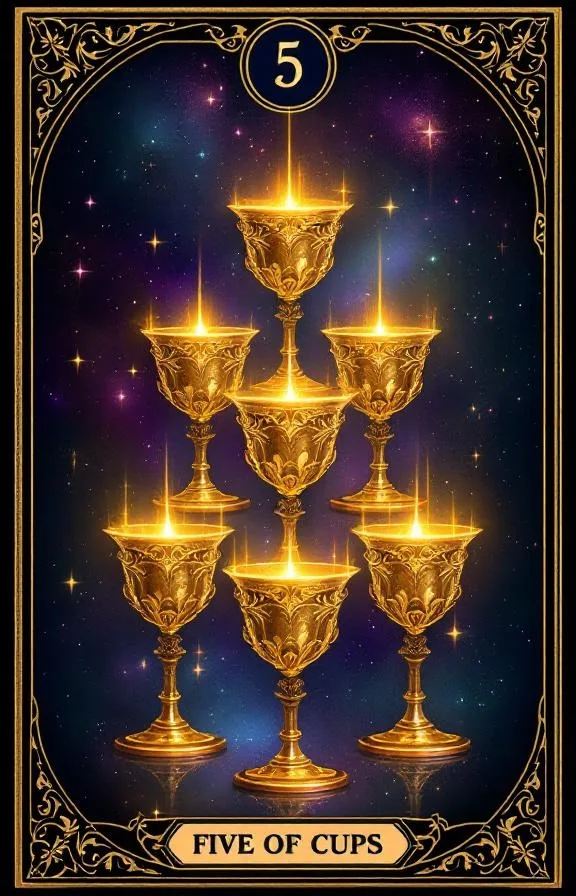
Three cups have fallen. The liquid is gone — soaked into ground that will not give it back. Behind the figure, two cups remain standing. Full, intact, waiting. The figure does not turn around. Cannot turn around. Not yet. The Five of Cups as feelings captures that specific weight of loss when grief fills your entire field of vision and the things you still have become invisible because the things you have lost are so impossibly loud.
The core feeling
Grief is the feeling the mind produces when reality has been permanently edited and the emotional self has not caught up to the revision. Psychiatrist Elisabeth Kubler-Ross mapped the stages famously, but what she emphasized less publicly was how non-linear the process actually is — grief does not move in a straight line from denial to acceptance but circles back, revisits, ambushes. The Five of Cups lives in the circling. The moment where the person knows, intellectually, that loss has occurred and still feels the phantom presence of what was lost as if it might return.
What makes this card particularly difficult is the element of fixation. The five cups are not all spilled. Two remain. But grief has a gravitational pull that bends attention toward absence rather than presence, and the person experiencing Five of Cups feelings is caught in that gravity. They are not choosing to focus on loss over what remains. Grief is choosing for them.
Five of Cups upright as feelings
Upright, the Five of Cups is grief without consolation. The person is standing in the wreckage of something that mattered — a relationship, a hope, a version of the future they had already started living in mentally — and the dominant feeling is not anger or confusion but sorrow. Pure, heavy, undiluted sorrow that sits in the chest like wet concrete.
The physical experience is distinct. Heaviness in the limbs. A face that keeps arranging itself into sadness without the person's permission. The sudden inability to care about things that mattered twenty-four hours ago — meals, appointments, the opinion of strangers — because the loss has reorganized all priorities around itself. Everything is measured against it. Everything comes up short.
There is an honesty to this card that gets undervalued. The person is not performing grief. They are not grieving strategically to gain sympathy or manipulate an outcome. They are simply sad, in the way that only genuine loss produces, and the sadness is taking however long it takes. Most people will tell a grieving person to "look at the bright side." The Five of Cups is the card that says: not yet. Sometimes you need to stand with the spilled cups for a while before you can turn around.
Five of Cups reversed as feelings
Reversed, the figure begins — slowly, reluctantly — to turn. The two standing cups enter their peripheral vision. Not as replacements for what was lost, because nothing replaces what was lost, but as evidence that the world continues and contains things worth engaging with. The grief has not ended. It has loosened its grip enough to allow movement.
This turning is not a decision. It is more like a thaw. The frozen quality of acute grief begins to soften, and feelings other than sorrow start to trickle back in. Appetite returns. A joke lands. The person catches themselves looking forward to something and immediately feels guilty about it, because enjoying anything feels like betraying what they lost. That guilt is itself a sign of progress, paradoxically — you have to be feeling something other than grief to feel guilty about feeling something other than grief.
The reversed Five can also indicate someone who has been grieving longer than they realize. The loss happened months or years ago, but the emotional response has calcified into a permanent posture. They have built an identity around their wound. The reversal asks whether the grief has become a shelter they are hiding in rather than a storm they are weathering.
Five of Cups as feelings in love
In love readings, the Five of Cups is heartbreak. Straightforward, unglamorous heartbreak. The person is mourning a relationship or a romantic possibility that did not survive, and the mourning is consuming enough to make future romantic engagement feel impossible. They are not ready to date. They are not ready to "put themselves out there." They are standing in front of three spilled cups and the idea of raising the two remaining ones feels like a betrayal of everything the first three represented.
When this card shows up as someone's feelings toward you, the reading depends heavily on context. If you are the person they lost, they are grieving you with genuine depth. If you are a new romantic interest, they are looking at you through the lens of their loss — comparing you to what came before, measuring your potential against the pain that potential might produce. Neither position is comfortable.
For existing couples, the Five of Cups can signal grief within the relationship rather than grief about it — mourning a phase that has passed, a version of the partnership that no longer exists, a promise that was not kept. The couple is still together. Something between them has died. They both know it.
Five of Cups as feelings about you
When the Five of Cups describes someone's feelings about you, you are associated with loss in their emotional landscape. You may be the person who hurt them, the person who reminds them of someone who hurt them, or simply the person whose presence highlights what they no longer have. None of these are about your character. All of them are about their grief.
The hardest version of this reading is when you have done nothing wrong but your existence triggers their pain. You represent the road not taken, the alternative life, the reminder that choices have consequences that cannot be reversed.
Five of Cups as feelings in career
Professionally, the Five of Cups signals someone grieving a career setback with more intensity than they expected. A passed-over promotion. A failed project. A company they believed in that turned out to be ordinary. The loss has revealed how emotionally invested they were in a professional identity they can no longer claim, and the revelation itself is part of the grief — they did not realize they cared this much until it was gone.
Recovery in professional contexts is complicated because workplaces rarely make space for genuine grief about career losses. The person is expected to "move on" and "stay positive" while processing a loss that has genuinely altered their sense of who they are. The Five of Cups says: the grieving is valid even if the environment does not validate it.
Frequently asked questions
What does Five of Cups mean as feelings?
The Five of Cups represents grief and the fixation on loss that accompanies it. The person is emotionally consumed by what has been lost or what has failed, temporarily unable to appreciate what remains available to them.
Does Five of Cups represent positive or negative feelings?
The feelings are painful but not destructive. Grief, as the Five of Cups depicts it, is a natural and necessary response to genuine loss — it reflects depth of caring rather than weakness. Upright, the person is in the thick of mourning. Reversed, the earliest signs of emotional recovery are appearing, though the grief has not fully resolved.
What does Five of Cups reversed mean as someone's feelings?
Someone feeling the reversed Five of Cups is beginning to emerge from grief. They are tentatively re-engaging with life — noticing the cups that remain standing rather than fixating exclusively on what spilled. The process is fragile and non-linear; they may still have difficult days. But the worst of the emotional paralysis is loosening, and they are starting to consider that the future might contain something worth caring about.
Curious what Five of Cups means as feelings in YOUR situation? Try a free AI tarot reading and explore the emotional landscape of your cards.
