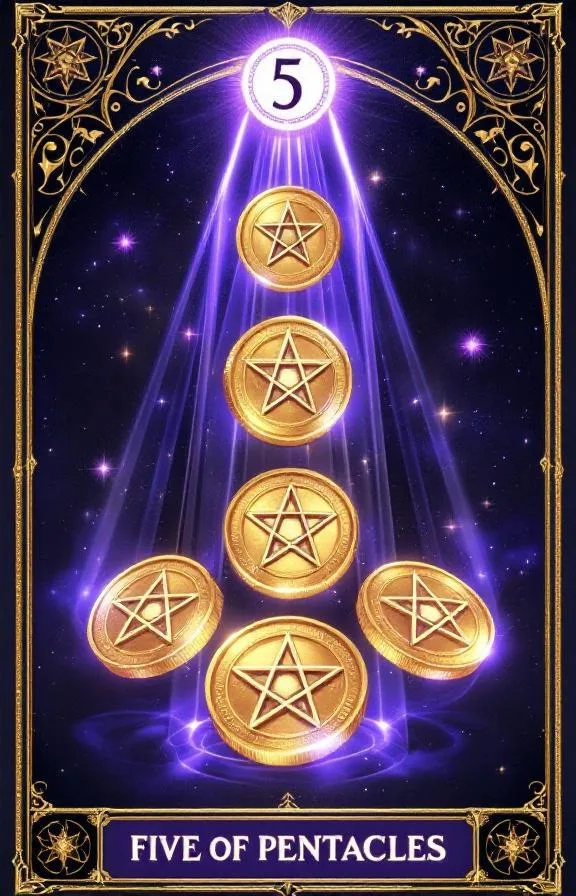
Two figures trudge through snow, ragged and limping, passing directly beneath a brightly lit stained-glass window. The warmth is right there. The door is right there. They don't look up. The Five of Pentacles as advice is not about your suffering — it's about the help you're refusing to see.
The advice
Ask for help. That's it. Three words. The hardest three words some people will ever say.
The Five of Pentacles appears when you're experiencing genuine hardship — financial stress, health problems, isolation, the grinding weight of not-enough — and you've decided, consciously or not, that you have to endure it alone. You don't. The church window is lit. Someone is willing to help. But pride, shame, or the deeply ingrained belief that needing help means failing has kept you walking past the door.
This card is not gentle about its message. The suffering in this image is real, but a significant portion of it is self-imposed. Not the hardship itself — that might be completely beyond your control. But the isolation? The refusal to reach out? The story you're telling yourself about how asking for help would make you weak? That part is optional. And it's making everything worse.
Brene Brown's research on vulnerability found that the willingness to ask for help is not a sign of weakness but one of the strongest predictors of resilience. People who can say "I need support" recover faster, maintain stronger relationships, and experience less chronic stress than those who white-knuckle through crises alone. The Five of Pentacles delivers the same finding, centuries before the research confirmed it.
Five of Pentacles upright advice
Upright, this card says: you are in a hard place, and pretending otherwise is extending your suffering.
Name what's wrong. Say it out loud. To someone. Not a social media post — a person who knows you. "I'm struggling financially." "I'm lonely." "I don't know how to fix this." The naming itself begins to crack open the isolation, because hardship thrives in silence. When you speak it, you create the possibility of response.
The upright Five also advises examining whether your current hardship has a practical solution you've been too proud to pursue. Government assistance. A payment plan on the debt. Therapy covered by your insurance. A phone call to a family member. These are not signs of failure. They are tools designed for exactly this situation, and refusing to use them because of some internal narrative about self-sufficiency is like refusing an umbrella because you should be tough enough to handle the rain.
One important nuance: the card doesn't promise that help will fix everything instantly. It promises that isolation makes everything worse. Start with connection. Solutions follow.
Five of Pentacles reversed advice
Reversed, you're beginning to recover. The worst has passed, or is passing, and light is returning. The advice shifts from "ask for help" to "accept the healing."
Some people are so accustomed to struggle that recovery feels suspicious. When good things start happening, they brace for the next disaster instead of receiving the improvement. If this is you, the reversed Five says: put the armor down. You survived. Now let yourself heal instead of preparing for the next wound before it arrives.
Reversed can also indicate the end of financial hardship — a job offer after a long search, a debt finally paid off, a health issue resolving. The advice here is to not rush past the relief. Sit with it. Let your nervous system register that the crisis is over. Too many people sprint from survival mode straight into the next ambition without ever acknowledging that they made it through something hard.
There's a practical dimension too. If the crisis taught you something about your financial vulnerabilities, your support network, or your health — don't waste that information. Build the system that would have caught you earlier. Emergency fund. Regular check-ups. Relationships maintained before you desperately need them, not after.
Five of Pentacles advice in love
In love, this card advises radical honesty about your emotional needs.
If you're in a relationship and feeling disconnected, isolated, or unsupported, the Five says: your partner probably doesn't know. Not because they don't care — because you haven't told them. You've been performing sufficiency, handling everything yourself, and they've believed your performance. Tell them the truth. "I feel alone even when you're here." "I need more from you and I don't know how to ask." Those sentences are terrifying and necessary.
Single and lonely? The Five advises against the toxic self-reliance that says you shouldn't need anyone. Humans are social animals. Wanting companionship is not a deficiency — it's biology. But the card also warns against seeking a relationship as a rescue from loneliness. Deal with the isolation directly first. Rebuild friendships. Join a community. Create connection that isn't dependent on a romantic partner appearing to save you.
For those going through a breakup or loss, the Five of Pentacles is compassionate but firm: grieve it fully, but don't build a permanent home in the grief. The snow is temporary. The cold will pass. But it passes faster when you let people walk beside you.
Five of Pentacles advice in career
Your career situation is harder than it looks from the outside. The Five acknowledges this without pity.
If you're unemployed, underemployed, or stuck in a role that's slowly crushing you, the card's advice remains consistent: ask for help. Talk to a career counselor. Tell your network you're looking. Apply for the position you think you're not qualified for — studies consistently show that people underestimate their candidacy, especially those who have recently experienced professional setbacks.
The Five also addresses workplace isolation. If you're the person who always handles things alone, who never asks for extensions, who never admits to being overwhelmed — your colleagues think you're fine. Your manager thinks you're fine. You are not fine, and the work is suffering because you'd rather produce mediocre results alone than excellent results with support.
For financial hardship specifically, the card advises immediate practical steps: check every assistance program available to you, negotiate payment plans on outstanding debts, talk to a financial advisor (many offer free initial consultations). Embarrassment about money is understandable. It is also expensive — it prevents people from accessing resources that exist specifically for their situation.
There's a harder truth here too. If your career has been in a sustained downturn, ask if you are resisting a change the situation is demanding. Sometimes the Five of Pentacles doesn't mean "endure this job search." It means "this entire career path has ended, and the sooner you accept that, the sooner the next one begins."
Action steps
- Tell one person the truth about what you're going through. Not the curated version. The real version. Choose someone you trust and say the thing you've been holding alone. Connection begins with honesty.
- Research one practical resource you haven't used yet. A financial assistance program. A support group. A free counseling service. A community organization. The help exists — your job is to find the door and walk through it.
- Stop comparing your hardship to others'. "Other people have it worse" is not comfort. It's a mechanism for dismissing your own legitimate needs. Your struggle counts even if someone else's struggle is different.
- If you're recovering, build one system to prevent this from happening again. An emergency fund. A regular health screening. A maintained support network. Recovery without structural change is just waiting for the next crisis.
Frequently asked questions
What does the Five of Pentacles mean as advice?
The Five of Pentacles advises you to ask for help during a difficult time. Its central message is that isolation worsens hardship, and that support — financial, emotional, professional — is available if you're willing to reach for it. The card distinguishes between the hardship itself, which may be beyond your control, and the refusal to seek help, which is a choice you can change immediately.
Is the Five of Pentacles always a negative card?
The Five depicts genuine difficulty, but its advice is ultimately constructive. It acknowledges pain without romanticizing it, and it points toward the specific action — reaching out for support — that can begin to change the situation. Reversed, it often indicates recovery is already underway. Even upright, the lit window in the image is a reminder that warmth exists nearby. The card is about what you do with hardship, not just the fact that hardship exists.
How does the Five of Pentacles advise on financial problems?
The card advises practical, immediate action: research available assistance programs, negotiate payment plans, speak to a financial advisor, and tell trusted people in your life what you're dealing with. It warns against pride-driven isolation that prevents you from accessing resources designed for exactly your situation. Financial hardship is a logistics problem with emotional dimensions — address both, starting with whichever one you've been ignoring.
