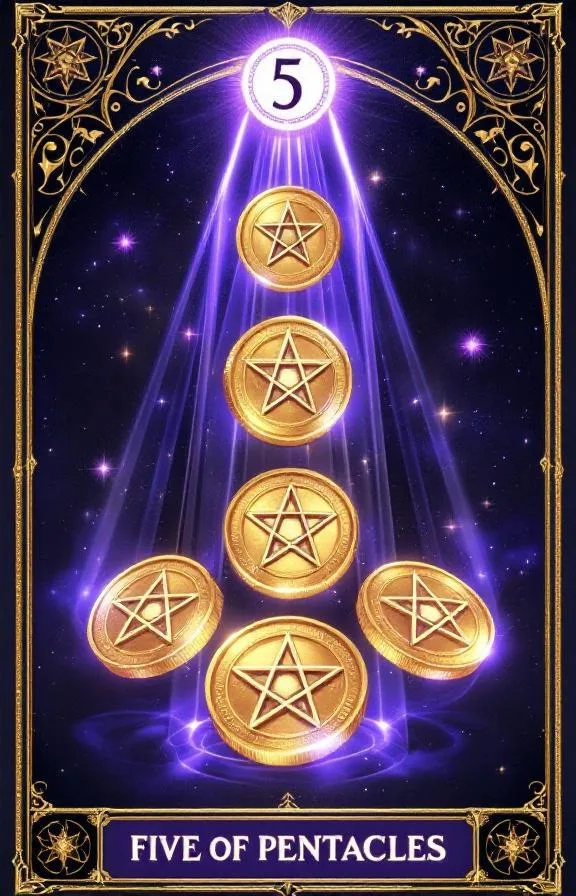
They stand outside the lit window, watching warmth happen to other people. Not with envy exactly — something quieter, more resigned. The Five of Pentacles as a person carries the particular weight of someone who has been on the outside long enough to stop expecting an invitation. They are the outsider. And the most heartbreaking thing about them is that the door is often unlocked.
The personality profile
The outsider archetype is defined not by what they lack but by their relationship with lack. Plenty of people experience hardship. The Five of Pentacles person has let hardship become identity. This is the crucial distinction. They are not just going through a difficult period — they have organized their entire self-concept around struggle, exclusion, and the belief that resources available to others are somehow not available to them.
This is not self-pity, though it can look like it from the outside. It is a deeply internalized narrative, often rooted in childhood experiences of real deprivation. Growing up without enough money, without stable housing, without the social capital that lubricates belonging — these experiences write code that runs silently in the background for decades. The person may be objectively comfortable now. The code still runs.
Sociologist Pierre Bourdieu's concept of habitus — the deeply ingrained habits, skills, and dispositions we acquire through life experience — captures this perfectly. The Five of Pentacles person's habitus was formed in scarcity. Even surrounded by abundance, they move through the world as if scarcity is still the operating condition. They buy the cheapest option. They apologize for taking up space. They assume they will be the first one cut when resources tighten.
Five of Pentacles upright as a person
Upright, this person is in active struggle — and that struggle, paradoxically, can produce a kind of fierce dignity. They endure. Whatever is happening to them — financial hardship, social exclusion, health problems, the particular loneliness of being different in a conformist environment — they keep walking. The image on the card is two figures trudging through snow. Not collapsed. Not dead. Walking.
Their resilience is real but comes at a cost that is invisible to casual observers. They have learned to minimize their needs to a degree that seems impressive until you realize it is a survival mechanism, not a lifestyle choice. They do not ask for help because asking means admitting need, and admitting need means being vulnerable, and vulnerability has never once worked out for them. At least, that is what their history has taught them.
The most important thing to understand about this person upright is that their isolation is often partially self-imposed. The stained-glass window in the traditional card image represents sanctuary — a church, a community, a place of warmth. It is right there. But the figures walk past it. The Five of Pentacles person walks past help because accepting help threatens a self-sufficiency that has become their last source of pride.
Five of Pentacles reversed as a person
The reversal brings a turning point. This is the outsider who has started walking toward the door instead of past it. Something has shifted — maybe they hit bottom, maybe someone's kindness broke through, maybe they simply got tired of being cold. Whatever the catalyst, they are beginning to let go of their identity as someone who suffers.
This is harder than it sounds. Letting go of suffering when suffering is all you know feels like losing yourself. The reversed Five of Pentacles person is doing brave, invisible work — rebuilding their self-concept without the familiar scaffolding of deprivation. They are learning to say "I need help" without hearing it as "I am weak."
Sometimes the reversal shows the opposite trajectory: someone who has escaped hardship but keeps returning to it. They sabotage their own recovery. They leave stable situations for chaotic ones. They choose partners who recreate the deprivation they grew up in. Not consciously. The code runs in the background.
Five of Pentacles as a person in love
They love with the intensity of someone who knows what it means to go without. When they find genuine connection, they hold onto it — sometimes too tightly, sometimes in ways that smother the other person with the weight of unspoken need.
Their biggest fear in relationships is abandonment, and this fear shapes everything. They monitor their partner for signs of withdrawal with the hypervigilance of a trauma survivor scanning for threats. A delayed text. A distracted dinner conversation. A weekend trip with friends that was not discussed in advance. Each small absence triggers a disproportionate response because, in their internal world, every absence is a rehearsal for the final one.
Loving this person well means being explicit about commitment in ways that might feel redundant to someone without their history. You cannot assume they know you are staying. You have to say it. Regularly. Directly. Without conditions.
Five of Pentacles as a person at work
Professionally, they often undervalue themselves with a consistency that is painful to witness. They accept lower salaries than their skills warrant. They volunteer for tasks nobody else wants. They do not negotiate. The idea of demanding more triggers the same scarcity response: who am I to ask? Someone else needs it more.
When they do succeed — and they often do, because their tolerance for difficulty far exceeds most people's — they struggle to internalize it. The promotion feels temporary. The praise feels undeserved. The comfort feels borrowed.
Five of Pentacles as someone in your life
You might not recognize this person immediately because they are skilled at hiding their deprivation. They deflect with humor. They insist they are fine. They change the subject when conversations drift toward money, health, or the uncomfortable question of whether they are actually okay.
The most helpful thing you can do is not to rescue them — they will resist rescue — but to simply keep the door open. Literally and metaphorically. Invite them in without pressure. Offer without conditions. Let them come to warmth on their own timeline, and do not take their initial refusal as a final answer.
Frequently asked questions
What kind of person does the Five of Pentacles represent?
The Five of Pentacles represents someone who has internalized an outsider identity — a person shaped by experiences of scarcity, exclusion, or hardship who continues to operate from a mindset of deprivation even when circumstances have changed.
Is the Five of Pentacles as a person positive or negative?
It is complicated. Their resilience and capacity to endure genuine difficulty are admirable qualities that most people never develop. But their inability to accept help, their tendency to self-isolate, and their deep identification with suffering can keep them trapped in patterns that no longer serve them. The card is ultimately about the gap between available support and the willingness to accept it.
How do you recognize a Five of Pentacles person?
They minimize. Everything. Their needs, their accomplishments, their pain. They apologize more than the situation warrants. They are the last to eat, the first to leave, the one who insists on paying even when they clearly cannot afford it. There is a quiet pride in their struggle that makes them both admirable and deeply difficult to help.
