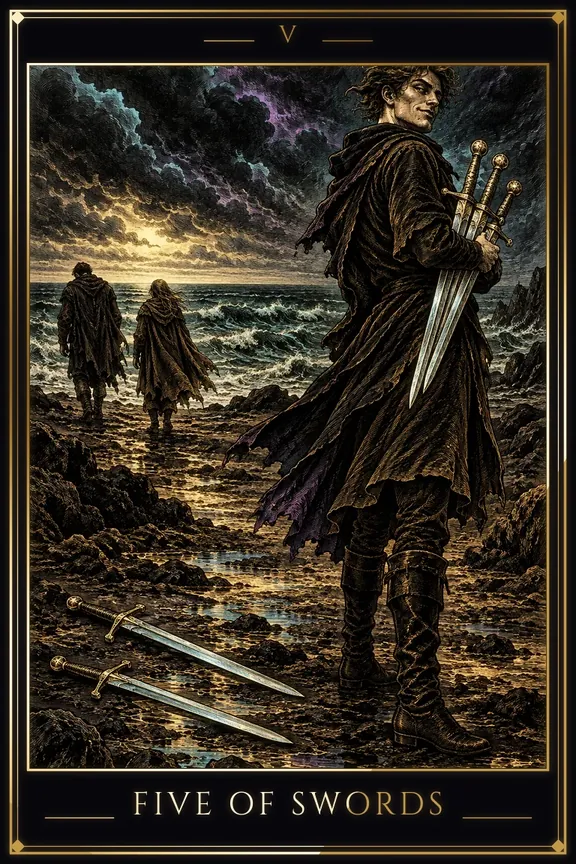
He won the argument. Demolished every counterpoint, exposed every logical weakness, delivered the final blow with a smile that was technically polite and emotionally devastating. Now he is standing in the ruins of the conversation holding his victory like a trophy, wondering why everyone has left the room. The Five of Swords person wins. That is what they do. The question nobody has successfully answered for them yet is: at what cost?
The personality profile
The Five of Swords person understands power dynamics the way a chess player understands the board — instinctively, constantly, several moves ahead. They walk into every room already assessing: Who has influence? Where are the alliances? What are the vulnerabilities? This is not paranoia. It is a survival skill they developed so early it has become invisible to them. They do not know how to stop mapping the terrain because they have never felt safe enough to try.
Here is the uncomfortable truth about the Five of Swords person: they are often right. Their assessments of people tend to be accurate. Their strategic thinking genuinely does identify the optimal path to a given outcome. The problem is that their definition of "optimal" accounts for their own advantage and discounts almost everything else — other people's feelings, long-term trust, the possibility that winning the battle might cost them the war.
Robert Greene, in his analysis of historical power strategies, documented a pattern he called "crushing your enemy totally" — the idea that partial victory creates future enemies while total victory eliminates them. The Five of Swords person has internalized this logic. They do not compromise because they believe compromise means leaving the other side with enough strength to come back later. They are usually wrong about this, but the belief runs deep.
Five of Swords upright as a person
Upright, this person channels their tactical intelligence into legitimate competition. They are the entrepreneur who sees market gaps before anyone else, the attorney who builds cases like fortresses, the negotiator who walks away with everything they came for and somehow makes the other side feel like they got a fair deal.
At their best, the Five of Swords person is simply someone who refuses to lose — and who has the intellectual resources to back up that refusal. They are strategic without being manipulative, competitive without being cruel, and ambitious in ways that push entire organizations forward because when a Five of Swords person is on your side, they bring the same relentless energy to your goals that they bring to their own.
They have a dark charisma that comes from competence. People are drawn to them because competence is attractive and because there is something reassuring about being allied with the person who always seems to be three steps ahead.
Five of Swords reversed as a person
Reversed, the tactician becomes a bully. Not the obvious kind — the Five of Swords person is too smart for that. Their bullying is intellectual, strategic, deniable. They manipulate through information control, through subtle social exclusion, through arguments structured to make the other person feel stupid rather than merely wrong.
The reversed Five of Swords person collects wins that no one else considers wins. Conversations where they "proved" their point at the expense of a friendship. Negotiations where they extracted concessions through pressure rather than persuasion. Projects where they took credit for collective work because they positioned themselves as the linchpin.
They burn through relationships like fuel. Each victory isolates them further, and each isolation confirms their belief that relationships are fundamentally transactional — that people are either useful or in the way. This is the Five of Swords trap: the loneliness of perpetual victory.
Eventually someone calls it out. Usually someone quieter, less combative, less strategically minded — someone the Five of Swords person underestimated because they mistook gentleness for weakness. That moment of being truly seen by someone they dismissed is the closest the reversed Five of Swords person gets to transformation.
Five of Swords as a person in love
Love is the Five of Swords person's most dangerous territory. They bring the same strategic thinking to romance that they bring to everything else, and it works spectacularly in the short term — they are attentive, charming, and astonishingly good at figuring out exactly what their partner wants to hear. The seduction phase is their masterpiece.
The problem arrives when the relationship requires vulnerability. Vulnerability, to the Five of Swords person, feels like disarmament. Sharing a fear gives the other person leverage. Admitting a mistake concedes tactical ground. They would rather maintain a position of emotional superiority than experience the mutual exposure that genuine intimacy requires.
Arguments with this person are exhausting. Not because they yell — they rarely yell — but because they argue to win, not to understand, and their intellectual toolkit makes them formidable opponents in any verbal exchange. The partner who survives long-term with a Five of Swords person is either someone strong enough to refuse the game entirely or someone who has already lost themselves trying to play it.
Five of Swords as a person at work
They thrive in competitive environments. Sales, litigation, trading floors, political campaigns, startup culture. Any arena where winning is explicitly the point. They struggle in collaborative environments where consensus matters more than outcomes, because their instinct is always to optimize for results rather than relationships.
The Five of Swords person makes an excellent strategist and a terrible team player, unless the team is explicitly organized around competition with an external opponent. Give them an enemy and they will unite the group. Take the enemy away and they will find one internally.
Five of Swords as someone in your life
If you recognize this person, protect your boundaries without trying to beat them at their own game. You will not out-strategize a Five of Swords person — that is their home court. What you can do is refuse to play. Name the dynamic directly: "You are arguing to win, not to understand." This short-circuits their approach because it moves the conversation from the strategic plane, where they dominate, to the emotional plane, where they are far less skilled.
The Five of Swords person's deepest fear is irrelevance. They compete because they believe they must earn their place in every room. If you can make them feel valued without requiring them to perform, you will see a different person underneath all that armor. Briefly. Before the visor comes back down.
Frequently asked questions
What kind of person does the Five of Swords represent?
The Five of Swords represents a tactician — someone who instinctively maps power dynamics, thinks strategically, and prioritizes winning in ways that range from impressively effective to relationally destructive.
Is the Five of Swords as a person positive or negative?
Most people find this personality challenging. Their strategic intelligence is genuinely valuable in competitive contexts, but their tendency to treat relationships as contests creates conflict and isolation. The healthiest Five of Swords people learn the critical distinction between situations that require competition and those that require cooperation.
How do you recognize a Five of Swords person?
They keep score. Not always visibly, but always. They remember who slighted them, who helped them, and who owes them a favor. They are charming when it serves them and cutting when it does not. They have very few close friends but an extensive network of people who respect or fear them.
