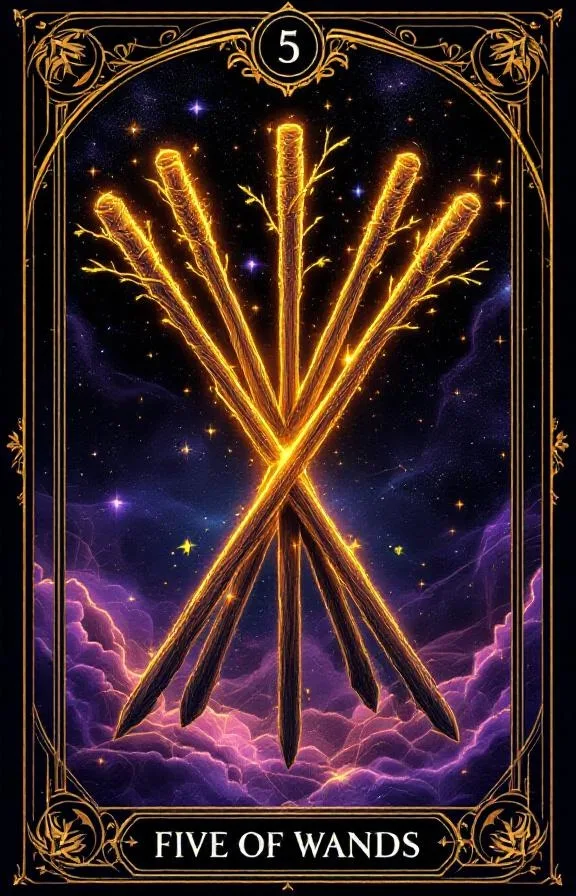
Five figures swinging wands at each other in what looks like chaos. Nobody is winning. Nobody is losing. Everyone is expending enormous energy, and the ground beneath them stays exactly the same.
The Five of Wands shows you conflict — but the kind of conflict that matters is not always what you think.
The advice
Pick your battles. This is the card's central instruction, and it is more radical than it sounds. The Five of Wands does not say avoid conflict. It says stop engaging in conflicts that produce nothing. Stop swinging your wand at opponents who are not real threats. Stop competing with people who are fighting their own fights while you happen to be standing nearby.
Most of the conflicts in your life right now are noise. Not all of them — but most. The Five of Wands appears when you have been spending energy on disputes, competitions, or disagreements that will not change your life regardless of outcome. That argument with the colleague about process? Noise. The comparison spiral on social media? Noise. The petty territorial skirmish at the family dinner? Noise.
The real fight — the one that actually matters — is quieter and harder to identify because you have been so distracted by the commotion. The Five of Wands says: put down your wand, step back from the scrum, and figure out which battle is worth your full strength.
Five of Wands upright advice
Upright, the Five of Wands describes a situation where multiple forces are competing and nobody has established dominance. This is not necessarily bad. Competition sharpens you. Disagreement clarifies your position. Friction generates heat, and heat generates change.
The upright advice is to engage selectively. Do not withdraw from every conflict — some of them are productive. The challenge is distinguishing between competition that elevates you and competition that merely exhausts you. A useful test: after the engagement, do you feel sharper or depleted? If depleted, you picked the wrong fight.
The Five of Wands upright also advises checking your ego. Sometimes you are swinging your wand not because the issue matters but because you cannot stand to lose. That is not strategy. That is reflex. And it costs you energy you could be investing in something that moves your life forward rather than defending a position that does not need defending.
Five of Wands reversed advice
Reversed, the conflict has either resolved or gone underground. On the surface, things look calm. Beneath the surface, tensions are festering. The reversed Five of Wands warns against mistaking silence for peace.
If you have been avoiding a necessary confrontation, this card says: the avoidance is costing more than the confrontation would. Unaddressed conflict does not disappear. It metastasizes. The conversation you are dreading will only get harder the longer you wait.
Alternatively, the reversal can indicate that you have successfully moved past a period of intense competition. The battles are done. You survived. Now the advice is to resist the urge to keep fighting when the fight is over. Some people become so accustomed to conflict that peace feels threatening. If that resonates, the reversed Five says: put the wand down. The skirmish ended. Let yourself rest.
Five of Wands advice in love
In love, the Five of Wands signals friction — but not the relationship-ending kind. This is the friction of two strong personalities negotiating their territory. Arguments about money, chores, time allocation, in-laws. None of these are fatal individually. Together, they create a grinding tension that can erode connection if left unaddressed.
The advice for couples is to stop trying to win arguments and start trying to solve them. Winning means one person loses, and the relationship absorbs the cost. Solving means both people sacrifice something and the relationship gains stability. Every time you choose victory over resolution, you are drawing down the partnership's reserves.
For singles, the Five of Wands suggests you may be creating unnecessary competition in your dating life — comparing yourself to other suitors, performing for attention, treating attraction like a contest. The card says: drop the performance. The person worth being with does not want to be won. They want to be chosen by someone who showed up as themselves.
Five of Wands advice in career
Professionally, this card describes a competitive environment where multiple people or ideas are vying for limited resources — attention, budget, promotions, clients. The advice is not to avoid the competition but to choose your arena carefully.
The biggest mistake people make under Five of Wands energy is competing on someone else's terms. If your colleague is better at politics, do not try to outpolitick them. If a competitor has deeper pockets, do not try to outspend them. Find the field where your specific strengths give you an advantage, and compete there.
The card also warns against internal workplace conflict that masquerades as collaboration. Those meetings where everyone talks and nothing changes? That is Five of Wands energy. If you are in a leadership position, the advice is to cut through the noise: make a decision, assign ownership, and move on. Collaborative conflict is only useful when it produces a result.
Action steps
- List every active conflict in your life, then cross out the ones that will not matter in six months. Be honest. Most of them will get crossed out. Focus your energy on what remains.
- Choose one fight worth having and commit to it fully. Half-engagement is worse than no engagement. If the conflict matters — the promotion, the relationship boundary, the creative direction — bring your full attention and resolve it.
- Withdraw from one pointless competition this week. Unsubscribe from the comparison. Stop monitoring the rival. Drop the argument you were continuing out of pride. Notice how much energy returns when you stop swinging at shadows.
- In your next disagreement, listen for 60 seconds before responding. Not formulating your rebuttal while they talk. Actually listening. The Five of Wands is often sustained by people who are too busy swinging to notice what the other person is actually saying.
FAQ
Is the Five of Wands telling me to avoid all conflict?
No. The card is telling you to be selective about which conflicts deserve your energy. Some friction is productive — it clarifies your values, sharpens your ideas, and forces you to articulate what you want. The Five of Wands warns against the kind of conflict that generates heat but no light: petty arguments, ego-driven competitions, and disagreements where neither outcome would meaningfully change your life. Fight when it matters. Walk away when it does not.
What does the Five of Wands mean when I am already in a conflict?
It means you should assess whether the conflict is moving toward resolution or just cycling. The Five of Wands depicts perpetual skirmishing — lots of action, no progress. If your current conflict feels like that, the card is telling you to change your approach. Stop doing what has not been working. Try a different angle, bring in a mediator, or simply state your position clearly once and refuse to repeat yourself. The goal is not to fight harder but to fight smarter.
How do I know if the Five of Wands competition is healthy or destructive?
Ask yourself two questions. First: am I growing from this, or just surviving it? Healthy competition pushes you to develop skills, clarify your position, and raise your game. Destructive competition drains you, makes you bitter, and forces you to become someone you do not want to be. Second: does the arena matter to me, or am I fighting here because someone else chose this battlefield? If you are competing in a space that does not align with your actual goals, the competition is destructive regardless of whether you win.
