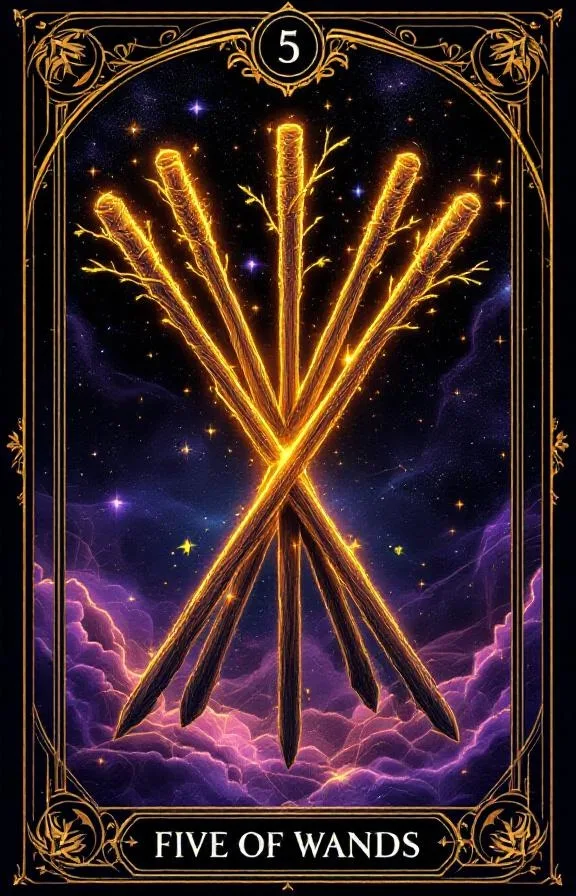
Five people in a room, all talking at once, nobody listening. Each one convinced their point is the most important. Each one slightly louder than the last. You have been in that room — at work, at family gatherings, inside your own head when three competing desires refuse to resolve into one clear direction. The Five of Wands as feelings is the emotional texture of that chaos: friction that generates heat but no light.
The core feeling
Frustration is the surface emotion, but underneath it lies something more interesting: competitive energy that has no clear outlet. The Five of Wands does not describe the clean anger of someone who has been wronged. It describes the messy, scattered irritation of someone surrounded by conflict that feels simultaneously petty and impossible to ignore.
The best analogy might be what social psychologists call "social comparison distress" — the emotional toll of constantly measuring yourself against others. Leon Festinger proposed social comparison theory in 1954, and seven decades later it remains one of the most replicated findings in psychology: humans cannot stop comparing, and the comparing rarely makes them feel better. The Five of Wands captures the emotional state where comparison has become overwhelming. Too many competitors. Too many opinions. Too many people who want the same thing you want, and the jostling for position has made it impossible to focus on actually getting it.
Five of Wands upright as feelings
Upright, the Five of Wands indicates someone whose emotional landscape is a battleground — not a war, exactly, but a series of skirmishes that leave them drained without producing resolution. They feel challenged from multiple directions simultaneously. Arguments at work bleed into tension at home. A disagreement with a friend activates an old wound from a family dynamic. Everything connects to everything else, and the connecting threads are all pulled tight.
The person experiencing these feelings is not passive. This matters. Five of Wands energy is aggressive, reactive, engaged. They are fighting. They are defending. They might even be enjoying it on some level — there is an adrenaline component to sustained conflict that can become addictive if someone does not have healthier sources of stimulation.
But the dominant feeling is exhaustion disguised as determination. The person keeps swinging because stopping feels like losing, even though winning has become impossible to define. What would winning even look like? They are not sure anymore. They just know they are not going to be the one who backs down.
Five of Wands reversed as feelings
Reversed, the Five of Wands moves the conflict inward. The external battles quiet down, but the internal ones intensify. The person stops fighting with others and starts fighting with themselves — second-guessing decisions, rehashing arguments, running mental simulations of confrontations they will never have.
This is often more emotionally painful than the upright version. External conflict, however exhausting, has the advantage of clarity: the enemy is visible, the issue is named, the arena is defined. Internal conflict has none of those anchors. The person feels at odds with themselves but cannot articulate the sides of the argument clearly enough to resolve it.
The reversed Five can also indicate conflict avoidance that has become its own source of frustration. The person has been swallowing disagreements for so long that the accumulated resentment has nowhere to go. They smile when they are angry. They agree when they disagree. And underneath the pleasant surface, something is building pressure.
Five of Wands as feelings in love
In love readings, the Five of Wands as feelings rarely indicates hatred or genuine cruelty. It points to something more common and in some ways more difficult: the low-grade, persistent friction that develops when two people want different things and neither is willing to fully surrender their position.
Arguments about dishes and schedules and who said what last Thursday. The fights are small. They are also relentless. And the cumulative emotional effect is a relationship where both people feel unheard, misunderstood, and slightly defensive at all times. The affection might still be there — often is, actually — but it is buried under layers of petty conflict that neither person knows how to stop generating.
When this card represents someone's feelings toward a romantic interest, it can also indicate the chaotic, competitive energy of pursuit when obstacles are present. They want you, but they feel like they have to fight for your attention — against other suitors, against your indifference, against circumstances. The desire is real. The frustration of the chase is equally real. Most people underestimate how quickly romantic pursuit can shift from thrilling to exhausting, and the Five of Wands marks that exact turning point.
Five of Wands as feelings about you
If someone feels the Five of Wands toward you, the relationship is stimulating but contentious. You challenge them — intellectually, emotionally, maybe competitively. They find you engaging but also slightly infuriating. You push buttons they wish they did not have.
This is not necessarily a bad thing. Some of the most important relationships in a person's life are the ones that generate friction. Iron sharpens iron and all that. But the person is not at peace when they think about you. You stir things up. That stirring might eventually produce growth, but right now it mostly produces agitation.
Five of Wands as feelings in career
Professionally, the Five of Wands as feelings describes someone drowning in workplace conflict. Office politics, competing priorities, colleagues who undermine each other while smiling in meetings. The person feels like they spend more energy navigating interpersonal dynamics than doing actual work, and the imbalance has started to corrode their motivation.
The career-specific frustration of this card is often about recognition. Multiple people want credit for the same outcome. Nobody agrees on the right approach. The person feels their contributions are either invisible or actively contested, and the emotional result is a brittle combination of determination and resentment that makes it hard to do their best work — which, ironically, makes the competition for recognition even fiercer.
Frequently asked questions
What does Five of Wands mean as feelings?
The Five of Wands represents feelings of frustration, competition, and scattered conflict. Someone experiencing these feelings is emotionally overwhelmed by too many simultaneous challenges — external disagreements, internal contradictions, or the exhausting friction of competing against others for something they want.
Does Five of Wands represent positive or negative feelings?
Mostly negative in terms of comfort, but not without purpose. The frustration this card describes is often a signal that something needs to change — a boundary needs to be set, a conversation needs to happen, a competition needs to be either won or abandoned. Reversed, the negativity intensifies as external conflict becomes internal turmoil and unspoken resentments accumulate.
What does Five of Wands reversed mean as someone's feelings?
Someone feeling the reversed Five of Wands is turning conflict inward. Rather than fighting with you or others directly, they are fighting with themselves — suppressing disagreements, avoiding confrontation, and building internal pressure that may eventually need release. They want peace but are pursuing it through avoidance rather than resolution.
Curious what Five of Wands means as feelings in YOUR situation? Try a free AI tarot reading and explore the emotional landscape of your cards.
