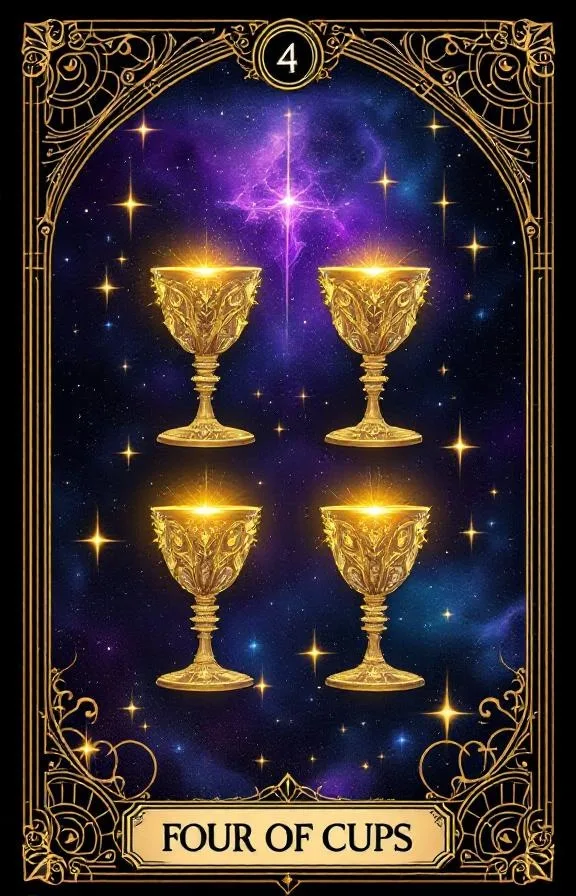
Nothing is wrong. That is the strangest part. Nothing is wrong, and you cannot make yourself care about any of the things that used to matter. The offers are still on the table. The people are still there. But something inside you has gone quiet in a way that feels less like peace and more like a signal dying. The Four of Cups as feelings is that flat, gray emotional state where everything available looks insufficient and nothing absent seems worth pursuing.
The core feeling
Apathy gets a bad reputation, but the emotional state the Four of Cups describes is more nuanced than simple laziness or indifference. This is active disengagement — the psyche pulling back from available options because none of them resonate with something deeper that the person cannot name. Existential psychologist Irvin Yalom wrote extensively about what he called "the confrontation with meaninglessness," and the Four of Cups captures the emotional aftermath of that confrontation: a person sitting with their feelings in a way that looks passive from the outside but is actually a form of refusal.
Three cups sit before the figure in this card. A fourth is offered by a hand emerging from a cloud. The figure ignores all of them. The critical question is not why they are refusing what is offered — it is what they are waiting for instead. The feeling is not emptiness but dissatisfaction so deep that it has eaten through the person's ability to respond to ordinary pleasures.
This is not depression, though it can look identical from the outside. Depression typically involves a loss of capacity to feel. The Four of Cups involves a loss of interest in what is available to feel about. The mechanism is different. The result, unfortunately, can look the same.
Four of Cups upright as feelings
Upright, the Four of Cups represents emotional withdrawal in its most deliberate form. The person has looked at what life is offering — relationships, opportunities, pleasures — and found all of it wanting. Not terrible. Not painful. Just... not enough. The emotional equivalent of scrolling through hundreds of streaming options and closing the app because nothing appeals.
The felt experience is peculiar. A flatness that does not hurt but does not feel good either. Conversations happen and the person participates adequately without being present. Meals taste fine. Sleep comes. Everything functions. But the animating spark that makes functioning feel worthwhile has gone somewhere the person cannot follow.
What makes this particularly difficult to address is that the person often cannot explain what they want instead. They know the current options are insufficient. They cannot describe what sufficiency would look like. Ask them what would make them happy and they will stare at you with genuine bewilderment because the question itself feels wrong — not unanswerable, but irrelevant.
Four of Cups reversed as feelings
Reversed, something shifts. The apathy begins to crack, and what comes through the cracks is not happiness exactly — it is curiosity. The person starts glancing at the fourth cup, the one they had been ignoring. A possibility they dismissed begins to look less impossible. An invitation they would have declined a week ago gets a second thought.
The reversed Four of Cups can also signal the painful recognition that apathy was serving a protective function. The person was not merely disinterested — they were hiding from engagement because engagement requires vulnerability, and vulnerability had burned them before. As the apathy lifts, the feelings it was suppressing begin to surface, and they are not all comfortable. Relief mixed with grief mixed with the embarrassment of realizing how long they spent refusing to feel.
Sometimes the reversal is less dramatic. The person simply gets bored with being bored. Apathy, sustained long enough, becomes its own form of suffering — and the desire to escape that suffering provides exactly the motivation the upright card was missing.
Four of Cups as feelings in love
In love readings, the Four of Cups is the card nobody wants to see but many need to understand. When it represents someone's romantic feelings, it signals emotional flatness toward available options — including, potentially, their current partner. They are not angry. They are not preparing to leave. They are just present in the relationship without being invested in it, and that passive non-investment can be more damaging than active conflict.
When this card shows up as someone's feelings toward you specifically, the honest read is that they are not emotionally engaged. Not hostile, not turned off — just not turned on either. You are one of the cups on the ground that they are staring past. Harsh but useful: knowing someone is indifferent allows you to make decisions based on reality rather than hope.
For existing relationships, the Four of Cups is a warning more than a verdict. The apathy is real but rarely permanent. Couples therapists see this pattern constantly — partners who have stopped being curious about each other and started coexisting. The fix is usually not grand gestures but small disruptions to routine. Novelty, however minor, breaks the seal.
Four of Cups as feelings about you
When the Four of Cups describes someone's feelings about you, you are not causing their emotional withdrawal — you are simply failing to break through it. They are in a state where nothing and nobody registers with full impact. Your texts get read and answered adequately. Your presence is tolerated without being sought. You exist in their emotional landscape as furniture: functional, unremarkable, possibly moved past without notice.
This is not personal, which somehow makes it worse. Being disliked at least means you made an impact.
Four of Cups as feelings in career
In professional contexts, the Four of Cups is burnout without the drama. The person shows up, delivers acceptable work, meets deadlines, and feels absolutely nothing about any of it. They are not suffering in a way that demands attention — they are simply absent from their own professional life in a way that slowly corrodes both their output and their self-concept.
The particular danger here is that apathy in career settings can be self-reinforcing. Disengagement leads to mediocre work, which leads to fewer interesting opportunities, which deepens the disengagement. The person knows intellectually that they need to re-engage. Knowing does not produce the feeling. That gap between knowledge and motivation is where the Four of Cups lives permanently.
Frequently asked questions
What does Four of Cups mean as feelings?
The Four of Cups represents emotional apathy and withdrawal — a state where available options, relationships, and opportunities fail to generate genuine interest or engagement. The person feels flat rather than actively unhappy, disconnected from the things that should matter to them.
Does Four of Cups represent positive or negative feelings?
Predominantly challenging. Upright, it signals disengagement and emotional flatness that can strain relationships and stall personal growth. Reversed, the energy shifts toward tentative re-engagement — the apathy is beginning to lift and curiosity is returning. Neither position indicates malice or hostility; the emotional challenge is indifference rather than antagonism.
What does Four of Cups reversed mean as someone's feelings?
Someone feeling the reversed Four of Cups is emerging from a period of emotional shutdown. They are beginning to notice options they previously ignored, including potentially you. Their interest is returning gradually rather than explosively — do not expect sudden passion, but the fact that they are re-engaging at all signals meaningful internal change.
Curious what Four of Cups means as feelings in YOUR situation? Try a free AI tarot reading and explore the emotional landscape of your cards.
