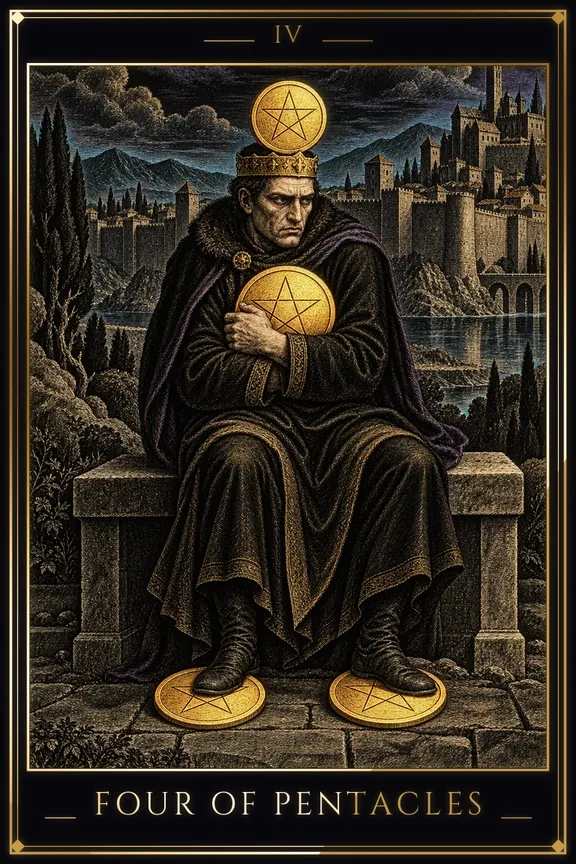
The grip tightens before the person even realizes they are gripping. That is the first thing to understand about the Four of Pentacles as feelings. The possessiveness this card describes does not announce itself with a villain's monologue. It arrives disguised as love, as protection, as reasonable concern — and by the time anyone notices the white knuckles, the pattern is already entrenched.
The core feeling
Possessiveness gets dismissed as a character flaw, but that framing misses what is actually happening emotionally. At its root, possessiveness is fear wearing the costume of control. The person is not trying to dominate — they are trying to prevent loss. Every tightened boundary, every jealous question, every refusal to share is an attempt to stop something valuable from slipping away.
John Bowlby's attachment theory, developed through decades of clinical observation, describes how early experiences of loss or inconsistent care create adults who grip tightly to what they have. The anxiously attached person does not cling because they want power over their partner. They cling because somewhere deep in their nervous system, a alarm keeps firing: this could disappear. You could wake up alone. Hold on tighter.
The Four of Pentacles captures this emotional logic perfectly. The figure on the card is not hoarding for the pleasure of having. They are hoarding because letting go feels like dying. That is not an exaggeration of the feeling. It is the feeling.
Four of Pentacles upright as feelings
Upright, the Four of Pentacles shows someone who has closed their hands around what they have and cannot bring themselves to open them. Their feelings are genuine and often intense, but they express them through control rather than generosity. Love becomes surveillance. Care becomes restriction. The person monitors where their partner goes, who they talk to, how much attention they give to others — not because they are cruel, but because every variable they cannot control represents a potential exit.
There is also a version of this card that has nothing to do with relationships. Sometimes the Four of Pentacles describes the emotional experience of financial anxiety — the feeling of holding money so tightly that spending anything, even on necessities, produces a visceral wave of dread. The person knows intellectually that they have enough. The feeling insists they do not.
What makes this card painful rather than villainous is the self-awareness that often accompanies it. Many people experiencing Four of Pentacles energy know they are doing it. They can see themselves clutching. They just cannot stop. The fear of loss overrides the knowledge that the clutching itself is causing the very thing they dread.
Four of Pentacles reversed as feelings
The reversal brings two very different possibilities, and context determines which one applies. The first: the person has begun to release their grip. They are learning, slowly and with great discomfort, that holding on so tightly was suffocating the thing they loved. The possessiveness is loosening, and what replaces it feels terrifying and free in equal measure.
The second possibility is darker. The reversed Four can indicate possessiveness that has escalated. The grip has not loosened — it has become desperate. The person has crossed the line from protective to controlling and may not be able to find their way back without intervention. Boundaries are not just tight. They are walls.
Between these extremes lies a third common experience: the person has lost what they were holding onto and now feels the specific emptiness of open hands that were recently full. They do not know how to be without the thing they structured their entire emotional life around protecting.
Four of Pentacles as feelings in love
In romantic readings, the Four of Pentacles is one of the most polarizing cards. It almost always indicates strong feelings. The person cares. Deeply. The problem is not the caring — it is the way caring has mutated into control.
When this card represents someone's feelings about you, they are emotionally invested in a way that may feel flattering at first and suffocating later. They want you close. Always close. They track your moods like weather systems, not out of empathy but out of a need to predict whether you are pulling away. Every late reply becomes evidence. Every new friendship becomes a threat.
Here is the opinion that will not be popular: some amount of possessiveness is normal and even healthy in committed relationships. The problem starts when it becomes the primary emotional mode — when the person cannot feel love without simultaneously feeling fear, and cannot feel fear without reaching for control. The Four of Pentacles marks the point where that cycle has become the relationship's defining pattern.
Four of Pentacles as feelings about you
If someone holds Four of Pentacles feelings about you, you have become essential to their sense of security. That is significant. But it also means they may resist your growth, your independence, or any change that shifts the dynamic they have organized their emotional life around.
You might feel both loved and trapped — adored in ways that leave no room for movement. Their feelings are not fake. They are just shaped by fear into something that can feel more like a cage than an embrace.
Four of Pentacles as feelings in career
At work, this card describes feelings of territorial defensiveness. The person guards their role, their projects, their status with the energy of someone who believes that sharing credit means losing value. They may hoard information, resist delegation, or react disproportionately to changes in team structure.
Underneath the professional armor is usually a person who has been made redundant before, or who grew up in an environment where resources were scarce and sharing meant going without. The workplace behavior is a survival strategy imported from a context where it once made sense. Understanding that does not excuse it. It does explain it.
Frequently asked questions
What does Four of Pentacles mean as feelings?
The Four of Pentacles represents possessive, fearful attachment — feelings rooted in a deep terror of loss. The person cares intensely but expresses that care through control, holding tightly to people or situations rather than trusting that what is theirs will stay.
Does Four of Pentacles represent positive or negative feelings?
The feelings themselves are intense and real, but their expression tends toward the negative. Upright, possessiveness restricts both the holder and the held. Reversed, there is either a painful but healthy releasing of control or a worsening of the grip. The card challenges the person to ask whether love and fear have become the same thing in their emotional vocabulary.
What does Four of Pentacles reversed mean as someone's feelings?
Reversed, someone is either learning to let go of their need to control — which feels vulnerable and frightening — or they have lost grip entirely and are dealing with the emotional fallout of open hands. In rarer cases, the reversal signals possessiveness that has intensified beyond what upright could contain.
Curious what Four of Pentacles means as feelings in YOUR situation? Try a free AI tarot reading and explore the emotional landscape of your cards.