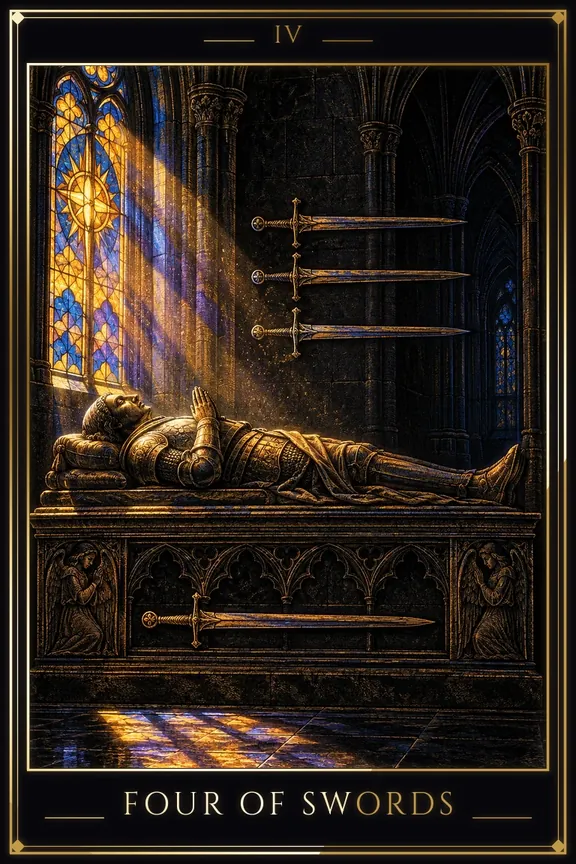
They canceled plans again. Not because something came up. Because nothing came up, and that was the point. The Four of Swords person needs stillness the way most people need noise — desperately, protectively, with a conviction that the rest of the world finds baffling. They are not lazy. They are recovering from something you probably cannot see.
The personality profile
The Four of Swords person has learned, usually through exhaustion or breakdown, that withdrawal is not weakness. It is strategy. While the culture rewards constant motion — hustle, grind, network, engage, produce — this person has discovered that their best thinking, their best work, and their best self emerge only after silence. Extended silence. The kind that makes other people nervous.
This is someone with a rich interior life that they protect fiercely. Their inner world is not an escape from reality. It is where they do their most important processing. While extroverts think by talking and Type A achievers think by doing, the Four of Swords person thinks by disappearing. They retreat into solitude the way a blade retreats into a sheath — not because it is no longer sharp, but because sharpness without rest destroys the edge.
There is always a backstory. Nobody becomes this deliberate about rest without first learning what happens when rest is neglected. The Four of Swords person has usually pushed themselves past a breaking point at least once — a burnout, a health scare, a period of such sustained mental pressure that their body or mind simply refused to continue. That experience reshaped their relationship with productivity permanently.
Four of Swords upright as a person
Upright, this person has achieved something rare: genuine comfort with stillness. They can sit in a room alone for hours and emerge refreshed rather than restless. They do not fill silence with chatter or fill time with activity for its own sake. They are intentional about where their energy goes, and they have learned that saying no to most things is how they say a profound yes to the few things that matter.
Their calm is contagious. Being around the upright Four of Swords person lowers your heart rate. They speak deliberately. They listen without formulating their response while you are still talking. When they give you advice, it carries weight because you know it was not produced reactively — it was considered, turned over, examined from multiple angles during one of their long quiet mornings.
Herbert Benson, the Harvard cardiologist who pioneered research into the relaxation response, demonstrated that deliberate stillness produces measurable physiological changes: reduced cortisol, lower blood pressure, improved immune function. The Four of Swords person lives this research without having read it. Their body taught them what the science later confirmed.
Four of Swords reversed as a person
Reversed, the retreat becomes a hiding place. This person is not recharging. They are avoiding. The silence they cultivate is not restorative but defensive — a way to dodge the demands of life by pretending they have transcended those demands.
The reversed Four of Swords person sleeps too much. Cancels too often. Describes their isolation as self-care while the dishes pile up and the emails go unanswered. They have confused withdrawal with healing and stagnation with peace.
There is often depression underneath the spiritual language. The reversed Four of Swords person may frame their withdrawal in terms of mindfulness or introversion or boundary-setting, but the truth is simpler and sadder: they are exhausted, and the stillness that once restored them has become a place they cannot leave. The sheath has become a coffin.
Four of Swords as a person in love
In romantic relationships, the Four of Swords person needs a partner who understands that their need for solitude is not a rejection. This is the most critical thing. When they close the door to their study or go for a walk alone or sit in the car for ten minutes before coming inside, they are not running from the relationship. They are maintaining the internal equilibrium that allows them to be present when they return.
The partner who panics at their withdrawal — who texts "are you okay?" three times in an hour, who interprets silence as anger — will exhaust them rapidly. The partner who trusts the retreat and welcomes the return will discover something remarkable: a person who is fully present because they took the time to arrive fully. Their attention, when they give it, is complete. Undivided. Worth waiting for.
They are not passionate in the dramatic sense. Grand gestures exhaust them. What they offer instead is steadiness. The 11 PM cup of tea brought without being asked. The hand on your back when you did not know you needed it. Love expressed through quiet acts of maintenance rather than fireworks.
Four of Swords as a person at work
Professionally, they produce their best work in environments that respect deep focus. Open offices with constant interruption will break them. Give them a closed door, a clear brief, and enough time, and they will deliver something exceptional — precisely because they did not try to do it while simultaneously answering Slack messages and attending a meeting about a meeting.
They are not leaders in the visible sense. They are not the person giving the presentation. They are the person who prepared the thinking that made the presentation possible.
Four of Swords as someone in your life
If you have a Four of Swords person in your life, the greatest gift you can offer is patience with their rhythm. Their pace is slower than yours. Not because they are less capable, but because they are unwilling to sacrifice quality of thought for speed of output. When they re-emerge from a period of quiet, meet them without reproach. Ask what they discovered in the silence. You might be surprised by the depth of the answer.
Frequently asked questions
What kind of person does the Four of Swords represent?
The Four of Swords represents a monk-like personality — someone who has learned that stillness and withdrawal are essential to their mental health and creative functioning. They are deliberate, contemplative, and deeply self-aware about their own need for rest.
Is the Four of Swords as a person positive or negative?
Upright, strongly positive. In a culture obsessed with constant productivity, this person models a sustainable relationship with work and rest that most people desperately need. Reversed, their healthy withdrawal can become avoidance, isolation, or depression disguised as mindfulness.
How do you recognize a Four of Swords person?
They cancel plans without guilt. They have a space in their home that is unmistakably theirs — a reading chair, a meditation corner, a workshop nobody else is invited into. They speak less than most people but say more when they do. Their phone is frequently on silent.