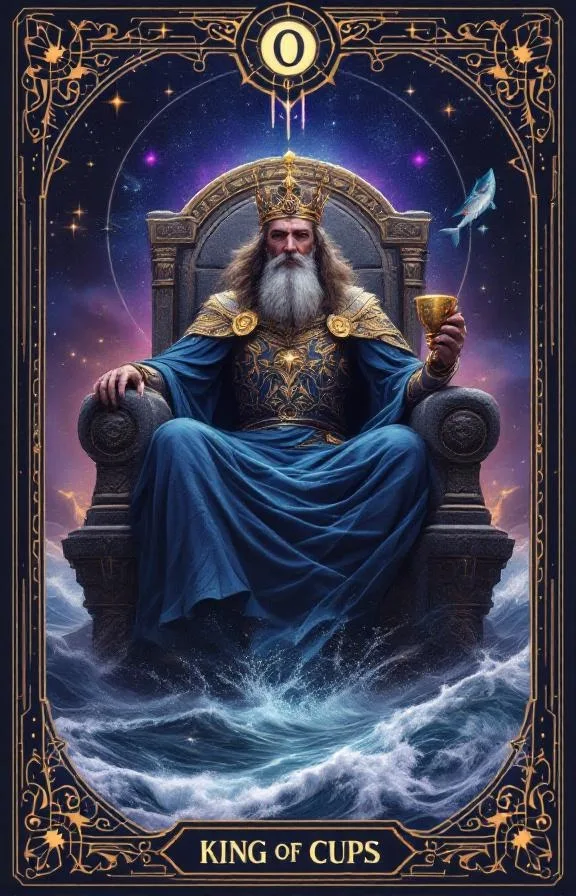
A king sits on a throne surrounded by turbulent water. His expression is calm. The ocean around him is not. That contrast is the entire lesson — the King of Cups does not control his emotions by eliminating them. He controls his response to them by experiencing them fully while acting with deliberate composure. Your reading produced this card because a situation in your life requires exactly that combination.
The advice
Lead with compassion. For others. For yourself. Even when — especially when — the waters are rough.
The King of Cups is the card of emotional maturity, which is a phrase people use without examining what it actually means. It does not mean feeling less. It does not mean staying calm because nothing bothers you. It means feeling the full weight of a situation and choosing your response instead of being chosen by your reaction.
This is hard. It is supposed to be hard. The King sits on that throne not because emotional mastery is easy but because he has practiced it until the practice became reliable. The turbulent water is not decorative. It represents genuine emotional intensity — anger, grief, fear, love — that the King feels deeply and expresses wisely. Not suppresses. Expresses wisely. The distinction between wisdom and suppression is the entire curriculum of this card.
Psychologist Daniel Goleman popularized the concept of emotional intelligence, and the King of Cups is its embodiment. The advice is to bring that intelligence into whatever challenge you are facing. Not cold logic. Not raw emotion. The sophisticated integration of both that allows you to be simultaneously honest about how you feel and strategic about what you do with that honesty.
King of Cups upright advice
Upright, the King says you have the emotional resources to handle this situation. Whatever it is. The question is not whether you are capable but whether you will deploy your capability.
The specific advice: lead. Not from authority. From understanding. The people around you — in your family, your workplace, your community — need someone who can hold space for complexity without crumbling. Who can hear difficult truths without becoming defensive. Who can make hard decisions without losing empathy for the people affected by those decisions. The King of Cups upright says you are that person right now.
Practically, the card advises diplomacy in its truest form. Not the kind that avoids conflict but the kind that navigates it with respect for everyone involved. If there is a dispute that needs resolving, approach it seeking understanding before seeking resolution. If there is a conversation you have been avoiding because it will be emotionally charged, have it — but have it the way the King would. Present, grounded, feeling everything, expressing it with precision rather than explosion.
The upright King also carries a warning about stoicism. There is a point where composure becomes performance and the performance costs more than the vulnerability would. If you are maintaining a calm exterior while your interior is in crisis, the card does not congratulate you. It asks who you are protecting with the performance, and whether that protection is worth the isolation it creates.
King of Cups reversed advice
Reversed, the King has lost his balance. The emotional waters are winning.
This can manifest as emotional volatility — outbursts, mood swings, reactions disproportionate to their triggers. The reversed King of Cups is the person who is normally composed suddenly losing it over something trivial, because the trivial thing was the last grain on a scale that had been tipping silently for months. The advice is not to suppress the outburst but to address what has been accumulating underneath it.
Alternatively, the reversal can indicate emotional manipulation. The King's emotional intelligence is powerful, and power misused becomes control. If you have been using your understanding of others' feelings to manage outcomes rather than support people — reading the room to gain advantage rather than connection — the reversed card says stop. Emotional intelligence as a weapon degrades the person wielding it as much as the people it is aimed at.
There is a third reading: burnout. The King of Cups reversed often appears in people who have been the emotional anchor for everyone around them for too long. The reserves are empty. The composure is artificial. The compassion has run out, replaced by exhaustion wearing a compassion mask. If this resonates, the card says step down from the throne temporarily. You cannot lead others when you have not attended to yourself. Take the rest. It is not abdication. It is maintenance.
King of Cups advice in love
In love, the King of Cups advises emotional leadership, which sounds clinical until you realize what it actually looks like: being the first person in the relationship to say the hard truth, extend forgiveness, or name the elephant in the room.
For couples, the card says one of you needs to be the mature one right now. Not permanently — that would be exhausting and unfair — but in this specific moment, someone needs to step above the conflict and address it with compassion rather than competition. The King of Cups says it is your turn. Not because you are right and they are wrong. Because you are capable and the situation requires capability.
For singles, the King advises choosing partners based on emotional depth rather than surface compatibility. The person who makes you laugh is great. The person who can sit with you while you cry, without trying to fix it, without becoming uncomfortable, without making it about them — that person is rare and worth the search.
The card also speaks to emotional availability in its most demanding form. Being emotionally available does not mean being permanently open to everyone. It means being genuinely present with the specific person in front of you, with the full weight of your attention and feeling. Most people are physically present and emotionally elsewhere. The King of Cups says that is not enough.
King of Cups advice in career
The King of Cups in career readings describes a leadership style that most organizations desperately need and systematically undervalue.
If you manage people, the card advises leading through emotional connection rather than hierarchical authority. Know your team as people, not as functions. Understand what motivates each individual, what frightens them, what they need to feel valued. This is not soft management — it is effective management. Teams led by emotionally intelligent leaders outperform teams led by purely strategic ones. The data on this is not even close.
For professionals navigating toxic workplace dynamics — passive-aggressive colleagues, emotionally volatile bosses, the specific exhaustion of maintaining composure in environments that reward dysfunction — the King says set the example you wish the environment modeled. You cannot change a toxic culture alone. But you can create a pocket of emotional health around yourself that others gravitate toward.
Career decisions — promotions, transitions, negotiations — benefit from the King's balanced approach. Feel the ambition, the fear, the excitement, the anxiety. Let all of those inform the decision. Then make the decision from the integrated whole rather than from whichever feeling is loudest. The King of Cups makes decisions from center, not from edge.
If you are considering a career in counseling, mediation, diplomacy, or any field that requires navigating other people's emotional landscapes professionally, the King strongly supports that direction. Your emotional intelligence is not just a personality trait. It is a professional qualification.
Action steps
- Respond instead of reacting today. When something triggers an emotional response, pause for three breaths before expressing it. Not to suppress the feeling. To choose how you communicate it.
- Have the conversation you have been avoiding. The one that requires emotional maturity from both sides. Approach it seeking to understand before seeking to be understood.
- Check on someone you lead. A direct report, a family member, a friend who looks up to you. Not about deliverables. About them. "How are you, really?" and then actually listen.
- Admit one vulnerability to someone who sees you as strong. The King of Cups knows that strength and vulnerability are not opposites. They are partners. Showing that you feel deeply does not undermine your authority. It humanizes it.
- Set one emotional boundary. Even kings need limits. Identify where your emotional labor exceeds your emotional capacity and draw a line. Communicate it clearly, without apology.
FAQ
Does the King of Cups mean I need to stay calm all the time?
No. Staying calm all the time is not emotional maturity — it is emotional suppression, and the reversed King of Cups specifically warns against it. The card advises feeling fully while choosing your expression deliberately. Sometimes the deliberate choice is to express anger, grief, or frustration openly. The King is not emotionless. He is emotionally sovereign. The difference is between "I cannot feel this" (suppression) and "I choose how to express this" (mastery). The second one is what the card recommends.
What if I do not feel qualified to be the emotionally mature one?
Nobody does. That is the uncomfortable secret the King of Cups holds. Emotional maturity is not a qualification you earn and then possess permanently. It is a decision you make in each moment, and some moments you fail at it. The card is not asking you to become an emotional master overnight. It is asking you to take one step in that direction in the situation currently in front of you. Respond with slightly more composure than your impulse suggests. Extend slightly more compassion than feels natural. The "slightly" compounds over time into the sovereignty the King represents.
How is the King of Cups different from the Queen of Cups as advice?
The Queen advises emotional depth — feeling fully, trusting your emotional intelligence, allowing sensitivity to inform your decisions. The King advises emotional governance — taking those deep feelings and translating them into effective action, leadership, and communication. The Queen sits with the cup in contemplation. The King holds the cup while governing a kingdom. Both involve emotional mastery. The Queen's mastery is internal. The King's mastery is the externalization of that internal work — bringing emotional intelligence into the world of decisions, relationships, and leadership in a way that influences outcomes.