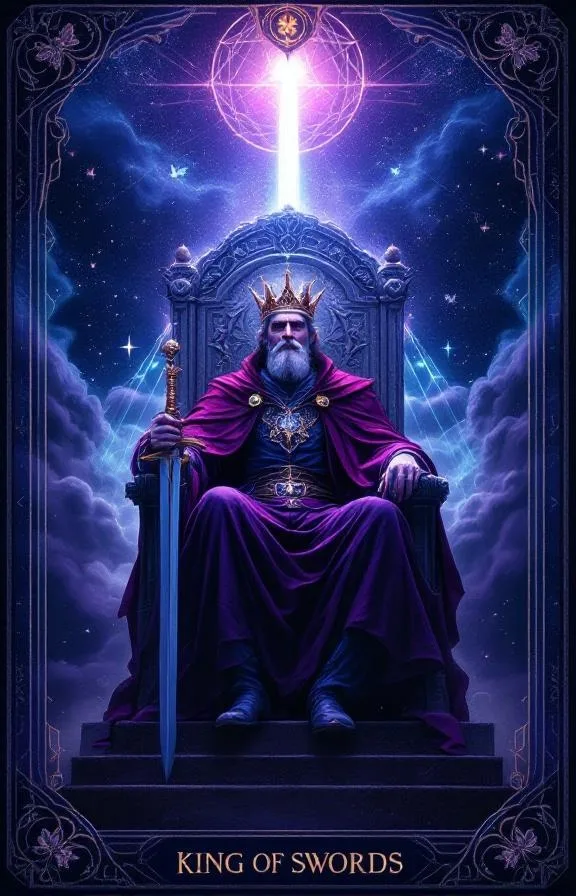
Remove your feelings from the equation. Not permanently. Not because they do not matter. Because right now, in this situation, your feelings are clouding a judgment that needs to be clear. The King of Swords sits on his throne with a sword held upright — not drawn for battle but raised as a symbol of fair, dispassionate authority. He has opinions. He has emotions. He does not let them make his decisions.
The advice
Judge the situation on its merits. Strip away the emotional narrative — the anger, the attachment, the fear, the hope — and look at what remains. What are the facts? What does the evidence actually support? If you removed your personal investment from this situation entirely and evaluated it the way a wise outsider would, what would that person conclude?
The King of Swords as advice appears when your emotional involvement is compromising your judgment. You are too close to see clearly. Too hurt to be fair. Too hopeful to be realistic. Too angry to be measured. The card is not criticizing you for having these feelings. It is telling you that this particular decision cannot be made from inside them.
This is the hardest version of the swords' advice to follow, because the King asks you to do something most people find deeply unnatural: override your emotional response with your rational one. Not suppress the emotions. Override them. Feel the anger and choose the fair response anyway. Feel the attachment and make the clear-eyed assessment anyway. Feel the fear and proceed based on evidence rather than anxiety anyway.
The King of Swords represents the highest expression of mental authority — the ability to think clearly under emotional pressure. He does not achieve this by being cold. He achieves it by being disciplined. The feelings are present. The discipline is in not handing them the steering wheel.
King of Swords upright advice
Upright, the King advises you to act as the ultimate authority in your own life. Not with arrogance, but with the quiet certainty of someone who has earned the right to trust their own judgment. You have the experience, the intelligence, and the information to make this call. Make it.
The King does not seek consensus for decisions that are his to make. He does not outsource his judgment to committees, polls, or the court of popular opinion. If you have been waiting for someone else to tell you what to do — a parent, a partner, a boss, a therapist — the King of Swords says: you already know. Trust your assessment. Act on it.
The upright King also advises fairness above all else. Whatever you are judging — a person, a situation, a conflict between others — evaluate it by consistent standards. Do not make exceptions for people you like. Do not apply harsher criteria to people you dislike. Fairness means the same rules for everyone, including yourself.
Philosopher John Rawls proposed the "veil of ignorance" — imagining you are designing a system without knowing what position you would hold within it. The King of Swords operates behind this veil naturally. His advice is not "what outcome benefits me?" but "what outcome is just?" These are different questions, and the willingness to ask the second one when the first one would be easier is what separates the King from the Knight.
King of Swords reversed advice
Reversed, the King of Swords warns about the corruption of intellectual authority. The reversed King uses his sharp mind to rationalize what he wants rather than to determine what is right. Every conclusion he reaches happens to align with his self-interest. Every analysis confirms his existing position. This is not thinking — it is confirmation bias with a PhD.
If the reversed King describes your current approach, the advice is to check your reasoning for motivated thinking. Are you building an argument or seeking the truth? There is a difference, and the reversed King has stopped recognizing it. He can construct a bulletproof logical case for almost anything, which means his conclusions are only trustworthy when he is genuinely open to being wrong. And the reversed King is never open to being wrong.
The reversed position also warns against using intellectual superiority as a dominance tool. Correcting people publicly, dismissing ideas with cutting precision, winning arguments through verbal intimidation rather than genuine persuasion — these are the reversed King's specialties, and they erode trust and relationships as effectively as any blunt cruelty.
Additionally, the reversed King can indicate a refusal to consider emotional data. Feelings contain information. The reversed King dismisses them categorically, and in doing so misses signals that his rational analysis alone cannot detect. The correction is not to become emotional but to recognize emotions as one valid input among several.
King of Swords advice in love
In relationships, the King of Swords offers the least romantic advice in the deck. And it might be exactly what you need.
If you are making a major relationship decision — whether to commit, whether to forgive, whether to leave — the King advises you to evaluate the relationship as it actually is, not as you wish it were. Remove the rose-tinted glasses. Remove the catastrophic glasses too. What is the factual track record of this relationship? Does this person's behavior align with their words? Are your needs being met consistently, not just in bursts of effort followed by decline?
This kind of assessment feels unloving, but the King argues it is the most loving thing you can do. For yourself and for the other person. Relationships built on accurate mutual assessment last. Relationships built on fantasy, projection, and wishful thinking collapse when reality intrudes — and reality always intrudes.
For couples in conflict: the King advises stepping back from the emotional dynamic and identifying the structural problem. Most recurring relationship conflicts are not emotional problems. They are structural ones — mismatched expectations, incompatible communication styles, unaddressed logistical issues. The King says: fix the structure. The emotions will follow.
For those dating: the King advises clarity about your standards and consistency in applying them. Not rigidity. Clarity. Know what you require, communicate it early, and do not negotiate on fundamentals. The King does not settle, and he advises you not to either.
King of Swords advice in career
The King of Swords is the ideal advisor for career decisions because he approaches them the way they should be approached: strategically, dispassionately, with full consideration of the facts and minimal interference from ego.
His career advice: make the decision you would recommend to someone else in your position. If your best friend described your exact professional situation and asked for advice, what would you tell them? The answer you give to that hypothetical is almost always clearer than the answer you give yourself, because distance enables objectivity. The King of Swords says: give yourself that distance.
For leaders and managers: the King advises leading through fairness and intellectual authority rather than through charm or force. Make decisions transparently. Explain your reasoning. Hold everyone — including yourself — to the same standards. The leader who plays favorites, even unintentionally, loses the moral authority that makes leadership effective.
For those in professional disputes: the King advises documentation. Not as a weapon but as a discipline. Record what was agreed, what was delivered, what was promised. When facts are documented, disputes resolve faster and more fairly. The King does not rely on memory — memory is unreliable. He relies on evidence.
If you are considering whether to take on a leadership role, the King of Swords says: yes, but only if you are prepared to make unpopular decisions based on what is right rather than what is easy. Leadership in the King's framework is not about being liked. It is about being trusted. And trust comes from consistency, fairness, and the willingness to say what no one wants to hear when it needs to be heard.
Action steps
- Evaluate one situation as if advising a stranger. Write a description of your current dilemma in the third person. "A person in this situation faces these options..." Then advise that person. The advice you give them is the advice you need.
- Apply the same standard to yourself. Identify one area where you hold others to a standard you do not meet yourself, or where you excuse your own behavior but criticize it in others. Correct the inconsistency.
- Make one decision based purely on evidence. Identify a pending decision where your feelings and your logic disagree. For this one decision, follow the logic. Observe the outcome.
- Document before discussing. Before your next important conversation — professional or personal — write down the key facts, your position, and the outcome you seek. Enter the conversation with this document as your guide rather than your emotions.
- Ask: "Is this fair?" Apply this question to one decision per day for a week. You will be surprised how many of your daily choices fail the fairness test when you examine them honestly.
FAQ
What does the King of Swords mean as advice?
The King of Swords as advice tells you to approach your situation with rational clarity, intellectual integrity, and fair judgment. The card appears when emotional involvement is clouding your ability to see the situation accurately. Its guidance is to temporarily set aside feelings — not dismiss them, but set them aside — and evaluate the facts. Make the decision a wise, impartial judge would make, even if it conflicts with what your emotions are urging.
Is the King of Swords telling me to ignore my feelings?
Not ignore — deprioritize temporarily. The King of Swords recognizes that feelings contain information but also recognizes that they can distort judgment when they are too intense. His advice is to feel your emotions, note them, and then make your decision based on a broader analysis that includes but is not dominated by emotional input. Think of it as adjusting the volume. Your feelings are part of the song. The King is telling you to turn down the emotional volume enough to hear the other instruments in the arrangement.
How do I develop the King of Swords' clarity of judgment?
Practice deliberate objectivity. When facing a decision, write down the emotional response and the rational assessment separately. Compare them. When they conflict, investigate why. The emotional response may be revealing something the rational assessment is missing, or the rational assessment may be correcting a distortion the emotional response is creating. Over time, this practice builds the capacity to hold both perspectives simultaneously — which is what the King of Swords does on his best days. It is not about choosing reason over feeling. It is about integrating both into a judgment that is fair, accurate, and wise.