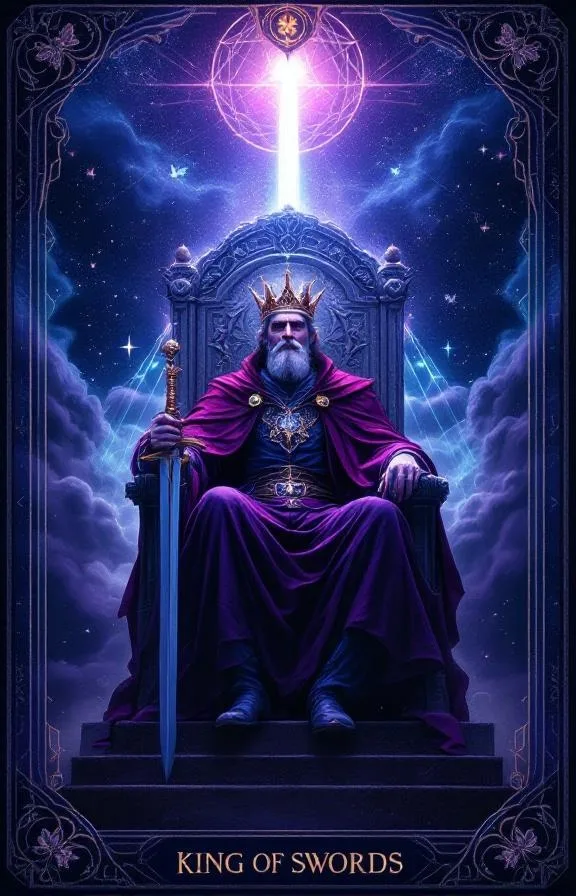
He does not raise his voice. He has never needed to. When the King of Swords person speaks, the room adjusts. Conversations pause. Phones go face down. Something about his presence — the stillness, the precision, the absolute certainty behind every sentence — communicates authority so completely that raising his voice would be redundant. He is the person you instinctively address when presenting to a group, even if he is not the highest-ranking individual in the room. You do this without knowing why. He knows exactly why.
The personality profile
The King of Swords person has achieved something most people cannot: the integration of intellectual power with ethical responsibility. They are not just smart. Many people are smart. They are principled in their intelligence — they use their mind in service of fairness, structure, and truth rather than personal advantage. This makes them, in the best expression, genuinely trustworthy authorities. In the worst expression, rigid ideologues who mistake their own perspective for universal law.
Their thinking is systematic. Where the Knight of Swords charges and the Page of Swords investigates, the King organizes. They build frameworks. They create hierarchies of priority. They can take a chaotic situation — a dispute, a project in freefall, an ethical dilemma — and impose order on it so cleanly that the solution appears inevitable, as though the chaos was always going to resolve this way and simply needed someone to point it out.
The word authority deserves scrutiny here. The King of Swords person's authority is not positional — it does not come from a title or a corner office. It is epistemic. People defer to them because they are usually, demonstrably, correct, and because their correctness is offered without ego. They do not need you to know they were right. They need the right outcome to occur. The credit is irrelevant.
King of Swords upright as a person
Upright, this person is the standard against which fair decision-making is measured. They listen to all sides before forming a judgment, and once the judgment is formed, they communicate it with such clarity that even the party who disagrees can understand the reasoning. They do not hide behind ambiguity. They do not hedge.
Their moral code is explicit and consistently applied. They hold themselves to the same standards they hold others to — and this consistency is what separates them from authoritarians, who impose rules they themselves do not follow. The upright King of Swords person would rather lose a debate honestly than win one through manipulation, and this preference is not a performance. It is structural to who they are.
In groups, they naturally assume the role of arbiter. People bring disputes to them. Not because they are always gentle — they are frequently not gentle at all — but because their verdicts are fair. They will tell you something you do not want to hear, and you will grudgingly accept it because you know it was arrived at honestly.
Their emotional register is narrow but deep. They do not express affection easily. They do not laugh at things they do not find genuinely funny. They do not compliment unless the compliment is earned. This austerity makes their rare expressions of warmth extraordinarily meaningful. A "well done" from the King of Swords person is worth a hundred casual compliments from anyone else.
King of Swords reversed as a person
Reversed, the authority becomes authoritarian. The principle becomes rigidity. The fair-minded judge becomes a tyrant who has confused their own perspective with objective truth and their own preferences with universal standards.
The reversed King of Swords person does not collaborate. They dictate. They present their conclusions as facts and their opinions as laws. Dissent is not debated — it is dismissed, categorized as ignorance or disloyalty, and filed away as evidence of the dissenter's inadequacy.
Their intelligence, which upright serves justice, now serves control. They use logic as a weapon — constructing arguments so airtight that disagreement becomes practically impossible, not because the argument is correct but because the person constructing it has more rhetorical skill than the person challenging it. They win by structural advantage and call it truth.
The family version of the reversed King is the patriarch who rules through intellectual intimidation. Whose dinner-table opinions cannot be challenged because challenging them produces a debate the challenger cannot win, not on substance but on skill. Whose children learn to perform agreement rather than risk the dismantling of their position.
John Stuart Mill warned that the greatest threat to liberty was not tyranny by rulers but "the tyranny of the prevailing opinion." The reversed King of Swords person is this tyranny personified — not a despot with an army, but an intellect so dominant that alternative viewpoints wither in its presence, not because they lack merit but because they lack the rhetorical armor required to survive the encounter.
King of Swords as a person in love
In love, the King of Swords person is steady, protective, and emotionally reserved. They show devotion through structure rather than spontaneity — through the reliability of their presence, the consistency of their standards, the way they create an environment where their partner can thrive because the chaos has been managed, the decisions have been made, the path has been cleared.
Emotional intimacy is their weakest area. They can discuss feelings analytically — they can name the emotion, trace its origin, evaluate its validity — but they struggle to simply feel with another person without processing the experience through their intellectual framework first. Their partner may sometimes feel that they are being understood rather than felt, known rather than met.
The relationship works when the partner brings warmth the King cannot generate alone. Not emotional performance. Genuine warmth that the King can receive without it triggering their analytical reflex. The right partner teaches the King of Swords that some experiences are diminished by being understood and enriched by being surrendered to.
King of Swords as a person at work
This is their natural domain. The King of Swords person in a professional context is simply operating at full capacity. They set clear expectations, provide honest feedback, make difficult decisions without excessive agonizing, and build teams that function with the kind of disciplined clarity that other managers envy and cannot replicate.
They are the leader people respect rather than love. Their teams produce excellent work because the standards are unambiguous and the consequences for failure are fair. This is leadership without charisma — leadership through competence, clarity, and an unwavering commitment to doing things correctly.
King of Swords as someone in your life
If you have a King of Swords person in your life, understand that their reserve is not disinterest. Their standards are not criticism. Their silence is not withdrawal — it is processing.
Challenge them intellectually and they will respect you. Challenge them emotionally and they will struggle. Not because they do not care, but because emotional challenge requires a kind of surrender that their personality has spent a lifetime learning to resist.
The most important thing to know about the King of Swords person is also the easiest thing to miss: underneath the formidable exterior, they are profoundly lonely. Authority is isolating. Being the person everyone turns to for judgment means being the person who never gets to be judged — never gets to be uncertain, confused, wrong, messy, human. If you can see through to that loneliness without making a production of it, without turning it into a project, you will have given them something almost nobody else has offered. Permission to put the sword down.
Frequently asked questions
What kind of person does the King of Swords represent?
The King of Swords represents an authority — someone who integrates intellectual power with ethical principle to become a natural leader and arbiter. They think in systems, communicate with precision, and are trusted to make fair judgments because they consistently do.
Is the King of Swords as a person positive or negative?
Upright, deeply positive. Few archetypes in the tarot represent such a reliable combination of intelligence and integrity. Reversed, the same qualities produce a controlling, intellectually domineering personality who uses logic as a tool of power rather than justice.
How do you recognize a King of Swords person?
People instinctively defer to them in group settings, even when someone else holds the formal authority. They speak with precision and never say more than necessary. They hold eye contact comfortably. Their approval is rare enough to be memorable. Their disapproval, delivered quietly, lands harder than most people's anger.