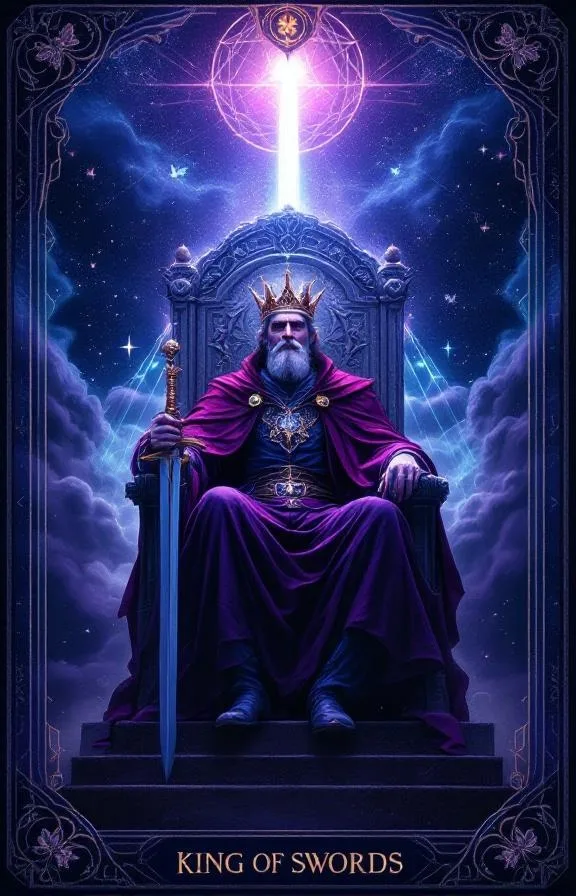
He sits upright. Sword vertical. Eyes forward. Nothing about his posture suggests warmth, but nothing about it suggests cruelty either. He has simply removed his feelings from the equation — or appears to have — and what remains is judgment stripped to its essential structure: fair, clear, and absolutely unsentimental. The King of Swords as feelings is the emotional experience of detachment, which is a far more complicated feeling than most people assume.
The core feeling
Detachment is not the absence of feeling. This is the single most important thing to understand about the King of Swords. The person experiencing this card's energy feels everything. They feel anger, desire, sadness, affection. But they have developed the ability — through practice, temperament, or necessity — to observe their feelings without being governed by them. The emotion arrives. They note it. They do not act on it until they have assessed whether acting would be wise.
This sounds admirable on paper. In practice, it produces a profound loneliness that the detached person rarely admits to. They stand apart from their own inner life, watching it like weather from behind glass. The storm is real but it is happening to someone else — a version of themselves they have placed at one remove. The distance is protective and also isolating, because the people around them interpret it as indifference when it is actually the most disciplined form of caring the person knows how to practice.
Stoic philosopher Epictetus argued that it is not events that disturb us but our judgments about events. The King of Swords has internalized this principle so completely that he sometimes forgets it has a cost. The cost is spontaneity. The cost is the occasional moment of unguarded joy. The cost is being known.
King of Swords upright as feelings
Upright, the King of Swords represents someone whose emotional life is run by their intellect. They have clear principles. They apply those principles consistently. Their feelings, when they emerge, are measured against a framework of values and logic before they are allowed to influence behavior. This produces a person who is remarkably fair, consistently rational, and difficult to get close to.
Their emotional experience is structured. Where other people have feelings that sprawl, overlap, and contradict each other in real time, the King of Swords sorts his. This is anger and it is justified. This is attraction and it is inconvenient. This is grief and it will be processed on schedule. The system works. It also misses things that only unstructured feeling can catch — intuitive leaps, irrational bonds, the mess and magic of emotional life lived without a manual.
There is authority in this emotional position. People trust the King of Swords' judgment precisely because it is not contaminated by personal feeling. He will give you the honest assessment. He will make the hard call. He will not spare your feelings, not because he enjoys causing pain but because he considers false comfort a form of disrespect. The truth, in his emotional calculus, always outranks kindness.
King of Swords reversed as feelings
Reversed, the King's detachment warps. The distance from his own feelings, which upright served as wisdom, now manifests as something colder. He is not observing his emotions. He is suppressing them. The difference is crucial: observation acknowledges what is there and chooses a response. Suppression pretends there is nothing to acknowledge.
The reversed King of Swords can manifest as emotional tyranny — someone who imposes their intellectual framework on others' feelings, dismissing grief as weakness, labeling vulnerability as manipulation, demanding that everyone around them process emotions with the same clinical efficiency they use themselves. This is not fairness. This is control wearing fairness as a costume.
Another reversal pattern is the collapsed facade. The person has maintained detachment for so long that they have lost access to their actual emotional responses. They know what they should feel. They cannot locate what they do feel. Therapy becomes an exercise in archaeology — digging for affect that was buried so long ago the person no longer remembers what prompted the burial. When the feelings finally surface, they are often disproportionate, explosive, and terrifying to a person whose identity is built on composure.
King of Swords as feelings in love
In romantic readings, the King of Swords as feelings presents a paradox. The person cares about you. They may even love you. But their love will never look the way you expect it to if you are expecting grand gestures, emotional declarations, or the beautiful chaos of being swept away. King of Swords love looks like reliability. It looks like showing up. It looks like making rational decisions that prioritize the relationship's long-term health over the short-term dopamine hit of dramatic romance.
When this card represents someone's feelings toward you, they have evaluated you. Carefully, thoroughly, with the kind of analytical rigor most people reserve for investment decisions. If they have decided to be with you, the decision was not impulsive and it will not be reversed on a whim. The upside: you can trust their commitment. The downside: being evaluated like a strategic investment is not particularly romantic, and telling them it hurts will prompt a logical argument about why evaluation is a superior form of partner selection.
The fundamental challenge of loving someone in King of Swords mode is that they express care through acts of competence rather than acts of emotion. They will fix the problem. They will solve the logistics. They will make the plan. What they will not do, without significant encouragement, is hold your hand and say "I know this is hard." They think fixing the problem is saying that. It is not.
King of Swords as feelings about you
When the King of Swords describes someone's feelings about you, they regard you with intellectual respect and emotional restraint. You have earned their esteem, which is not freely given. They consider you intelligent, capable, and worth taking seriously.
What you may not feel from them is warmth. This does not mean warmth is absent. It means it is being held at a distance consistent with their emotional operating system. If you want to know how the King of Swords really feels about you, watch their actions. Actions are the language they speak fluently. Words about feelings are their second language, spoken haltingly and with an accent.
King of Swords as feelings in career
Professionally, the King of Swords represents someone whose emotional relationship with work is entirely structured around competence and principle. They derive satisfaction from doing things correctly, from making decisions based on evidence, from maintaining standards when everyone around them is cutting corners. Their feelings about their career are a source of quiet pride rather than passionate enthusiasm.
The King of Swords does not love their work the way the Wands suit loves work — with fire and creative energy. The King of Swords loves work the way a craftsman loves precision. It is not exciting. It is necessary. It is done well because it should be done well, and that is enough.
Frequently asked questions
What does King of Swords mean as feelings?
The King of Swords represents detachment — not the absence of emotion but the disciplined observation of emotion from a measured distance. The person feels things deeply but processes those feelings through an intellectual framework that prioritizes fairness, logic, and principle over spontaneous expression.
Does King of Swords represent positive or negative feelings?
The King of Swords represents emotionally controlled, principled feelings that can read as positive (fair-minded, dependable, clear-thinking) or negative (cold, emotionally unavailable, suppressed) depending on context and degree. Upright, the detachment is a tool. Reversed, it becomes a cage. The card's emotional quality is not warm or cold — it is deliberate.
What does King of Swords reversed mean as someone's feelings?
Someone feeling the reversed King of Swords has lost the balance between thought and emotion. Their detachment has become suppression, and the suppressed feelings may emerge as coldness, controlling behavior, or sudden emotional outbursts that shock them as much as anyone else. The intellectual armor that served them well upright has become a barrier to genuine connection, and they may not realize how isolated they have become until the facade cracks.
Curious what King of Swords means as feelings in YOUR situation? Try a free AI tarot reading and explore the emotional landscape of your cards.