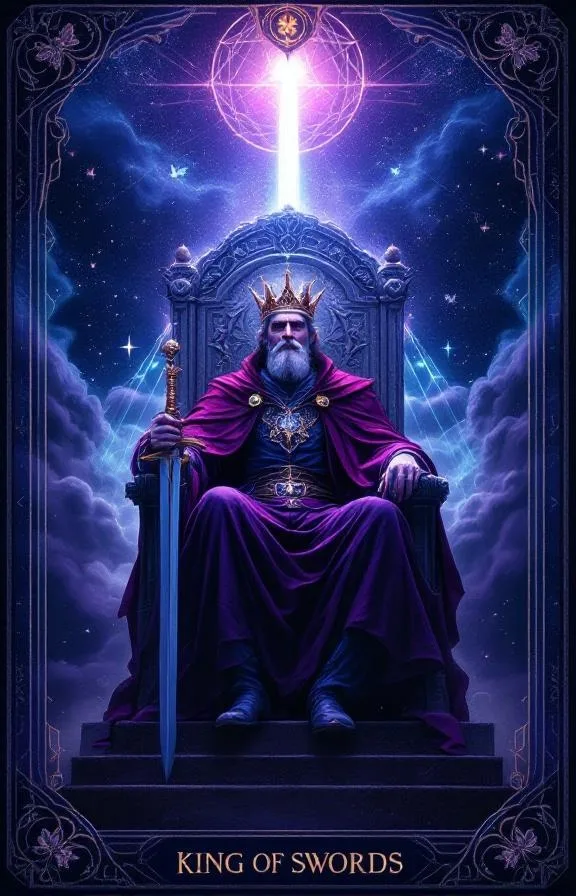
The King of Swords does not say yes casually. He says it the way a judge issues a ruling — after reviewing the evidence, weighing the arguments, and arriving at a conclusion that holds up under cross-examination. When this card appears in your yes-or-no reading, the situation has been assessed and the verdict is in.
The quick answer
Yes. The King of Swords represents intellectual authority, principled judgment, and decisions that don't waver once made. His yes is rooted in reason, not optimism. Think of it as the kind of affirmation an experienced advisor gives after reviewing everything and concluding the path forward is logically sound, ethically clean, and worth pursuing.
What the King of Swords means upright in a yes or no reading
Where the Queen of Swords sees clearly, the King acts on that clarity with full institutional weight behind him. He doesn't have opinions. He has verdicts. And his verdicts tend to be right because they're built on thorough analysis, not impulse.
The yes he delivers carries a specific implication: the decision has been vetted. Risks assessed, alternatives considered, and the chosen path identified as the most rational one available. This is what psychologists call "executive function" operating at its highest level — the cognitive machinery of planning, impulse control, and strategic thinking firing cleanly. The King of Swords operates from the prefrontal cortex, not the amygdala. His yes is deliberate, and deliberate decisions consistently outperform reactive ones.
The King also represents ethical clarity. His affirmation is not merely strategic — it's principled. If your question has a moral dimension, this card says the right course of action and the effective course of action are aligned. You don't have to compromise your integrity to get what you want.
What the King of Swords reversed means for yes or no
Reversed shifts from clear yes to cautious maybe. The formidable mind is still present but it's been corrupted — rigidity posing as conviction, manipulation disguised as strategy, intellectual power deployed to serve an agenda rather than pursue truth.
The reversed King can describe a situation where someone in authority is using their position unjustly. Decisions that serve their interests, presented as objectively correct. If your question involves an institution, a bureaucracy, or someone who holds structural power over you, the reversed King warns: the system may not be operating fairly.
On a personal level, the reversal asks whether your thinking has calcified. Are you so invested in your current analysis that new contradicting evidence can't get in? That's not clarity. That's fortification.
The answer may still be yes, but only if it survives honest cross-examination. Test your certainty before acting on it.
King of Swords yes or no in love
Yes, centered on intellectual respect and honest communication rather than passion alone. The King of Swords appears when a partnership is defined by mutual admiration of each other's minds — where conversation matters as much as chemistry, and both people can be fully honest without risking the relationship.
Asking about someone specific? The King describes a person who values integrity, communicates clearly, and expects the same. They may not be the most demonstrative romantic partner. Their commitment, once given, is reliable precisely because it wasn't given impulsively. They chose you with full awareness of what they were choosing.
The couples who thrive under this card argue fairly, admit mistakes, and prioritize the relationship's integrity over their individual need to be right.
Reversed in love: controlling behavior disguised as protectiveness. Communication that's become about winning arguments rather than understanding your partner. If intellectual superiority has become a weapon, the dynamic needs to change before the answer can be yes.
King of Swords yes or no in career and finances
Strong yes. The King of Swords favors career decisions requiring strategic thinking, leadership, and the ability to operate within complex systems. Asking about a promotion, a legal matter, a business strategy, any professional situation demanding analytical rigor? Your approach is sound and the outcome favors you.
This card particularly supports moves that establish authority or expertise. Launching a consulting practice. Publishing research. Taking a leadership role. Pursuing an advanced degree. The yes is grounded in the intellectual work you've already done — it validates the preparation.
Financially, the King advises disciplined, rational money management. Investments backed by thorough research, negotiations approached with clear strategy, decisions made from knowledge rather than emotion. The King of Swords doesn't gamble. He calculates.
Reversed in career warns against authoritarian management, intellectual dishonesty, or using position to silence dissent. Short-term compliance, long-term erosion of trust.
Tips for reading the King of Swords in yes or no questions
Ask specific questions. Vague questions produce vague answers, even from a card this decisive. "Should I accept this specific job offer?" produces a clearer reading than "Will my career improve?"
Trust the logic. If the King appears and your analysis supports a yes, stop second-guessing. You've done the thinking. Execute. Second-guessing a well-reasoned conclusion wastes the clarity this card provides.
Apply ethical scrutiny. The King doesn't separate effectiveness from ethics. If the course of action you're considering requires moral compromise, his yes doesn't apply. The affirmation is contingent on integrity of approach.
Frequently asked questions
Is the King of Swords a yes or no card?
Yes. He represents intellectual authority, principled judgment, and the kind of decision-making that holds up under pressure. When he appears, the path forward is logically sound. His yes carries reliability — it doesn't waver when challenged because it wasn't formed impulsively.
What does the King of Swords reversed mean for yes or no?
Reversed shifts yes to cautious maybe. Intellectual authority has been compromised by rigidity, manipulation, or the use of logical arguments to justify emotionally driven conclusions. Examine whether your reasoning is genuinely objective or shaped by a need to control the outcome. Honest self-examination restores the yes.
Does the King of Swords represent a specific person?
Often, yes — a leader, advisor, judge, or expert whose judgment carries weight. They tend to be fair-minded, analytically sharp, and emotionally contained. If such a person is involved in your situation, their perspective is worth taking seriously. Their assessment is likely more objective than most.