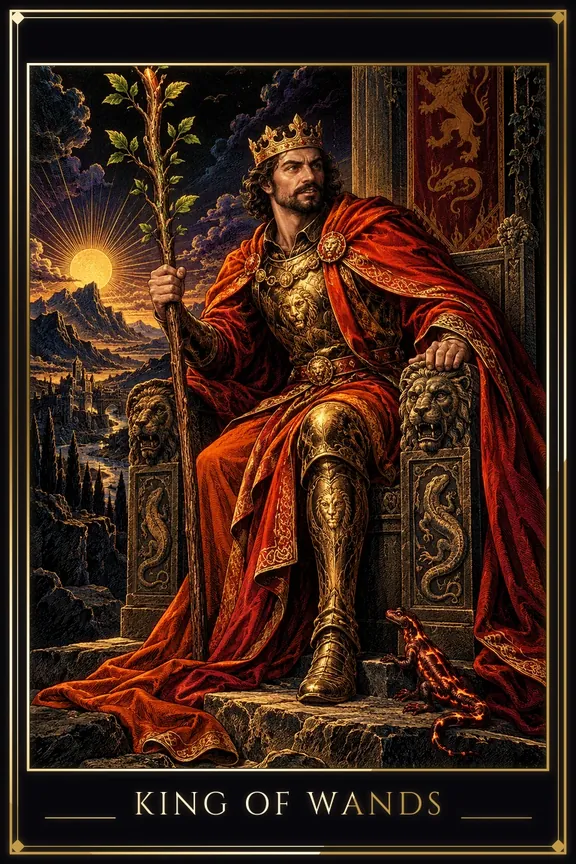
When he speaks, the table goes quiet. Not because he demands it — he rarely raises his voice — but because everyone in the room has learned, over time, that when this man opens his mouth, the direction changes. He doesn't suggest. He decides. And somehow, everyone agrees that his decisions are better than their suggestions. The King of Wands person doesn't ask for authority. He generates it.
The personality profile
The King of Wands is fire that has learned patience. That's the whole story, and it takes decades to achieve. Every other Wands archetype struggles with some aspect of their element — too impulsive, too scattered, too intense, too burned out. The King has integrated the fire. He uses it. It doesn't use him.
This is a person who has been the Ace, the Knight, the Page. He's burned too bright, crashed too hard, started too many things, abandoned too many people. He's made the mistakes. All of them. And he's metabolized those mistakes into a leadership style that combines vision with execution, passion with discipline, ambition with actual follow-through.
Psychologist Robert Hogan's research on leadership derailment found that the most common reason leaders fail isn't lack of talent but lack of self-awareness — specifically, the inability to moderate strengths that, taken to extremes, become weaknesses. The King of Wands person has solved this problem. His fire is enormous, but his self-regulation is equally developed. He knows when to push and when to wait. When to speak and when to let the room talk itself into his conclusion.
Most leadership archetypes in tarot are about position or intellect. The King of Wands is about presence. He walks into a crisis and people calm down. Not because he has a plan — he might not — but because his composure communicates that a plan will emerge, and it will work. That's a different kind of authority than rank or expertise. It's elemental.
King of Wands upright as a person
Upright, the King of Wands person is the leader everyone wishes they had. He sets direction without micromanaging. He holds high standards without creating fear. He gives credit generously and absorbs blame willingly. His people would follow him into uncertain territory because he's been there before and come back.
His decision-making is distinctive. He listens — actually listens, not the performative silence before a predetermined verdict — and then decides quickly. The decision is often bold, sometimes counterintuitive, and almost always right. He trusts his instincts, but his instincts have been honed by years of experience. What looks like intuition is actually expertise compressed into reflex.
He's remarkably comfortable with power. He doesn't apologize for having authority, doesn't pretend to be "one of the guys," doesn't play down his position. But he also doesn't weaponize it. Power, for the King of Wands person, is a tool. Not an identity. He'd give it up tomorrow if the mission required it.
There's a quiet warmth to him that surprises people who expect severity. He remembers names. He asks after families. He notices when someone in his organization is struggling and addresses it — not publicly, not performatively, but directly, one-on-one, with the door closed. His care is private and therefore trustworthy.
King of Wands reversed as a person
Reversed, the commander becomes the tyrant. The same force of will that made him an exceptional leader now makes him an unbearable one. He stops listening. He stops delegating. He stops trusting anyone's judgment but his own, and the people around him — who once felt empowered — now feel controlled.
The reversed King of Wands person is domineering. His confidence, unchecked by feedback, calcifies into dogmatism. He becomes the leader who asks for input and then ignores it. Who punishes disagreement. Who surrounds himself with people who tell him what he wants to hear, then wonders why his decisions have gotten worse.
His temper, which the upright King keeps contained, starts showing. Not in outbursts — the reversed King is too controlled for that — but in cold, devastating judgments delivered quietly. The raised eyebrow that ends a career. The measured tone that carries more threat than shouting. He weaponizes his composure.
King of Wands as a person in love
In love, the King of Wands person is protective, passionate, and deeply loyal — but on his terms. He has a vision for the relationship, and he expects his partner to share it. That vision is usually generous: a life of purpose, adventure, and shared accomplishment. But the fact that it's his vision, often presented as the vision, can make a partner feel like a passenger in someone else's story.
He shows love through action. He fixes the problem. He handles the crisis. He provides — not just financially, but structurally. He creates the conditions for his partner to thrive, and he does it with genuine care. His challenge is vulnerability. Asking for help doesn't come naturally to someone whose identity is built on being the person who handles things. The partner who can get the King of Wands to admit he's struggling has accomplished something rare and valuable.
King of Wands as a person at work
CEO. Founder. Military command. Studio head. Any leadership position where vision, charisma, and decisive authority intersect. He's less effective in advisory roles — telling someone else what to do without the ability to implement is frustrating for him. He needs the wheel. Not the passenger seat, not the navigation app — the wheel. Give it to him and get out of the way.
King of Wands as someone in your life
Respect his authority without worshipping it. The King of Wands person in your life has earned the right to lead, but he also needs people who will tell him when he's wrong — and the best way to do that is privately, directly, and with evidence. He doesn't respond to emotion. He responds to conviction backed by facts. Challenge him well and he'll respect you more than you expected. Challenge him poorly and he'll dismiss you in a sentence. Be prepared for both.
Frequently asked questions
What kind of person does the King of Wands represent?
A natural commander — someone who has integrated ambition, charisma, and discipline into a leadership style that inspires loyalty and drives results. He's the person who makes big decisions look easy because he's spent years learning how.
Is the King of Wands as a person positive or negative?
Strongly positive when self-aware. He's one of the most effective and admirable archetypes in tarot. The danger is that his strengths — decisiveness, confidence, authority — become toxic without the counterbalance of humility and genuine feedback. An unchecked King of Wands is the worst kind of leader: brilliant, charismatic, and completely unwilling to listen.
How do you recognize a King of Wands person?
They're the one sitting quietly while everyone else talks, then saying the one thing that reframes the entire conversation. They carry authority in their posture, their voice, their eye contact. People defer to them instinctively. They've probably built something — a company, a team, a reputation — that speaks louder than their resume.