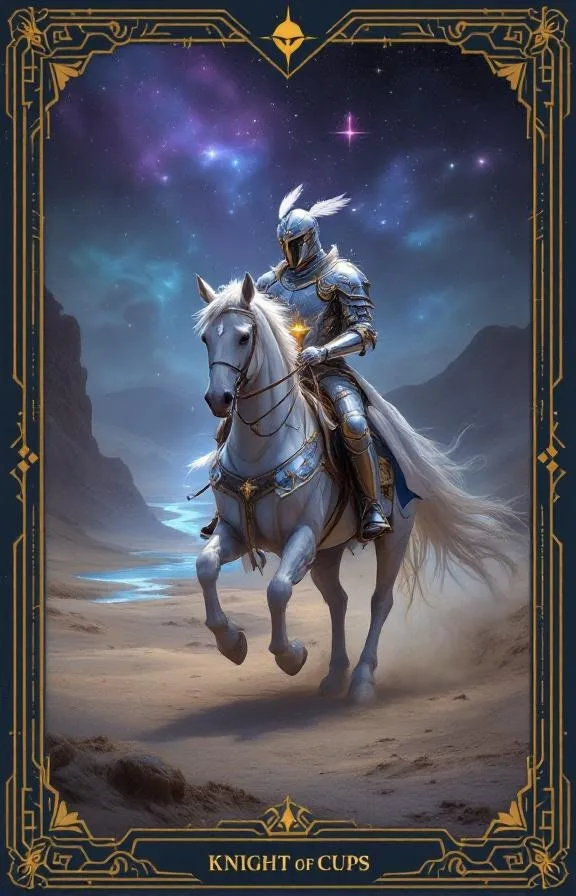
A knight on a white horse, cup extended, moving forward with the deliberate grace of someone who knows exactly where their heart is pointing. Not charging. Not hesitating. Advancing. The Knight of Cups appeared because the moment for emotional action has arrived and you are still standing at the edge of it, composing the perfect first move instead of making an imperfect one.
The advice
Follow your heart. Actually follow it — with your feet, your voice, your decisions, your schedule. Not theoretically. Physically.
The distinction matters because most people who say they follow their heart actually follow their fear at a slightly different angle. They feel the pull toward something and then negotiate with it. "I will follow my heart after I have more financial security." "I will follow my heart once I know they feel the same way." "I will follow my heart as soon as the timing is better." The Knight of Cups has no patience for conditional heart-following. The horse is moving. Get on it or do not, but stop pretending the conditions are not already met.
The Knight is a romantic in the original sense — not sentimental, but driven by ideals. The advice here is to let your ideals be louder than your practicality for a limited, decisive period. You can return to practicality later. Right now, your practical mind has been running the show for too long and the result is a life that functions beautifully and means very little.
Knight of Cups upright advice
Upright, the Knight says move toward what you feel. The direction is clear. The execution is what you have been avoiding.
Someone needs to hear how you feel about them. Say it. A project needs the emotional investment you have been withholding. Give it. A dream that you have been dismissing as impractical needs at least one concrete step in its direction. Take it. The Knight of Cups is not asking you to abandon reason. It is asking you to stop using reason as a fortress against vulnerability.
The specific quality the upright Knight brings to advice is charm — which in tarot does not mean manipulation but rather the willingness to lead with warmth. Whatever situation you are navigating, the card says approach it with genuine feeling rather than strategic calculation. People respond to authenticity even when it is clumsy, and the Knight's approach — cup extended, intention visible — works precisely because it does not try to hide.
There is risk here. The card does not pretend otherwise. Following your heart means being visible in your desire, and visibility invites rejection. The Knight of Cups says the risk is acceptable. Not small. Not negligible. Acceptable. The person who never gets rejected is the person who never reaches for anything worth having.
Knight of Cups reversed advice
Reversed, the romantic energy goes sideways. Either you are chasing an illusion — pursuing a person, dream, or ideal that exists mostly in your imagination — or you have become so afraid of emotional risk that the knight has dismounted entirely and is just standing in a field holding a cup with nowhere to go.
The first scenario requires honest self-assessment. Is the thing you are pursuing real or constructed? Is the person you are chasing actually available, or are you in love with the chase itself? The reversed Knight of Cups says infatuation and love are not the same thing, and at this moment you might be confusing one for the other.
The second scenario — emotional paralysis — requires a different kind of honesty. You feel deeply but act not at all. The feelings are real, vivid, and consuming, but they never translate into words spoken to another person or decisions made in the physical world. The reversed Knight says feelings that never become actions eventually become regrets. And regrets are heavier than rejection.
If the reversal indicates moodiness or emotional instability — swinging between intense passion and complete withdrawal — the advice is to find the middle register. Not every feeling needs to be acted on immediately. Not every impulse is guidance from the universe. The Knight of Cups reversed says slow down just enough to distinguish genuine emotional direction from momentary emotional weather.
Knight of Cups advice in love
In love, the Knight of Cups is the proposal card. Not necessarily literal marriage — but the act of declaring your feelings openly, without escape clause, without the safety net of ambiguity.
For singles with someone specific in mind, the advice is uncomfortably direct: tell them. Not hint. Not create situations where the feeling might become mutually apparent through proximity and body language. Tell them, clearly, in words, that you have feelings for them. Accept the full spectrum of possible responses. The Knight of Cups says the declaration itself is an act of integrity regardless of the outcome.
For couples, the card advises romantic pursuit within the relationship. Somewhere along the way, pursuit was replaced by cohabitation, and the Knight says that transition cost something important. Pursue your partner again. Not because they need convincing but because pursuit communicates value. Write the letter. Plan the date that requires actual thought. Look at them the way you did before looking at them became automatic.
If you are navigating competing romantic interests, the Knight advises choosing with your heart rather than your spreadsheet. The person who looks best on paper and the person who makes your chest tight are not always the same person. The Knight says follow the chest.
Knight of Cups advice in career
Professionally, the Knight of Cups champions purpose-driven work.
The card asks whether your career serves your values or merely your bank account. Both are valid needs, but when compensation becomes the only reason to show up, something essential degrades. The Knight does not advise quitting your job — it advises infusing your existing work with the emotional investment it has been missing, or, if that is impossible, beginning the search for work that can hold your full self.
For creative professionals, the Knight is strong encouragement. Your best work comes from emotional engagement, not technical proficiency. The technically perfect piece that you felt nothing while creating will communicate exactly that — nothing. The flawed piece you poured yourself into will reach people. The Knight says choose emotional truth over technical safety.
If you are pitching an idea, negotiating a deal, or interviewing for a position, the card advises letting your genuine enthusiasm show. Professional culture rewards composure, and composure has its place, but the Knight of Cups says the thing that will distinguish you from other candidates is not your resume — it is your visible, unperformable passion for the work.
For career changes motivated by calling — the pull toward work that feels meaningful even though it pays less, the urge to create rather than optimize — the Knight says the pull is valid. Follow it while being smart about the logistics. Passion without planning leads to romantic bankruptcy. Planning without passion leads to the cubicle you are trying to escape. The Knight holds both the cup and the reins.
Action steps
- Make the first move this week. Romantic, professional, creative — whatever requires you to extend yourself toward someone or something. Do it before you are ready.
- Write a letter you do not have to send. To the person you have feelings for, the dream you are afraid to pursue, the version of yourself you want to become. The act of articulating what your heart wants is the first step toward following it.
- Audit your charm. Not your manipulation tactics — your warmth. When was the last time you approached a situation leading with genuine feeling rather than strategic positioning? The Knight says warmth opens doors that strategy cannot.
- Accept one emotional risk. Define it specifically. "I will tell this person how I feel by Friday." "I will submit my creative work to this platform by next week." Deadline plus specificity converts intention into action.
FAQ
Is the Knight of Cups a sign to pursue a specific person?
Often, yes. The Knight is an action card — it represents emotional pursuit in motion. If you pulled this card while thinking about someone specific, the advice is to act on that feeling. But "act" does not mean "obsess from a distance" or "create an elaborate scenario." It means express yourself honestly and directly. The Knight extends the cup openly. No tricks. No games. If the person receives it, wonderful. If they do not, the Knight has lost nothing except the weight of unexpressed feeling.
What if following my heart conflicts with my responsibilities?
The Knight of Cups does not advise abandoning your responsibilities. It advises examining whether your definition of responsibility has expanded to fill every space where passion used to live. People who frame every desire as irresponsible have often confused self-denial with maturity. The card asks whether you are genuinely unable to follow your heart or merely unwilling to renegotiate the structure of obligations you built around yourself. Usually it is the latter, and usually the renegotiation is possible.
How do I know the difference between intuition and infatuation?
Intuition is quiet and directional — it tells you where to go without insisting on a specific outcome. Infatuation is loud and outcome-dependent — it needs a particular person or result to validate it. The Knight of Cups reversed especially warns against confusing the two. Test it this way: if the object of your desire rejected you, would the underlying direction still make sense? If yes, it is intuition. If the entire impulse collapses without the specific person or outcome attached to it, it is infatuation. Both are valid feelings. Only one is reliable navigation.
