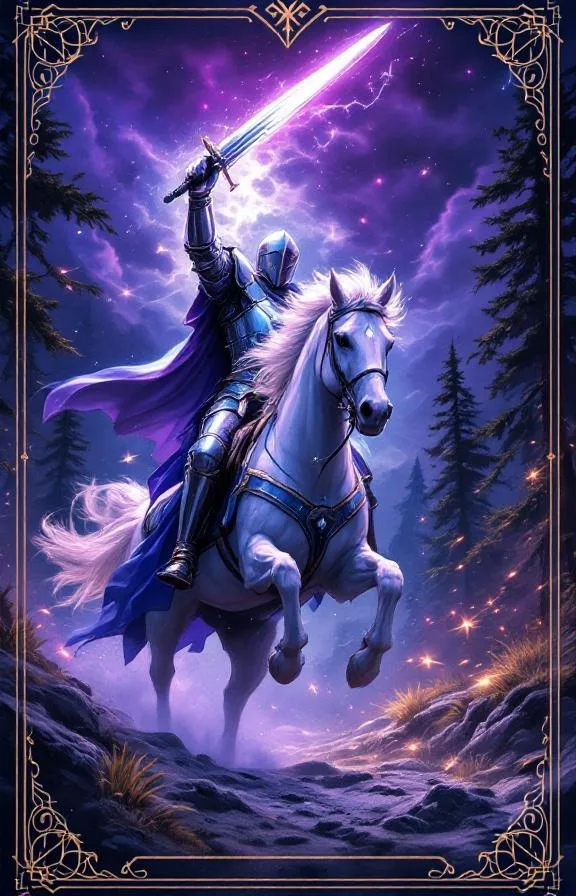
Slow down. You are moving too fast to see where you are going, and the Knight of Swords as advice is grabbing the reins before you charge off a cliff you did not notice because your eyes were fixed on the horizon. The horse is at full gallop. The sword is drawn. The wind is screaming past. Everything about this card radiates speed and determination. And that is exactly the problem.
The advice
Think before you act. Four words. Possibly the most ignored advice in human history, and the Knight of Swords delivers it with urgency because you are about to make a move that you have not thought through, and the consequences will be proportional to your speed.
The Knight of Swords is not a bad card. The energy it represents — decisive, ambitious, fearless — is genuinely valuable. But energy without direction is destruction. A sword swung blindly will cut, but it will cut indiscriminately. The Knight charges into battle with passion and conviction, often before understanding the terrain, the enemy's position, or whether the battle was even necessary.
Here is the question this card puts to you: are you acting from clarity or from adrenaline? Because they feel identical from the inside. The rush of righteous anger, the certainty that you are right, the urgency that says "act now, think later" — these sensations mimic decisiveness. But decisiveness requires direction, and direction requires thought, and thought requires the one thing the Knight of Swords refuses: pause.
The card's advice is not to abandon your mission. It is to slow down enough to aim. Five minutes of planning can save five months of damage control.
Knight of Swords upright advice
Upright, the Knight of Swords advises you to channel your mental intensity into strategic action rather than impulsive reaction. The drive is there. The intelligence is there. What is missing is the pause between stimulus and response.
Before sending that email — the one you composed in anger and feel urgently compelled to dispatch — wait twenty-four hours. Before confronting the person who wronged you — with the speech you have been rehearsing during the entire drive over — stop. Park. Breathe. Revise.
The upright Knight also warns against intellectual arrogance. Being smart is not the same as being right, and being right is not the same as being effective. You might have the superior argument. You might see the flaw in everyone else's logic. That does not mean charging in with your analysis at full speed will produce the outcome you want. Persuasion requires patience. The Knight of Swords has none, and that is why his victories tend to be pyrrhic.
Practical guidance from the upright Knight: before your next major move, consult someone who thinks differently than you do. Not for validation — you will get plenty of that from your own momentum. For perspective. Find the person who will say "have you considered..." and actually listen to what follows. The Knight's weakness is tunnel vision. A second viewpoint breaks the tunnel.
Knight of Swords reversed advice
Reversed, the Knight of Swords has either crashed or stalled. The charge has either ended in collision — the impulsive action taken, the damage done, the consequences arriving — or the Knight has frozen, all that aggressive energy turned inward into anxiety, frustration, and mental paralysis.
If you have already acted impulsively and are dealing with the aftermath, the reversed card advises damage control through humility. Admit what happened. Acknowledge the recklessness. Do not defend the impulse that caused the problem — correct the problem. "I acted too quickly and I am sorry" is a statement most people will accept, because most people have done the same thing.
If the Knight's energy has stalled — if you feel intellectually aggressive but unable to act — the reversed card suggests that fear has entered the equation. You know what you want to do. You can see the charge you want to make. But something is holding you back, and the reversed Knight asks you to identify what that something is. Is it wisdom? Or is it cowardice wearing wisdom's clothes?
The distinction matters. If genuine caution is slowing you down, listen to it. If fear of failure or rejection is disguising itself as strategic thinking, the reversed Knight says: charge. Imperfect action beats perfect paralysis.
Knight of Swords advice in love
In love, the Knight of Swords advises you to stop treating relationships like debates to be won. If you approach every disagreement with your partner as an argument to be dominated through superior logic, the card tells you to recognize what you are actually doing: destroying intimacy in the name of being right.
Emotional conversations are not debates. They do not have winners and losers. They have people trying to be understood. When your partner says "I felt hurt," the Knight's instinct is to explain why they should not have felt hurt, to present evidence, to construct a logical case for why their feelings are irrational. This approach is not just ineffective — it is corrosive. Stop arguing feelings. Start acknowledging them.
For new relationships: the Knight of Swords warns against rushing. You met someone. The chemistry is intense. Every instinct says to accelerate — daily texts, immediate exclusivity, plans for the future on date three. The Knight's intensity can be intoxicating for both parties, but it burns through the natural development of trust. Let the relationship unfold at a sustainable pace. Passion without patience is a fire that burns through its fuel.
If you are about to confront a partner about something: the Knight advises planning the conversation rather than ambushing them with it. Write down your three most important points. Enter the conversation knowing what outcome you need. And be prepared to listen as much as you speak, which is the Knight's greatest challenge.
Knight of Swords advice in career
Professionally, the Knight of Swords appears when someone is about to make a bold but potentially reckless career move. The resignation submitted in a moment of frustration. The aggressive pitch that alienates rather than persuades. The public challenge to leadership that might be right but is strategically disastrous.
The career advice is: be bold, but be smart about it. The Knight has courage — admirable, necessary courage. What the Knight lacks is timing and delivery. An excellent idea presented at the wrong moment, in the wrong tone, to the wrong audience, becomes a terrible idea in practice. The insight is wasted because the execution was poor.
For those considering a career leap — starting a business, changing fields, asking for the promotion — the Knight of Swords says your impulse is probably sound but your timeline might be premature. What would this move look like if you spent three more months preparing? Not planning forever. Three months. That window often transforms "risky gamble" into "calculated risk" without losing the momentum that makes the move possible.
In workplace conflicts: the Knight advises against the scorched-earth approach. You might be right about the problem. Sending the all-company email calling it out might feel righteous. But it will also end your political capital and possibly your tenure. Channel the Knight's energy into strategic advocacy instead of dramatic confrontation. Same message, different delivery, vastly different outcome.
Action steps
- Implement the 24-hour rule. Before any significant action taken in emotional heat — an email, a confrontation, a resignation, a dramatic gesture — wait 24 hours. Not to change your mind necessarily, but to verify that your mind is clear rather than clouded by adrenaline.
- Write a pre-mortem. Before executing your plan, imagine it has already failed. What went wrong? What did you not account for? This exercise does not kill momentum — it refines aim.
- Ask "What am I not seeing?" To someone you trust. Not rhetorically. Genuinely. Then sit quietly while they answer. Do not interrupt. Do not argue. Just receive.
- Separate the message from the method. You probably have the right message. The Knight of Swords is usually correct in substance. The problem is delivery. Take your message and redesign its delivery for the specific audience. The truth hits different when it arrives on time and in the right tone.
FAQ
What does the Knight of Swords mean as advice?
The Knight of Swords as advice tells you to slow your mental and emotional velocity before taking action. The card recognizes your intelligence, determination, and courage, but warns that these qualities without pause and planning lead to collateral damage. Its core guidance is: think first. The impulse is probably right. The timing, method, and delivery need refinement. Channel the Knight's energy through strategy rather than letting it charge unchecked.
Is the Knight of Swords telling me not to act?
No. The Knight of Swords never advises inaction — that would contradict its fundamental nature. What it advises is strategic action rather than impulsive action. The difference is not in whether you move but in how you move. An impulsive charge may reach the target but destroy everything else in its path. A strategic charge reaches the same target with fewer casualties. The card is asking you to aim, not to lower your sword.
How do I balance the Knight of Swords energy with patience?
The Knight's challenge is that patience feels like weakness to this energy. The reframe that works: patience is not inaction — it is precision. A surgeon does not rush because rushing means cutting wrong. A martial artist does not charge because charging means missing the opening. Apply the same logic to your situation. Speed serves you only when it is directed. The practice is to feel the urgency, acknowledge it, and then direct it rather than surrendering to it. Five minutes of redirection can save months of repair.