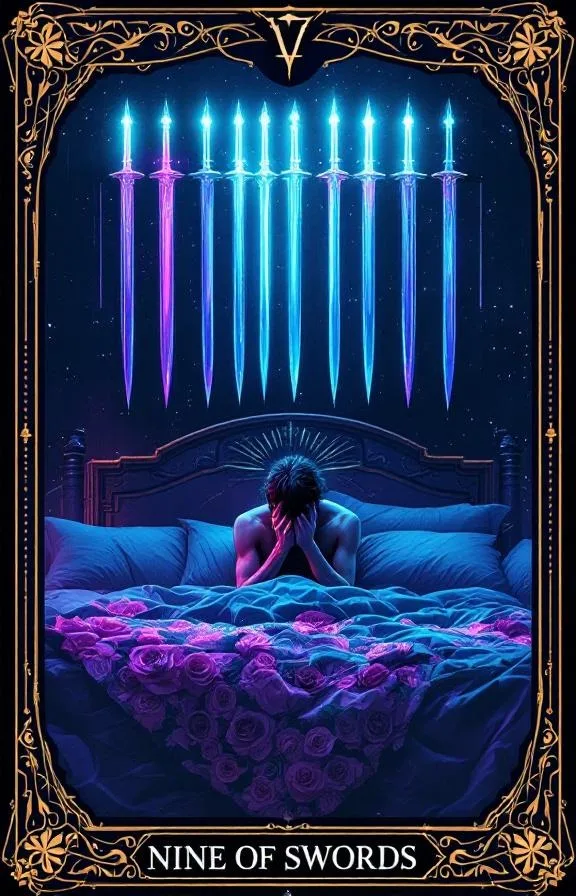
Three in the morning. Wide awake. Running the same mental footage on a loop — the worst case scenario, the humiliation, the catastrophe, the ruin. Nine swords on the wall behind a figure sitting up in bed with their head in their hands. The Nine of Swords as advice does not pretend this is pleasant. It tells you it is survivable, and that the suffering happening right now is being manufactured by your mind, not by reality.
The advice
Stop catastrophizing. That is the instruction, and it is simultaneously simple and nearly impossible for the person receiving it. Because from inside the anxiety spiral, every terrible prediction feels like reasonable preparation. You are not panicking — you are planning for the worst. You are not spiraling — you are being realistic. Except you are not. The Nine of Swords is specific about this: the fear is real, but the future it describes is not.
This does not mean nothing bad will happen. Bad things happen constantly, to everyone, with or without your anxious anticipation of them. What the Nine of Swords points out is that the suffering you are experiencing right now — this moment, sitting up at 3 AM — is not caused by the bad thing. It is caused by your imagination of the bad thing. The actual event, if it occurs, will bring its own pain at its own time. The current pain is self-inflicted.
That is a hard thing to hear, and it is easy to mistake for dismissal. The Nine of Swords is not dismissing your feelings. Anxiety is visceral, physiological, overwhelming. The card is dismissing the authority of your anxious predictions. Your brain at 3 AM is an unreliable forecaster. It specializes in worst-case scenarios because its evolutionary job is threat detection, not accurate prediction. Just because it says disaster is certain does not mean disaster is likely.
Nine of Swords upright advice
Upright, the Nine of Swords advises immediate, practical intervention in your thought patterns. Not positive thinking — that rarely works when genuine anxiety is involved. Instead, reality testing.
Take the catastrophic thought and interrogate it like a witness. What evidence supports this fear? What evidence contradicts it? If the worst case did happen, what would you actually do? Not "what would happen" — you have already imagined that in excruciating detail. What would you do? Who would you call? What steps would you take? When you shift from imagining the disaster to planning the response, anxiety loses a significant amount of its power. Because the planning reveals something the catastrophizing obscures: you would handle it. Not easily. Not painlessly. But you would handle it.
The upright card also advises you to share your fears with someone. Anxiety grows in isolation and shrinks in conversation. The thought that seems earth-shatteringly terrible at 3 AM often sounds manageable when spoken aloud at noon — not because the fear was silly, but because daylight and human connection restore proportion.
One more thing: the Nine of Swords frequently appears when someone is suffering from guilt. Not just worry about the future, but shame about the past. If the midnight thoughts are replaying something you said, did, or failed to do, the card advises you to address the guilt directly. Apologize, make amends, or forgive yourself. The loop will not stop until you do.
Nine of Swords reversed advice
Reversed, the Nine of Swords indicates either recovery from the darkest phase of anxiety or an escalation that requires professional help. The position determines which, and only you can make that assessment honestly.
If you are emerging from a period of severe anxiety, the reversed card validates the progress. The worst is behind you. The sleepless nights are becoming less frequent. The catastrophic thoughts are starting to feel less convincing. Keep going. Recovery from chronic anxiety is not linear — there will be setbacks — but the overall trajectory is toward dawn.
If you are moving deeper into the spiral, the reversed Nine of Swords stops being gentle. This card tells you that the level of mental suffering you are experiencing is not normal, not necessary, and not something you should manage alone. Anxiety disorders are medical conditions. They respond to treatment. The reversed card says: call a therapist. Talk to a doctor. Tell someone the full truth about what is happening inside your head.
There is no bravery in suffering alone when help exists. Asking for support is not weakness. Refusing to ask because you believe you should be able to handle it — that is the actual problem.
Nine of Swords advice in love
In romantic contexts, the Nine of Swords often advises someone who is consumed by anxiety about a relationship rather than actually present in it. You are so busy worrying about whether your partner will leave, whether you are enough, whether the relationship will last, that you have stopped experiencing the relationship itself.
This is self-fulfilling prophecy territory. The constant need for reassurance, the reading of every text for subtext, the emotional surveillance — these behaviors push people away, creating the very abandonment you feared. The Nine of Swords advises you to recognize this pattern and interrupt it.
Practical love advice: when the anxious thought arrives — "they did not text back, they must be losing interest" — do not act on it. Do not send the follow-up. Do not craft a test. Sit with the discomfort for thirty minutes and see if it passes. Most of the time, it will. The text will arrive. The explanation will be mundane. And you will have saved yourself and your partner from the exhausting cycle of anxious pursuit and reassurance.
For those going through heartbreak: the Nine of Swords validates that the grief is overwhelming right now but asks you to recognize which part is pain and which part is your mind amplifying the pain. "I am sad" is pain. "I will never love again and no one will ever want me" is amplification.
Nine of Swords advice in career
Professionally, this card addresses work anxiety, imposter syndrome, and the 3 AM dread about professional failure. The presentation that might go badly. The performance review that might destroy your career. The business that might fail. The layoff that might be coming.
The Nine of Swords career advice: proportion. Most professional fears are about social consequences — looking foolish, being judged, losing status — rather than existential threats. A bad presentation is embarrassing, not fatal. A negative review is painful, not career-ending. Even job loss, while genuinely difficult, is temporary and recoverable. Your brain at 3 AM does not do proportion. Your daytime brain, with help, can.
For entrepreneurs and freelancers, whose professional anxiety has no institutional boundaries: create those boundaries yourself. Designate a "worry window" — a specific time of day when you allow yourself to think about business anxieties. Outside that window, redirect. Not because the worries are not legitimate, but because uncontrolled rumination does not produce better solutions. It produces exhaustion.
If imposter syndrome is the specific flavor of your Nine of Swords: keep a record of your accomplishments. Not in your head — on paper. When the 3 AM voice says "you do not belong here," the paper says otherwise. Trust the paper. It has better evidence.
Action steps
- Write down your worst fear in one sentence. Then write the most likely outcome in one sentence. Compare them. The gap between worst fear and most likely outcome is the territory of catastrophizing. Name that gap.
- Create a "3 AM protocol." When anxiety wakes you, have a pre-planned response that does not involve your phone. Get up, drink water, write the fear in a dedicated notebook, then return to bed. The physical act of writing externalizes the thought and reduces its power.
- Tell one person the specific thing you are afraid of. Not "I am anxious." The specific fear. "I am afraid my partner is going to leave me because of what I said last Tuesday." Speaking precision reduces anxiety more effectively than speaking generally.
- Schedule an appointment with a therapist. Not as a last resort. As a first step. Anxiety responds well to treatment, and the Nine of Swords appearing as advice suggests your current coping strategies are insufficient. That is not a character flaw. It is a signal to upgrade your tools.
FAQ
What does the Nine of Swords mean as advice?
The Nine of Swords as advice tells you that the anxiety you are experiencing is disproportionate to the actual threat. The card does not dismiss your suffering — it acknowledges that the pain is real while pointing out that the catastrophic future your mind has constructed is not. Its guidance is to interrupt the spiral through reality testing, external support, and when necessary, professional help. The core message is: you are suffering from your thoughts about the situation more than from the situation itself.
Is the Nine of Swords always negative?
As an advice card, the Nine of Swords is actually constructive despite its disturbing imagery. It identifies a specific problem — catastrophic thinking and unchecked anxiety — and points toward specific solutions. The card appears because you are already in pain, not to create new pain. Its purpose is to name what is happening so you can address it. In that sense, it is one of the more actionable cards in the deck.
How can I stop the Nine of Swords anxiety spiral?
Three approaches work in combination. First, reality testing: challenge the specific predictions your mind is making by asking for evidence. Second, externalization: share the fear with someone you trust, because anxiety shrinks when it moves from your mind to a conversation. Third, professional support: if the anxiety is persistent, sleep-disrupting, and resistant to self-help strategies, work with a therapist who specializes in anxiety or cognitive behavioral approaches. The Nine of Swords is not telling you to power through. It is telling you to get help, and that getting help is strength.