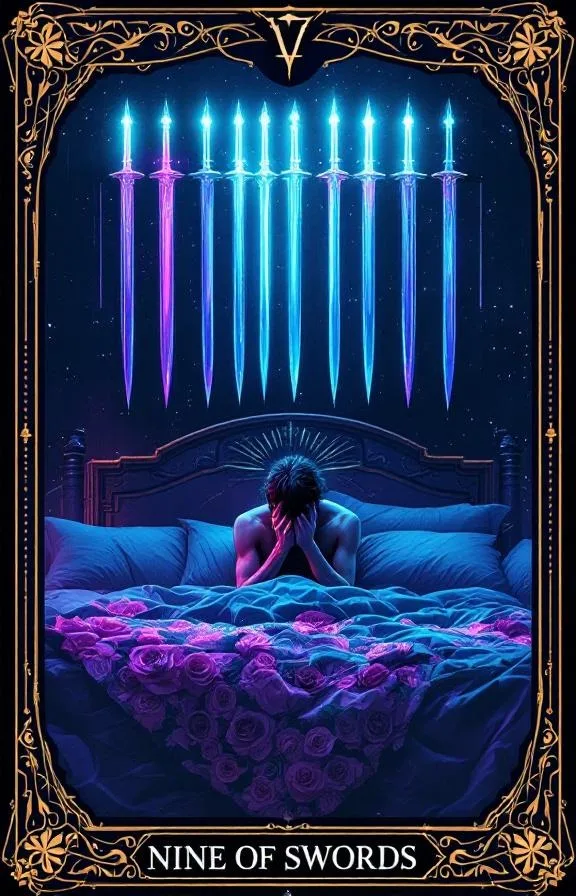
It is 2:47 AM and they are awake. Again. Running the same conversation through their head for the fourteenth time, each replay revealing a new angle of potential catastrophe that the previous thirteen somehow missed. Did that email come across as passive-aggressive? Was that silence during the meeting directed at them? Is that mole getting bigger? The Nine of Swords person does not just worry. They build cathedrals of worry, architecturally perfect, lit from within by a relentless need to anticipate every possible disaster before it arrives.
The personality profile
The Nine of Swords person lives at the intersection of high intelligence and high anxiety — a combination that produces someone capable of imagining worst-case scenarios with cinematic detail. They do not worry vaguely. They worry specifically, elaborately, and with such internal conviction that their imagined catastrophes feel as real as memories. Sometimes more real, because memories at least have the decency to be fixed. Worries can be endlessly revised, expanded, upgraded.
Theirs is a mind that refuses to rest. It scans for threat constantly, like antivirus software running in the background — checking, rechecking, flagging false positives with the same urgency as genuine dangers. The cognitive load is exhausting. They are tired in a way that sleep does not fix, because the part of them that produces the worry does not shut down when the lights go out. It accelerates.
Here is something most people get wrong about the Nine of Swords person: they are not pessimists. Pessimists expect bad outcomes and make peace with the expectation. The Nine of Swords person does not expect bad outcomes. They fear them while simultaneously knowing their fears are disproportionate, which adds a layer of frustration to the anxiety — the meta-anxiety of knowing you are anxious for insufficient reasons and being unable to stop.
Nine of Swords upright as a person
Upright, this person is functional but suffering. They show up to work, maintain relationships, meet their obligations. From the outside, they might look fine. Better than fine, even, because anxiety is an engine, and it drives them to over-prepare, over-deliver, over-anticipate — all of which register as conscientiousness in professional and social contexts.
The cost is invisible. They rehearse conversations before having them. They write and rewrite emails. They arrive early because being late is unthinkable. They apologize for things that do not require apology. They carry guilt about events they did not cause and could not have prevented.
The upright Nine of Swords person has usually developed compensatory skills that mask their internal state. They are excellent at contingency planning because they have already imagined everything that could go wrong. They are empathetic because hypervigilance toward threat includes hypervigilance toward other people's emotional states. They notice when someone is uncomfortable because they are always monitoring for discomfort.
Their capacity for care is genuine and enormous. They worry about the people they love with the same exhausting intensity they worry about themselves. They are the friend who checks in after a difficult day. The parent who cannot sleep until everyone is home. The partner who notices the slight change in your tone that signals something is wrong. Their attention is both their gift and their curse.
Nine of Swords reversed as a person
Reversed, the anxiety has either escalated past functionality or the person has begun to address it. These are dramatically different outcomes that share a card because they represent the same turning point: the moment when the current pattern becomes unsustainable.
The escalation looks like this: the worry that was once contained to nighttime hours has colonized the entire day. Decision-making becomes impossible because every option leads to a catastrophic scenario. Social interactions become unbearable because every conversation is a minefield of potential missteps. The person withdraws, not into the productive solitude of the Four of Swords, but into the panicked isolation of someone who has lost faith in their own ability to navigate the world.
The recovery version looks different. Quieter. The reversed Nine of Swords person who is healing has started to question the authority of their own fears. They have learned — usually through therapy, sometimes through sheer exhaustion — that their mind produces thoughts the way a factory produces widgets: automatically, relentlessly, without editorial judgment. Not every thought deserves investigation. Not every fear is a prophecy. This realization does not eliminate the anxiety, but it changes the relationship to it, and that change is everything.
Nine of Swords as a person in love
Loving a Nine of Swords person means learning to distinguish between legitimate concerns and anxiety performing as concern. They will worry about the relationship. Constantly. They will interpret your silence as distance, your distraction as disinterest, your bad day as their fault. This is not neediness, exactly. It is the relationship equivalent of checking the stove — a compulsive verification that everything is still intact.
The worst thing a partner can do is dismiss the anxiety. "You're overthinking it" is technically true and functionally useless. The Nine of Swords person already knows they are overthinking it. Telling them does not make them stop. It makes them feel ashamed of something they already cannot control, which adds shame to the anxiety, which produces more anxiety.
What works is steady reassurance delivered without exasperation. "I'm here. I'm not going anywhere. The relationship is fine." Repeated as many times as necessary with the same warmth each time. It is a lot to ask of a partner. It is also, for the right partner, deeply rewarding — because when the Nine of Swords person feels safe, the intensity that fuels their worry fuels their love with equal force.
Nine of Swords as a person at work
They are the employee who never misses a deadline and never forgives themselves for the one they almost missed three years ago. Their work is meticulous because the thought of submitting something imperfect produces physical discomfort. They proofread obsessively. They double-check their math. They send follow-up emails to confirm that their original email was received and understood.
Managers who recognize this pattern can channel it effectively by providing clear expectations and consistent feedback. The Nine of Swords person in a vacuum of information will fill that vacuum with worst-case assumptions. Regular check-ins cost the manager five minutes and save the Nine of Swords person five hours of spiraling.
Nine of Swords as someone in your life
Do not try to reason them out of their anxiety. Anxiety is not a rational position. It is a weather system. You cannot argue with weather. What you can do is offer shelter.
Learn their patterns. Know that Sunday evenings are bad. Know that silence after a text means nothing. Know that when they say "I'm fine," they are sometimes lying, and the lie is not a betrayal — it is a kindness they extend because they know their truth is heavy and they do not want to put it on you. Ask twice. The second "how are you really?" is where the honest answer lives.
Frequently asked questions
What kind of person does the Nine of Swords represent?
The Nine of Swords represents an overthinker — someone whose sharp mind generates worst-case scenarios with relentless detail and urgency. They are highly perceptive, deeply caring, and exhausted by the very intelligence that makes them who they are.
Is the Nine of Swords as a person positive or negative?
The suffering is real, but so are the strengths it produces. Their hypervigilance makes them extraordinarily attentive friends, partners, and colleagues. The question is not whether their anxiety is positive or negative but whether they have found ways to live with it that do not consume them.
How do you recognize a Nine of Swords person?
They apologize too often. They arrive early. They remember details about your life that you forgot you shared. They look tired in a way that has nothing to do with sleep. They make jokes about their anxiety that are funny enough to distract you from the fact that the jokes are also cries for help.