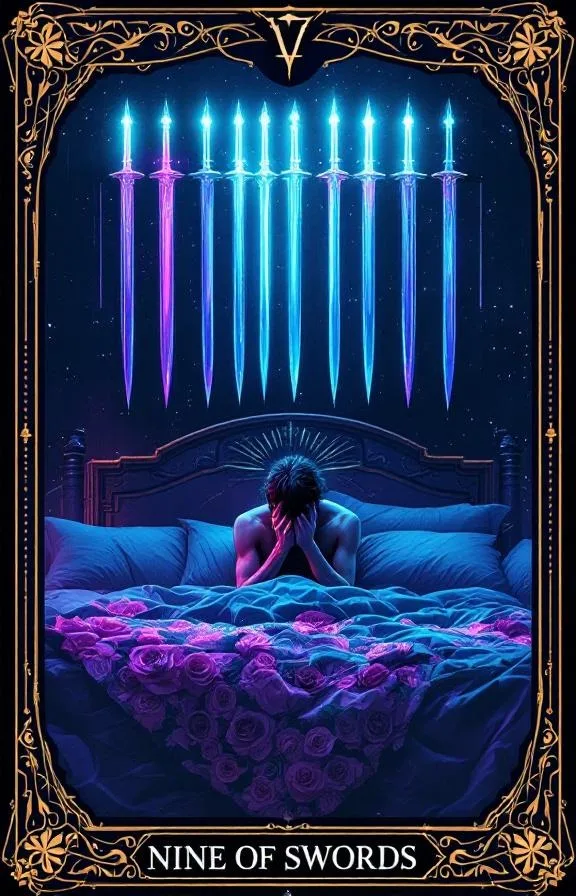
Three in the morning. Bolt upright. Heart hammering. The thing you have been avoiding all day — the conversation, the diagnosis, the debt, the suspicion — is sitting on your chest in the dark, and your mind is constructing worst-case scenarios with the precision and relentlessness of a machine that cannot be turned off. The Nine of Swords as feelings is dread: the specific torture of a mind that will not stop terrorizing its owner.
The core feeling
Dread is not the same as fear. Fear responds to present danger — the car swerving into your lane, the shadow in the hallway. Dread anticipates. It builds elaborate models of future catastrophe and then forces the person to live inside those models as if they were already real. The body cannot tell the difference between imagined disaster and actual disaster, so it produces the same cortisol, the same racing heart, the same nausea. The person suffers twice: once in the anticipation and once — if it ever actually happens — in the event itself.
The Nine of Swords is brutally specific about the timing of dread. This is a nighttime card. The figure sits up in bed, head in hands, swords mounted on the wall behind like a scorecard of worries. During the day, activity provides distraction. Social interaction provides perspective. The executive brain, with its capacity for rationalization and context, keeps the fears manageable. But at night, alone, in the dark, the executive brain clocks out and the amygdala runs the show. Every worry expands to fill the available silence.
What makes the Nine of Swords particularly cruel as an emotional experience is the loneliness of it. The person suffering this level of anxiety often cannot share it, either because the fears sound irrational when spoken aloud or because they are ashamed of their inability to control their own thoughts. So they sit in the dark. Alone with the swords.
Nine of Swords upright as feelings
Upright, the Nine of Swords represents anxiety at its most intense and self-generating. The person is not responding to a single identifiable crisis. They are caught in a thought spiral where one worry triggers another, which triggers another, until the original concern has been buried under an avalanche of catastrophic projections that have only a tenuous connection to reality.
Cognitive behavioral therapists call this "catastrophizing" — the mental habit of jumping from a minor concern to the worst possible outcome in a single leap. The email from the boss becomes termination becomes unemployment becomes homelessness becomes complete ruin. Each step feels logical in the moment. From the outside, the progression is obviously disproportionate. From the inside, it feels inevitable.
The physical dimension of this emotional state cannot be overstated. Insomnia. Nausea. Tension headaches. Jaw pain from clenching. The body is in full threat-response mode, flooding the system with stress hormones in response to a danger that exists entirely in the mind's projection. The person may look fine during the day. At night, they are a wreck.
Nine of Swords reversed as feelings
Reversed, the Nine of Swords can indicate one of two dramatically different states. The first is the beginning of relief — the anxiety starting to release its grip as the person realizes that the catastrophe they anticipated either did not happen or was survivable. The worst has passed, or the worst was never as bad as the worst they imagined. They are shaky, exhausted from the ordeal of their own thoughts, but the spiral is slowing.
The second possibility is the internalization of anxiety so thorough that it no longer looks like anxiety from the outside. The person has stopped sitting up at three in the morning — not because the dread has passed but because they have incorporated it into their baseline. The worry is constant but quiet, a low hum beneath every interaction, a weight so familiar they have forgotten what its absence feels like. This is more dangerous than the upright version precisely because it is harder to detect and treat.
The reversed Nine can also point to the person finally seeking help. Telling someone. Saying the words out loud that have been looping silently in the dark for weeks. This act of disclosure does not fix the anxiety, but it breaks the isolation, and isolation was the amplifier all along.
Nine of Swords as feelings in love
In romantic contexts, the Nine of Swords as feelings represents relationship anxiety at its most consuming. The person is lying awake imagining infidelity, abandonment, or the slow death of the relationship. Every unanswered text is evidence. Every change in tone is a warning sign. They are constructing and reconstructing narratives of betrayal and loss with a detail and specificity that would be impressive if it were not so destructive.
When this card represents someone's feelings toward you, they are afraid of losing you. That is the root of it. Under the suspicion, the checking, the need for reassurance that feels like it can never be enough — there is a person who cares about you deeply enough that the possibility of loss has activated their worst mental patterns. This does not make their behavior your responsibility, but it does contextualize it.
For couples dealing with Nine of Swords energy, the most important thing to understand is that reassurance has diminishing returns. Telling the anxious person "everything is fine" provides temporary relief and then the loop restarts. The work is not in answering the anxiety's questions — the anxiety will always generate more questions — but in addressing the underlying fear that powers the machine.
Nine of Swords as feelings about you
When the Nine of Swords describes someone's feelings about you, you are a source of significant worry for them. Not necessarily because you have done anything wrong. You might represent uncertainty — they do not know where they stand with you, and the not-knowing has activated their catastrophizing instinct. Or you might be going through something difficult, and their empathy has tipped over into anxious fixation on your problems.
The irony is that their dread about you probably has very little to do with who you actually are and everything to do with what you represent in their internal theater of fear.
Nine of Swords as feelings in career
Professionally, the Nine of Swords represents the kind of work anxiety that follows people home, sits at the dinner table, and climbs into bed with them. Performance anxiety. Imposter syndrome at its most aggressive. The conviction that they are about to be exposed as incompetent, that the next project will be the one that reveals them, that every colleague's success highlights their own inadequacy.
Psychologist Pauline Clance, who first described imposter syndrome in 1978, found that the people most likely to experience it were often the highest performers. The Nine of Swords in career does not indicate actual professional failure. It indicates the feeling of imminent failure experienced by someone whose standards for themselves are punishingly high.
Frequently asked questions
What does Nine of Swords mean as feelings?
The Nine of Swords represents dread — the agonizing experience of anxiety that peaks in the dark, builds catastrophic narratives from small worries, and makes the person feel isolated in their suffering. It is a card of sleepless nights and racing thoughts, where the mind becomes its own worst enemy.
Does Nine of Swords represent positive or negative feelings?
The Nine of Swords represents intensely negative feelings: anxiety, dread, guilt, and the mental anguish of uncontrollable worry. The one positive element is its implicit message that the suffering is largely self-generated, which means it can be addressed through awareness, support, and — often — professional help. The swords on the wall are real. The narrative they represent may not be.
What does Nine of Swords reversed mean as someone's feelings?
Someone feeling the reversed Nine of Swords is either finding relief from intense anxiety — the catastrophic thoughts are loosening their grip and perspective is returning — or they have buried the anxiety so deep it has become invisible while still shaping their every decision. Context will reveal which. If they seem calmer but remain avoidant, guarded, or emotionally flat, the anxiety went underground rather than away.
Curious what Nine of Swords means as feelings in YOUR situation? Try a free AI tarot reading and explore the emotional landscape of your cards.
