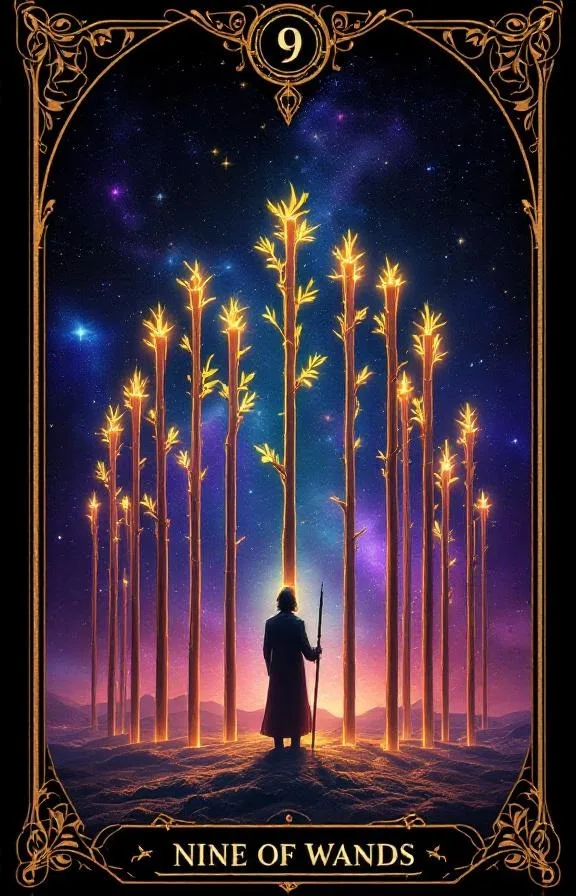
The bandage is still on his forehead and he's already back on his feet. Not because he's healed — he's clearly not — but because sitting down feels more dangerous than standing. The Nine of Wands person has been through something. You can see it in their posture: alert, wary, coiled. They're still here. That's the whole point.
The personality profile
The Nine of Wands person carries their history in their body. Tense shoulders. A gaze that tracks movement near doorways. The habit of sitting with their back against the wall. They've been hurt — genuinely, significantly hurt — and they survived, but survival left marks that changed how they move through the world.
This is resilience, but not the motivational poster kind. Not the "what doesn't kill you makes you stronger" bumper sticker. The Nine of Wands person knows that what doesn't kill you often leaves you exhausted, hypervigilant, and fundamentally altered. Their strength isn't inspiring in a comfortable way. It's the kind of strength you recognize only if you've needed it yourself.
Bessel van der Kolk's research on trauma describes how the body keeps score — storing experiences of threat and survival in the nervous system long after the conscious mind has processed them. The Nine of Wands person is a living illustration. They flinch at things that wouldn't register for someone else. They triple-check locks. They read the fine print. They anticipate betrayal not because they're pessimistic but because they've been betrayed, and the lesson stuck.
Nine of Wands upright as a person
Upright, the Nine of Wands person is still fighting. Battered, yes. Tired, absolutely. But still standing, still swinging, still showing up. There's something genuinely heroic about them — not the clean, photogenic heroism of someone who wins easily, but the ugly, exhausted heroism of someone who has every reason to quit and doesn't.
They're the single parent working two jobs. The cancer survivor who went back to graduate school. The person who rebuilt after losing everything in a divorce. They don't talk about their resilience much — they're too busy enacting it to narrate it.
What the upright Nine of Wands person needs is acknowledgment. Not pity. Not "you're so brave" said in that slightly condescending tone. Just someone who sees what they've been through and says, simply, "I know this is hard. I'm here." That's enough.
Nine of Wands reversed as a person
Reversed, the survivor becomes the walking wounded. They're still standing, but the posture has shifted from defensive to rigid. They can't relax. Can't trust. Can't allow anyone close enough to help because the last time they were vulnerable, someone used it against them.
The reversed Nine of Wands person has let their vigilance calcify into isolation. They've built a fortress and locked themselves inside it. The walls that once protected them are now a prison. They refuse help. They reject comfort. They treat kindness with suspicion because, in their experience, kindness has had conditions attached.
There's a stubbornness to their suffering that can frustrate the people who love them. They keep carrying burdens they could share. They keep fighting battles that ended years ago. They're so deeply identified with their struggle that they've forgotten what they're struggling toward. The fight has become the identity, and peace — if it ever came — might feel like a death.
Nine of Wands as a person in love
Love with a Nine of Wands person requires patience measured in months, sometimes years. They will test you. Not consciously — they're not playing games — but their nervous system will run tests: Can this person handle my worst day? Will they leave when things get ugly? Can I fall asleep next to them without checking the locks twice?
Every milestone takes longer with this person. First kiss. First vulnerability. First time they cry in front of you. First time they admit they need you. Each one is a wall coming down, and each wall comes down slowly, with resistance, and with the constant possibility that it goes right back up at the first sign of danger.
But if you stay — if you pass the tests not by being perfect but by being consistent — you will have the most fiercely loyal partner imaginable. A Nine of Wands person who trusts you will defend that trust with everything they have. Because they know exactly what it cost them to build it.
Nine of Wands as a person at work
Crisis counseling. Veteran support services. Trauma-informed care. Emergency response. Any field where understanding suffering isn't theoretical but experiential. They're also quietly excellent in quality assurance and risk management, because they naturally anticipate what can go wrong — not from anxiety but from hard-won pattern recognition. Their caution isn't pessimism. It's data.
Nine of Wands as someone in your life
Don't try to fix them. Don't try to rush them. Don't say "just relax" — they've heard it, and it doesn't help. The Nine of Wands person in your life needs exactly one thing from you: consistent, patient presence without an agenda. Show up. Keep showing up. Don't make promises you can't keep. Don't disappear without explanation. Be the proof that not everyone leaves. That's the only argument their nervous system will accept.
Frequently asked questions
What kind of person does the Nine of Wands represent?
A survivor. Someone who has endured significant hardship and is still standing — not because they're unaffected, but because they refuse to stop. Their strength is real, hard-won, and visible in the way they carry themselves.
Is the Nine of Wands as a person positive or negative?
Complex. Their resilience is genuinely admirable, but the hypervigilance and trust issues that often accompany survival can make relationships and daily life more difficult than they need to be. The card honors what they've endured while acknowledging the cost.
How do you recognize a Nine of Wands person?
They look tired but alert. There's a watchfulness about them that goes beyond normal attention — they're tracking something. They might have a harder time relaxing in social situations, tend to sit near exits, and will deflect questions about their past with practiced ease. Their scars, physical or emotional, are part of their presence even when they're not visible.