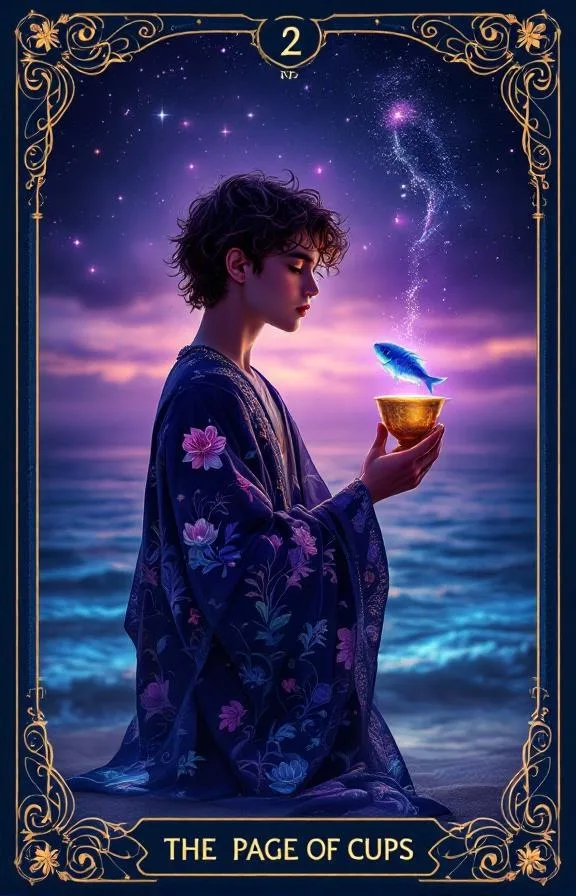
They wrote you a poem and slipped it under your door. It was not a good poem. That is entirely beside the point. The Page of Cups person communicates in gestures that are so earnest they border on absurd, and the absurdity is part of the charm. They are the person who sees a fish jump out of a cup and, instead of questioning the physics, asks what it is trying to say.
The personality profile
The romantic archetype is often dismissed as immature. This is a mistake, and a lazy one. The Page of Cups person carries something that most adults have abandoned: the willingness to be completely, visibly moved by things. A song. A sunset. A stranger's kindness at the grocery store. They cry at movies. They stop to talk to dogs. They fall in love with ideas, places, and people with a speed and sincerity that would be alarming if it were not so obviously genuine.
Their emotional life operates without the filters that adulthood installs. Where most people have learned to moderate their reactions — to feel privately, express carefully, always maintain plausible deniability about the depth of their investment — the Page of Cups person has not learned this, or has learned it and rejected it. They feel openly. They show openly. They love openly.
D.W. Winnicott's concept of the "true self" versus the "false self" maps onto this personality perfectly. Winnicott argued that psychological health depends on the ability to express one's genuine emotional states without excessive compliance to external expectations. The Page of Cups person is operating from the true self almost exclusively, which makes them vivid and vulnerable in equal measure.
Page of Cups upright as a person
Upright, the Page of Cups person is a walking invitation to feel something. Their enthusiasm is infectious in a way that goes beyond mere positivity — it reaches into whatever part of you has become calcified by routine and professionalism and adult caution, and it softens it.
They are creative without pretension. They make things — collages, playlists, sketches, handmade gifts — not because they are trying to be artists but because making things is how they process being alive. The output is secondary. The process is the point. They paint not to produce a painting but to experience the feeling of putting color on a surface.
Their romantic nature extends beyond relationships. They romanticize their morning coffee. Their commute. Their neighborhood in autumn. They find beauty in places that other people walk past without seeing, and they have a compulsion to share it — "look at that light" — that can feel either magical or exhausting depending on your own relationship with wonder.
Page of Cups reversed as a person
Reversed, the romanticism turns into emotional volatility. The same person who felt everything beautifully now feels everything destructively. The unfiltered emotional life that was charming upright becomes chaotic reversed — mood swings, dramatic reactions, a tendency to create crisis where none exists because they confuse intensity with significance.
They become the unreliable narrator of their own life. Every minor disappointment is a tragedy. Every crush is a soulmate. Every disagreement is a betrayal. The emotional volume is permanently at ten, and the lack of calibration exhausts everyone around them, including themselves.
Escapism into fantasy is another risk. They retreat into books, movies, daydreams, or online personas that feel more real than their actual life. The Page of Cups reversed can spend years living in an imaginary world — a fictional relationship, an idealized future, a romanticized version of someone who does not actually exist as they are being imagined. And the longer they stay in the fantasy, the less capable they become of tolerating reality's imperfections.
Page of Cups as a person in love
Oh, this is where they come alive. The Page of Cups person in love is a force of nature wrapped in handwritten letters and mix CDs and 3 AM texts that say "this song made me think of you." They fall hard. They fall fast. They fall with their whole body and a complete absence of strategy.
Their love is earnest to the point of being almost comedic. They are the person who shows up at your workplace with flowers. Who writes your name in the margin of every notebook. Who cries during your vows. They bring a kind of ceremonial weight to romance that can feel old-fashioned in the age of casual dating — and that is exactly what makes it valuable.
The danger is naivety. They project qualities onto their partners that may not be there. They hear what they want to hear. They see what they want to see. The first betrayal hits them like a freight train because they genuinely did not consider the possibility. Not every heart is as open as theirs, and learning this lesson is the most painful education of their life.
Page of Cups as a person at work
The Page of Cups person at work is the creative wild card. They contribute ideas that no one else would think of because their thinking is not constrained by conventional frameworks. They are best suited to roles that value imagination — graphic design, writing, music, early childhood education, art therapy, social media. Corporate environments drain them unless there is a creative component. They struggle with bureaucracy, formality, and any culture that punishes emotional expression.
Page of Cups as someone in your life
Having a Page of Cups person in your life is like having a window that is always open. Fresh air, but also rain sometimes. They bring spontaneity, tenderness, and an emotional honesty that can be startling if you are not used to it.
Protect their sensitivity without patronizing it. They do not need to be toughened up. The world will do that on its own schedule, and trying to accelerate the process by dismissing their feelings or telling them to grow up will only damage the thing about them that is most worth keeping. Instead, model healthy emotional boundaries without demanding that they suppress their nature. They need to learn where to direct all that feeling. They do not need to learn how to stop feeling.
Frequently asked questions
What kind of person does Page of Cups represent?
The Page of Cups represents a romantic, emotionally open individual who approaches life with genuine wonder and creative sensitivity. They are the youngest energy in the Cups court — not necessarily in age, but in their unguarded relationship with their own feelings.
Is Page of Cups as a person positive or negative?
Predominantly positive, though fragile. Their openness is their greatest strength and their greatest vulnerability. Upright, they bring beauty, sincerity, and creative energy to everything they touch. Reversed, the same openness can lead to emotional chaos, naivety, and a retreat into fantasy that prevents them from engaging with reality.
How do you recognize a Page of Cups person?
They are the one making something with their hands. Drawing in the margins. Humming to themselves. They respond to beauty with visible emotion — stopping mid-sentence to point out a cloud formation or tearing up at a piece of music. Their texts are long and punctuated with hearts. They remember the emotional content of conversations long after the facts have faded. And they look at you — really look — when you are talking, as if what you are saying genuinely matters to them. Because it does.