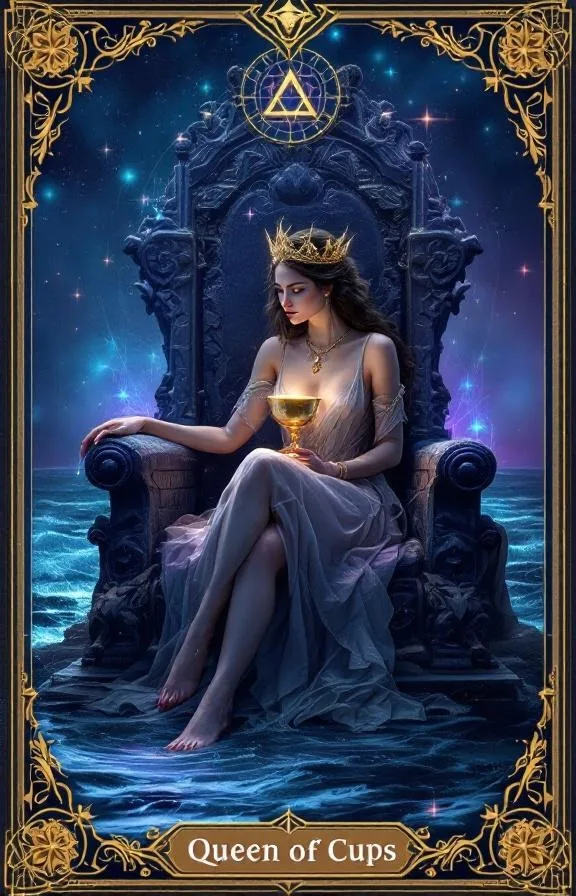
A queen on a throne at the water's edge, holding an ornate cup she does not drink from but contemplates. She feels everything in the room and lets none of it overwhelm her. That combination — deep sensitivity paired with unshakable composure — is the entire message of this card. And it showed up because you need to learn it.
The advice
Trust your feelings. Not blindly. Not impulsively. But as legitimate information that deserves the same weight you give facts and logic.
The Queen of Cups addresses a specific modern problem: the cultural habit of treating emotion as the opposite of intelligence. Feelings are considered unreliable, subjective, messy. Data is considered reliable, objective, clean. The Queen of Cups says this hierarchy is wrong, and the people who follow it are navigating with half their instruments disabled.
Your emotional responses contain information that your analytical mind cannot access. The gut feeling about a person that precedes any evidence. The unease about a decision that the spreadsheet says is correct. The pull toward something you cannot justify with logic. Neuroscientist Antonio Damasio spent decades demonstrating that decision-making literally requires emotional input — patients with damage to emotion-processing brain regions could not make even simple decisions despite fully intact logical faculties. The Queen of Cups has always known what Damasio had to prove.
The advice is not to follow your feelings everywhere without question. It is to consult them the way you would consult a trusted advisor — listen carefully, weigh their input, and include it in the final decision alongside everything else you know.
Queen of Cups upright advice
Upright, the Queen says your emotional intelligence is your greatest asset right now. Use it.
Whatever situation you are facing — a decision, a relationship challenge, a career crossroads, a creative block — the answer is accessible through feeling rather than analysis. You have been overthinking this. The Queen of Cups does not overthink. She sits at the edge of the water and lets the water speak.
Practically, the advice is to create space for emotional information to surface. This means slowing down. Turning off the noise. Sitting quietly with the question and noticing what arises in your body before your mind starts narrating. The feeling will come as a physical sensation first — tightness, warmth, heaviness, lightness — and translate into knowing second. Trust the knowing even when you cannot explain it.
The upright Queen also advises compassion — specifically, the kind that does not require you to absorb other people's pain. The Queen feels deeply without drowning. She understands others' suffering without making it her own. This distinction is crucial and most empathic people miss it. You can hold space for someone's pain without holding the pain itself. The Queen says that boundary is not cold. It is sustainable.
If you have been the emotional caretaker in every relationship — the person everyone calls when they need to process, the one who manages other people's feelings more carefully than their own — the upright Queen says this pattern is reaching its limit. Compassion without self-preservation is not compassion. It is codependence wearing a halo.
Queen of Cups reversed advice
Reversed, the emotional mastery the Queen represents has collapsed into one of two extremes: emotional flooding or emotional shutdown.
If you are overwhelmed — absorbing everyone's feelings, unable to distinguish your emotions from the ambient mood, crying at things that are not about you — the reversed Queen advises boundaries. Hard ones. The kind that feel selfish because your operating system confuses selfishness with self-care. You need to pull back from at least one emotional responsibility that is not yours. Delegate the support. Excuse yourself from the crisis. The people who depend on your emotional labor will survive without it temporarily, and you will not survive if you continue providing it indefinitely.
If you are shut down — numb, disconnected, performing emotions you do not feel — the reversal has a different message. Something hurt you badly enough that your system decided feeling was no longer safe. The Queen reversed says the decision was understandable and it is no longer serving you. The wall you built against pain is also blocking joy, connection, and the emotional intelligence that is your natural gift. Start taking bricks out. One at a time.
There is a third possibility: you do not trust your own feelings because someone taught you not to. A parent who dismissed your emotions. A partner who called you "too sensitive." A culture that equated feeling with weakness. The reversed Queen says those voices lied. Your sensitivity is accurate. It has always been accurate. The problem was never your feelings. The problem was the environment that could not handle them.
Queen of Cups advice in love
In love, the Queen of Cups advises emotional depth over emotional performance.
For singles, the card says stop dating people who make you perform a less emotional version of yourself. If you have to suppress your sensitivity, edit your feelings, or pretend to be less caring than you are in order to maintain someone's interest, that person is not your person. The Queen of Cups does not dim herself for anyone. Neither should you.
For couples, the advice is to create emotional safety within the relationship. This means becoming the person your partner can be fully honest with — not through declaration but through consistent, non-judgmental reception of their feelings. When they tell you something difficult, do not fix it. Hear it. When they express vulnerability, do not evaluate it. Hold it. Emotional safety is built in moments of reception, not in grand gestures of support.
If you are the partner who does all the emotional processing while the other person contributes logic, the Queen of Cups says rebalancing is necessary. You cannot be the only person in the relationship who deals in feelings. The emotional workload needs to be shared, and asking for that share is not being needy. It is being fair.
Queen of Cups advice in career
The Queen of Cups in career readings champions emotional intelligence as a professional skill.
If you are in leadership, the card says your most effective tool is not strategy — it is the ability to read a room, understand what motivates individuals, and create environments where people feel safe enough to do their best work. Data cannot tell you that your best employee is about to quit because they feel unseen. Emotional attention can.
For people in helping professions — therapy, healthcare, social work, teaching — the Queen of Cups delivers essential advice: protect your energy. Compassion fatigue is real, it is cumulative, and it is the occupational hazard that no HR department adequately addresses. The card says build rituals of emotional discharge. End-of-day practices that allow you to put down other people's feelings before you walk through your own front door.
For creative work, the Queen advises creating from genuine emotion rather than market demand. The piece that moves you will move others. The piece calculated to perform well might perform well and move no one. The Queen of Cups trusts emotional resonance over algorithmic optimization.
If you are navigating office politics, the card advises quiet observation over aggressive maneuvering. The Queen sees everything from her throne but acts selectively. Watch the dynamics. Understand the emotional undercurrents driving the political behavior. Then act from understanding rather than reaction.
Action steps
- Sit with a decision for ten minutes without thinking. Not analyzing. Feeling. Notice what your body tells you about each option. The tightening. The ease. The resistance. Those are data points.
- Set one emotional boundary this week. Identify a relationship where you are carrying more emotional weight than your share. Communicate the limit. Kindly, clearly, without negotiation.
- Validate someone's feelings without fixing them. When a person you care about shares a problem, respond with understanding instead of solutions. "That sounds really hard" is sometimes more useful than any advice.
- Check in with yourself three times today. Not with your schedule or your to-do list. With your emotional state. Just notice it. Name it. That practice builds the emotional awareness the Queen considers essential.
FAQ
Does the Queen of Cups mean I am too emotional?
No. The Queen of Cups never describes excess — she describes mastery. If you are asking whether you are "too emotional," you have been told by someone that your emotional range is a problem. The card disagrees. Your emotional depth is a skill that most people lack and many people need. The question is not whether you feel too much but whether you have learned to feel without being consumed. That is the difference between emotional depth and emotional dysregulation, and it is a skill that can be learned.
How do I trust my feelings if they have led me wrong before?
Your feelings did not lead you wrong. Your interpretation of your feelings may have. Emotion is raw data — accurate, immediate, physical. The error usually happens in translation, when the mind converts "I feel anxious around this person" into "this person is exciting." The Queen of Cups advises learning to read your emotional signals more accurately rather than dismissing them because of past misreadings. A thermometer that was read wrong once is not a broken thermometer. The reader just needs practice.
Is the Queen of Cups telling me to be more nurturing?
Only if nurturing is something you have been withholding from yourself. The card is often misread as advice to nurture others, but the Queen's primary relationship is with her own emotional landscape. She holds the cup but she does not pour it for everyone who asks. If you have been nurturing others at the expense of your own emotional needs, the card is actually advising the opposite: redirect some of that compassion inward. Fill your own cup first. The people around you will benefit from the overflow without requiring you to empty yourself.