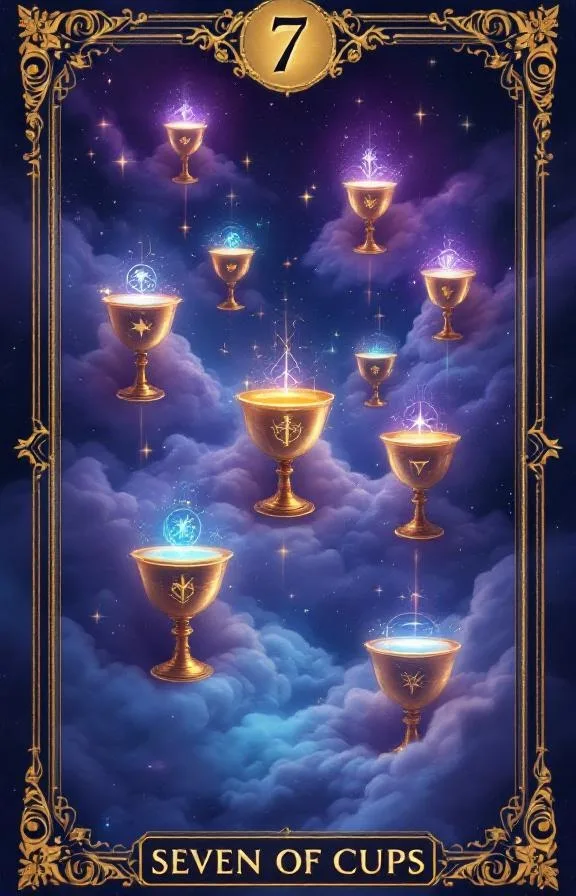
Seven cups floating in clouds, each containing a different fantasy — wealth, beauty, power, mystery. All of them glowing. None of them real. The Seven of Cups arrived because you are standing in a fog of possibilities and mistaking the fog for freedom.
The advice
Get real. Choose one thing and commit to it.
The Seven of Cups is the most misunderstood card in the deck for advice readings. People see all those shimmering options and assume the card is celebrating abundance of choice. It is not. It is warning you that too many options and no options produce the same result: paralysis.
Barry Schwartz called it the paradox of choice — as options increase, satisfaction decreases. But the Seven of Cups goes further than Schwartz. It says the options you are considering are not even real options. They are fantasies. Half-formed daydreams dressed up as plans. You have not researched them, tested them, or confronted the practical obstacles each one would involve. You have only imagined the best possible outcome of each and compared those imaginary outcomes against each other.
This is not decision-making. This is entertainment.
The card's advice is blunt: most of your options are illusions. Some are genuinely attractive but impractical. Some are practical but you have inflated their appeal. And at least one — probably the one that excites you least — is real, achievable, and worth pursuing. Your job is to figure out which one that is, commit to it, and let the rest dissolve.
Seven of Cups upright advice
Upright, the fog is thick and the card says you are lost in it. Not happily lost. Productively lost — which is worse because it feels like progress.
You have been "exploring options" for a while now. Researching. Making lists. Having exciting conversations about what you might do. The upright Seven of Cups says this phase has expired. Further exploration is not getting you closer to a decision. It is helping you avoid one.
The specific advice: impose a constraint. When everything feels possible, nothing gets done. Eliminate at least three options by the end of this week — not because they are bad options but because carrying them all is preventing you from executing any of them. The criteria for elimination are simple: which of these have you actually taken a concrete step toward? The ones that exist only as ideas after weeks or months of consideration are the ones to cut.
There is a particular trap the upright Seven highlights: confusing desire with intention. Wanting something is not the same as being willing to do the work it requires. You may want to write a book, start a business, move abroad, and change careers. Those are all desires. Intentions come with timelines, sacrifices, and unglamorous daily effort. The card asks you to be honest about which of your "plans" are actually wishes.
Seven of Cups reversed advice
Reversed, clarity is arriving. The fog is thinning and you can see which cups hold substance and which hold smoke.
The reversed Seven of Cups says you are ready to decide, and the card advises deciding quickly before the fog rolls back in. Clarity in the Seven of Cups context is temporary — it comes in windows, not permanent states. When you see clearly what you want, act on that clarity immediately. Do not wait for more information. Do not consult five more people. The additional input will only re-create the confusion you just escaped.
If the reversal signals that you have already chosen — you narrowed the options and committed to one path — the advice is to stop looking back at what you did not choose. Buyer's remorse is the Seven of Cups reversed shadow. You picked a real thing over several fantasies, and now the fantasies look appealing again precisely because you cannot have them. This is the nature of fantasies. They are always more attractive than reality because they do not include inconveniences like effort, risk, and Monday mornings.
Stay the course. The option you chose became real the moment you chose it. The ones you did not choose remained imaginary. Real beats imaginary every time, even when it does not feel that way.
Seven of Cups advice in love
In love, the Seven of Cups often points at romantic fantasy that has replaced romantic reality.
For singles, this manifests as either endless browsing or idealization. You are swiping without committing, maintaining three promising conversations without deepening any of them, or fantasizing about a specific person without ever actually asking them out. The card says pick one. Have a real conversation. Go on a second date with someone before seeking a third option. Your soul mate is not going to emerge from the cloud of possibilities. They are going to emerge from the awkward, imperfect, deeply unsexy process of getting to know a specific human being.
For couples, the Seven of Cups warns against the comparison trap. Social media has made it possible to witness curated versions of other people's relationships around the clock. If you are measuring your partner against a fantasy — whether that fantasy is an ex, a celebrity, or the imagined version of the person who flirted with you at the coffee shop — the card says stop. You are comparing a real person to a hologram. The hologram will win every time, and the real person will feel it.
The bold statement: romantic fantasy is relationship sabotage. Not always conscious, rarely malicious, but sabotage nonetheless. The Seven of Cups advises choosing the real person over the idea of a better one.
Seven of Cups advice in career
Professionally, the Seven of Cups diagnoses a common condition: career fantasy as a substitute for career action.
You have multiple directions you could take. Each one sounds exciting when you describe it at dinner parties. None of them have progressed beyond the daydream stage. The card is not impressed by your versatility. It is concerned about your execution.
The advice: pick the option that scares you least to start and most to abandon. That combination usually indicates the path with genuine momentum behind it. The project that excites you most may be the biggest fantasy. The one that feels most "ordinary" may be the one rooted in reality.
For entrepreneurs specifically, the Seven of Cups is a warning against shiny object syndrome. New business ideas feel better than existing business problems. Pivoting feels more exciting than persisting. But businesses are built in the boring middle, not at the exciting beginning, and the card says you need to stay in the boring middle long enough for it to produce results.
Job seekers will recognize the Seven of Cups as the paralysis of too many job boards, too many possibilities, and too little focused effort. Apply to fifteen companies with tailored applications rather than fifty with the same resume. Depth beats breadth when every cup is glowing.
Action steps
- Eliminate three options today. Whatever you have been considering — jobs, relationships, projects, cities — cross off three. Not because they are wrong. Because carrying all of them is keeping you from any of them.
- Write down the cost of each remaining option. Not the benefit. The cost. What each one requires in time, money, sacrifice, and discomfort. Fantasy evaporates when you add a price tag.
- Take one concrete step toward one option. Send the email. Register the domain. Make the phone call. Convert one cup from cloud to ground.
- Set a decision deadline. Choose a date by which you will commit to one path. Tell someone the date. Accountability makes procrastination harder.
FAQ
What if all my options genuinely are good?
Then the card's advice is even more relevant. When all options are good, the cost of not choosing exceeds the cost of choosing wrong. A mediocre choice executed well outperforms an excellent choice never made. The Seven of Cups says that the fantasy of keeping all possibilities alive is more damaging than the reality of committing to one imperfect path. Choose, execute, adjust. That sequence beats deliberate, deliberate, deliberate.
Does the Seven of Cups mean someone is being deceptive?
It can, but usually the deception is self-directed. You are lying to yourself about what you actually want, what you are actually willing to do, or how realistic your plans actually are. If another person is involved — a partner making promises, an employer offering vague opportunities — the card advises asking for specifics. Vague promises are the relational equivalent of cups in clouds. Get details. Get timelines. Get commitments in writing. If the other person resists specificity, that resistance is your answer.
How do I tell the difference between a real opportunity and a fantasy?
Real opportunities come with logistics. They have deadlines, costs, obstacles, and boring details. Fantasies are frictionless — they skip from idea to outcome without the messy middle. If you can describe an option's appeal in one sentence but cannot describe its first three practical steps, it is probably a fantasy. The Seven of Cups says the option that makes you think "this would be hard but I know how to start" is worth more than the one that makes you think "this would be amazing" without any idea how to begin.