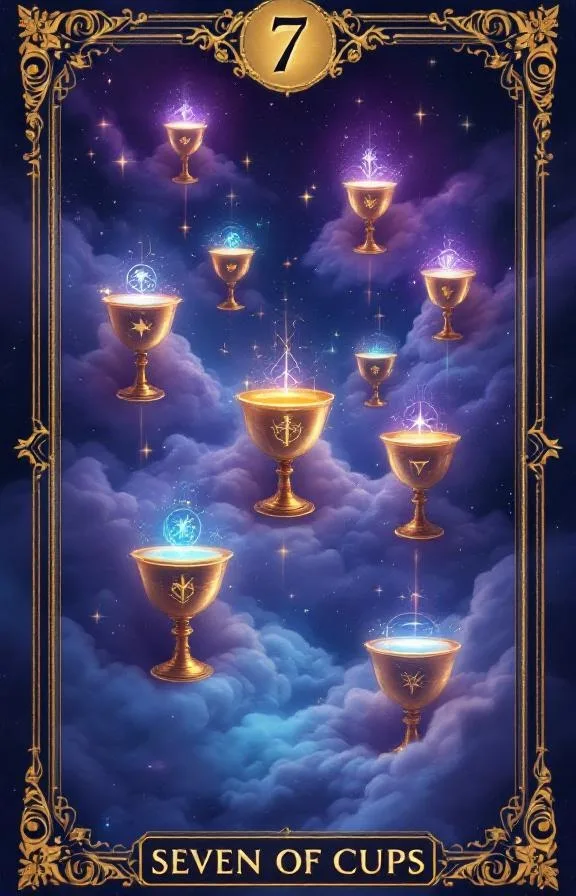
Ask them what they want to do with their life and you will get a different answer every week. Filmmaker. Herbalist. Travel photographer. Nonprofit founder. App developer. The Seven of Cups person contains multitudes — an entire catalog of possible selves, each one vivid and detailed and absolutely sincere in the moment it is being described. The problem is not a lack of vision. It is an excess of it.
The personality profile
The daydreamer archetype gets dismissed too easily. Society rewards focus. Pick a lane. Commit. The Seven of Cups person looks at all the lanes and sees beauty in every single one of them, and this expansive vision is treated as a character flaw rather than what it actually is: an overabundance of imagination.
Their inner world is extraordinarily rich. They can spend hours mentally constructing a life they have not yet lived — the apartment in Lisbon, the book they will write, the relationship they will have with the person they have not met yet. These are not idle fantasies. Each one is emotionally real to them. They feel the future as vividly as others feel the present, which makes choosing one path feel like killing six others.
Jerome Singer, who pioneered the study of daydreaming at Yale, argued that positive-constructive daydreaming is a sign of psychological health, not deficiency. The Seven of Cups person operates in this mode constantly — their mind generates possibilities the way other people's minds generate to-do lists. The question is not whether this capacity is valuable. It obviously is. The question is whether they can harness it.
Seven of Cups upright as a person
Upright, the Seven of Cups person is genuinely enchanting. Their enthusiasm is contagious. They see potential everywhere — in people, in situations, in half-formed ideas that most people would dismiss. Talking to them feels like brainstorming with someone who has no internal editor, and the result is an exhilarating rush of "what if" that can be genuinely inspiring.
They make excellent creative collaborators. Their strength is ideation — the raw generation of possibilities. They are the person in the room who throws out the idea that sounds absurd until someone realizes it is actually brilliant. They connect dots that others cannot see because their mind is not constrained by the conventional logic of what is practical or likely.
There is also an openness to their personality that borders on naivete. They believe in magic — not literally (though some of them do), but in the sense that they believe extraordinary outcomes are genuinely available. That the universe is more generous than cynics assume. This faith can be annoying to pragmatists, but it is also the quality that allows them to attempt things that more cautious people would never try.
Seven of Cups reversed as a person
Reversed, the dreaming replaces the doing. Completely. The Seven of Cups person has seventeen unfinished projects, four partially written novels, three business plans, and zero completed works. They have researched every detail of launching a pottery studio except for the part where they actually make pottery.
Decision paralysis is their defining struggle. Faced with multiple appealing options, they choose none. They wait for clarity that never arrives because clarity comes from commitment, and commitment is the thing they are avoiding. The irony would be funny if it were not so self-defeating: they want everything, so they end up with nothing.
Escapism becomes a serious concern. Drugs, alcohol, excessive gaming, compulsive scrolling, serial dating — any activity that provides a dopamine hit without requiring sustained effort becomes a trap. The reversed Seven of Cups person substitutes the feeling of possibility for the reality of achievement and loses years to the substitution.
They can also develop a pattern of dishonesty — not malicious lying, but a chronic exaggeration born of wanting their life to match their fantasies. They tell you about the job they are "basically starting next month" that is actually a vague email thread. They describe the relationship they are "sort of in" that is actually three unanswered text messages. The gap between their narrative and their reality widens until even they cannot tell the difference.
Seven of Cups as a person in love
In romance, the Seven of Cups person falls in love with potential. They meet someone and immediately project an entire future onto them — the house, the travels, the inside jokes they will develop. The actual person becomes a canvas for the Seven of Cups individual's imagination, which is flattering for about a month and then deeply disorienting.
Their partner starts to realize that they are not being seen for who they are but for who the Seven of Cups person needs them to be. And when reality inevitably intrudes — when the real person fails to match the fantasy — the Seven of Cups individual feels betrayed by a promise that was never actually made.
Serial dating is common. Each new person represents a new possibility, and the beginning of a relationship — when everything is potential and nothing is settled — is their favorite phase. The middle part, where love becomes routine and daily and requires showing up even when the magic has faded, is where they falter.
Seven of Cups as a person at work
The Seven of Cups person is the ultimate idea generator and the worst closer. They start strong, lose interest once the concept phase ends, and move on to the next shiny thing. They need a partner or a team structure that picks up where they leave off — someone who takes their brilliant spark and turns it into a deliverable. Roles in early-stage ideation, creative direction, brainstorming facilitation, or innovation labs suit them. Execution roles destroy them.
Seven of Cups as someone in your life
If you have a Seven of Cups person in your life, you have access to one of the most interesting minds you will ever encounter. Their conversation is never boring. Their perspective is never predictable. The cost is reliability — plans may change, commitments may dissolve, and timelines are suggestions at best.
Do not try to pin them down. It will not work and it will damage the relationship. Instead, enjoy the expansiveness while gently celebrating the rare moments when they actually complete something. Those moments need reinforcement. Not in a patronizing way — just genuine acknowledgment that the doing was as valuable as the dreaming. Because they already know how to dream. The doing is the part they need to be reminded is worth the effort.
Frequently asked questions
What kind of person does Seven of Cups represent?
The Seven of Cups represents an imaginative, possibility-obsessed individual who lives largely inside ideas and potential. They are creative, enthusiastic, and capable of seeing options that others miss, but they often struggle to translate their rich inner visions into concrete reality.
Is Seven of Cups as a person positive or negative?
Both, genuinely. Their imagination is a superpower that can produce extraordinary creative work and inspire everyone around them. But without discipline, it becomes escapism — a beautiful prison where nothing ever gets finished and reality can never compete with fantasy.
How do you recognize a Seven of Cups person?
They have multiple passions, change direction frequently, and describe their plans with vivid enthusiasm that feels totally convincing in the moment. Their living space is often filled with supplies and materials for hobbies they started and abandoned. They are always reading about something new. And they have that particular gleam in their eye when they say "I have this idea..." — a gleam you have seen many times before, attached to many different ideas.