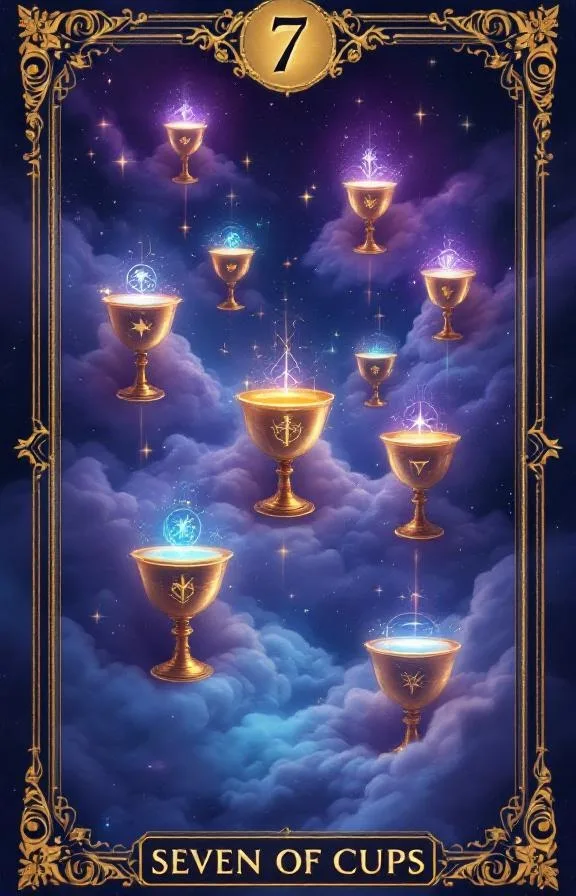
Seven cups float in clouds, each containing something different — a castle, a jewel, a laurel wreath, a dragon, a glowing figure. Every option shimmers with possibility. None of them are real. Not yet. The person staring up at them is drunk on potential, paralyzed by abundance, lost in a fog where wanting something and having something feel dangerously similar. The Seven of Cups as feelings is that seductive confusion: the emotional high of imagining without the discipline of choosing.
The core feeling
Fantasy as an emotional state operates differently than most people assume. It is not escapism, exactly, though it can serve that function. At its root, fantasy is the mind rehearsing emotional experiences it has not yet had — running simulations, testing scenarios, building elaborate futures out of desire and projection. Psychoanalyst Donald Winnicott argued that the capacity for fantasy is essential to emotional health, that it serves as a transitional space between internal wishes and external reality where new possibilities can be safely explored. The Seven of Cups captures that transitional space — but it also shows what happens when someone gets stuck in it.
The person experiencing Seven of Cups feelings has abundant emotional energy but no outlet for it. Their desire is diffuse rather than focused. They want everything and cannot rank their wants into an actionable sequence. The result is a peculiar emotional state — simultaneously overstimulated and undercommitted, full of feeling and empty of direction.
Seven of Cups upright as feelings
Upright, the Seven of Cups is emotional overwhelm dressed up as excitement. The person feels open to everything: new relationships, creative visions, spiritual experiences, material ambitions. Each possibility generates genuine feeling — real desire, real enthusiasm, real emotional engagement. The problem is not that the feelings are false. The problem is that they are indiscriminate.
This emotional state can feel exhilarating. The person is flooded with options and the high of imagining each one is more pleasurable than the work of pursuing any single one. Why commit to building one castle when you can imagine seven? The daydreaming produces real dopamine. The commitment would produce real inconvenience. Fantasy wins every time until the person notices that their life has not actually changed despite all the emotional activity.
The person in the Seven of Cups is also vulnerable to a specific kind of self-deception: confusing the vividness of a feeling with evidence of its viability. Because they can imagine the relationship so clearly, they believe it is real. Because the career change feels right in their chest, they assume the practical obstacles will dissolve. This is not stupidity. It is the natural consequence of emotional richness untethered from reality testing.
Seven of Cups reversed as feelings
Reversed, the clouds begin to thin. The person starts distinguishing between desires that are genuine and desires that were performing the role of genuine while actually being distractions. One or two cups come into sharper focus. The rest lose their shimmer and reveal themselves as what they always were — appealing ideas with no substance behind them.
This clarification is uncomfortable. Fantasy was serving a purpose: it allowed the person to feel the emotional reward of having options without bearing the emotional cost of eliminating any. The reversed Seven demands elimination. Choose. Let the unchosen options die. Grieve them if necessary. But stop floating.
The reversed card can also indicate someone who has become cynical about their own desires after too many fantasies failed to materialize. They have stopped trusting their enthusiasm because their enthusiasm has a track record of leading nowhere. The feeling is a guarded wariness toward their own imagination — "I know I want this, but I also know I have wanted things before and done nothing about them."
Seven of Cups as feelings in love
In romantic readings, the Seven of Cups describes feelings colored heavily by projection and idealization. The person has constructed an elaborate emotional narrative around a relationship or potential relationship, and the narrative may bear limited resemblance to the actual other person involved. They are in love with a version of you that exists primarily in their imagination — one that has been edited to remove inconvenient details and enhanced with qualities you may or may not possess.
This is the "potential" card. The person sees what you could be together. What the relationship might become. The life they might build. These visions are emotionally real to them and can generate intense feelings of attachment, longing, and even grief for a future that has not happened yet and may never happen.
When someone feels the Seven of Cups in a love context, the hardest truth is this: the strength of their feelings is not evidence of their accuracy. A person can feel deeply for someone they have barely spent time with, because fantasy does not require proximity. It requires only desire and imagination, and this person has both in abundance.
Seven of Cups as feelings about you
When the Seven of Cups represents someone's feelings about you, you exist in their emotional world as one possibility among several — or, more precisely, as a screen onto which they are projecting a specific possibility. They are excited about you. They may even be obsessed with you. But the "you" generating those feelings is at least partly a construction of their own making.
This is not dishonesty on their part. They genuinely believe they are seeing you clearly. The emotional experience is vivid and feels reliable. It is only when reality begins asserting itself — when you do something unexpected, when the relationship encounters friction, when the imagined version and the actual version diverge — that the projection becomes visible.
Seven of Cups as feelings in career
Professionally, the Seven of Cups indicates someone paralyzed by possibility. They have too many ideas, too many potential directions, and the emotional investment in each one prevents them from committing to any. The startup. The book. The career change. The freelance plan. Each generates genuine excitement when contemplated and genuine anxiety when pursued.
The person most at risk for Seven of Cups energy in their career is the one with genuine talent and broad interests. They could succeed at several things. The emotional cost of choosing one means abandoning the others, and that abandonment feels like loss. So they keep all options open, which means none of them advance, which means the talent remains potential rather than achievement. Potential is the most expensive currency in professional life. It costs nothing and buys nothing.
Frequently asked questions
What does Seven of Cups mean as feelings?
The Seven of Cups represents feelings dominated by fantasy, imagination, and unfocused desire. The person is emotionally engaged with multiple possibilities simultaneously, experiencing the excitement of imagined futures without committing to the work of making any of them real.
Does Seven of Cups represent positive or negative feelings?
The feelings themselves are pleasurable — fantasy generates real emotional excitement. But the card warns that those feelings may be unreliable guides. Upright, the person is lost in possibility without grounding. Reversed, clarity is emerging and the person is beginning to distinguish genuine desires from appealing distractions. The card is less about the quality of the feelings and more about their relationship to reality.
What does Seven of Cups reversed mean as someone's feelings?
Someone feeling the reversed Seven of Cups is emerging from a period of emotional confusion and beginning to identify what they actually want versus what they were merely fantasizing about. Their feelings are becoming more focused and grounded, which may mean they are finally getting serious about a connection — or it may mean they are recognizing that what they felt was projection rather than genuine attachment.
Curious what Seven of Cups means as feelings in YOUR situation? Try a free AI tarot reading and explore the emotional landscape of your cards.