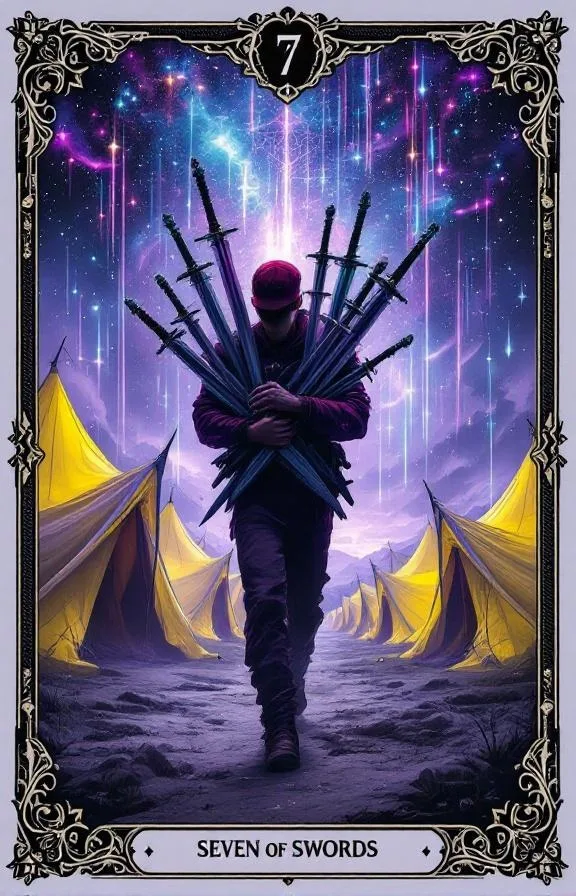
Not everything needs to be announced. The Seven of Swords as advice is the most misunderstood card in the deck — routinely reduced to "someone is being dishonest" when its actual message is far more nuanced. Sometimes the smart move is the quiet one. Sometimes strategy requires discretion. The Seven of Swords asks you to consider when transparency serves you and when it simply hands your advantage to someone who will use it against you.
The advice
The traditional image shows a figure carrying five swords away from a camp, leaving two behind. The standard interpretation is theft or deception. But look closer. The figure is alone. Outnumbered. Operating in a situation where a direct confrontation would be foolish. The Seven of Swords is the card of asymmetric strategy — what you do when you cannot win by brute force and need to win by intelligence instead.
As advice, this card says: be smart about your approach. Not every situation calls for full disclosure. Not every battle should be fought head-on. There are times when the wisest course of action is to move quietly, protect your plans from people who would undermine them, and secure what you need before anyone realizes what you are doing.
This is uncomfortable advice in a culture that valorizes radical transparency and vulnerability. And the Seven of Swords is not endorsing cruelty, fraud, or betrayal. The line it walks is between strategic discretion and dishonesty, and it trusts you to know the difference. Keeping a job search private from a vindictive boss is not deception. It is survival. Not sharing your business plan with a competitor disguised as a friend is not dishonesty. It is common sense.
The bold truth: sometimes the people who insist you should share everything with them are exactly the people you should share the least with.
Seven of Swords upright advice
Upright, the Seven of Swords advises you to use your mind as your primary weapon. You are in a situation where power is not distributed equally, and charging in with full transparency would be naive, not noble.
Think about what you can accomplish independently before involving others. Not because collaboration is bad, but because in this specific situation, involving the wrong people will compromise your goals. The upright Seven of Swords says: work alone when working alone is the smart play.
This card also advises you to trust your cunning. If you have been told your whole life that being strategic is manipulative, the Seven of Swords pushes back. Strategy is a form of intelligence. Reading a room and adjusting your approach is not manipulation — it is social competence. Knowing when to reveal information and when to hold it is not dishonesty — it is wisdom.
However, the upright card carries a warning embedded in its advice: the figure only carries five swords. Two remain behind. Whatever strategic advantage you gain through discretion will be incomplete. You will not get everything. The Seven of Swords advises you to accept that limitation rather than overreaching and getting caught.
Seven of Swords reversed advice
Reversed, the Seven of Swords shifts from "be strategic" to "come clean." Something that has been hidden needs to surface. A strategy that relied on secrecy has either run its course or been discovered, and continuing the deception will cause more damage than the revelation.
If you have been withholding information, the reversed card says the window for voluntary disclosure is closing. It is better to control the narrative by telling the truth on your terms than to have the truth exposed on someone else's terms. One is uncomfortable. The other is devastating.
The reversed Seven of Swords also applies when someone has been deceiving you. The advice here is to trust the evidence you have already gathered rather than accepting explanations that contradict what you can see. If something feels off, it probably is. The reversed card says stop giving people the benefit of the doubt when their behavior has already told you what you need to know.
Additionally, the reversed position sometimes indicates that a strategy you have been running is not sustainable. The mental overhead of maintaining the deception — the lies you need to track, the stories you need to keep consistent, the anxiety of potential exposure — has become more costly than whatever the deception was protecting. Simplify. Tell the truth. The relief will outweigh the consequences.
Seven of Swords advice in love
In romantic relationships, the Seven of Swords creates immediate tension because love is supposed to be the domain of total honesty. And the card's advice is: yes, mostly. But not always.
There are things you are entitled to keep private, even from a partner. Your internal thought process before you have reached a conclusion. Your past, to the degree that it does not affect the present. Your evolving feelings during a period of uncertainty when sharing them prematurely would cause unnecessary alarm.
The Seven of Swords in love advises discernment about timing and delivery. Not every feeling needs to be communicated the moment it is felt. Not every doubt needs to be verbalized before it has been examined. There is a difference between withholding and waiting — and the Seven of Swords trusts you to navigate that distinction.
However, if this card appears and you are actively hiding something significant — an affair, a debt, a secret that would change your partner's understanding of the relationship — the advice becomes: your strategy has an expiration date, and it is approaching faster than you think. Choose disclosure over discovery.
For new relationships: protect yourself. Share incrementally. Vulnerability is beautiful but premature vulnerability with someone who has not earned your trust is reckless, not brave.
Seven of Swords advice in career
Professionally, the Seven of Swords is the card of the entrepreneur, the freelancer, the person who succeeds by wit rather than by institutional power. Its career advice is: play smart.
Keep your best ideas close until they are ready to execute. Do not announce plans prematurely to colleagues who may co-opt or sabotage them. Do not share your salary negotiation strategy with coworkers who might undercut you. Do not broadcast your job search to your current employer before you have an offer in hand.
This is not paranoia. It is the recognition that professional environments often contain people whose interests directly conflict with yours, and that naivety about this fact has real consequences.
For entrepreneurs: the Seven of Swords advises that first-mover advantage exists but depends on operational security. If your business model is easily replicable, protect the details until you have established a foothold. The friend asking detailed questions about your business plan may be a future competitor. Or they may be a genuine ally. The Seven of Swords says: figure out which one before you answer.
For those in corporate environments: learn to read political dynamics before engaging with them. The person who presents your idea as their own was not being opportunistic in a vacuum — they saw an opening that your transparency created. The Seven of Swords does not blame you for being trusting. It advises you to be trusting more selectively.
Action steps
- Audit your information sharing. List the key plans, decisions, or feelings you are currently developing. For each one, ask: who needs to know this right now? If the answer is "no one yet," hold it.
- Identify your two left-behind swords. What are you willing to lose or leave behind in order to secure what matters most? The Seven of Swords requires acceptance that you cannot get everything. Name the acceptable losses.
- Evaluate one secret you are keeping. Is the secrecy protecting something legitimate (your safety, your strategy, your privacy) or is it avoiding something necessary (a hard conversation, accountability, the truth)? Act accordingly.
- Study the room before speaking. In your next meeting, professional or personal, spend the first ten minutes observing rather than contributing. Notice who has what agenda. Then decide what to share and what to hold.
FAQ
Is the Seven of Swords always about lying?
No, and this is the most common misreading of the card. The Seven of Swords is about strategy, discretion, and the intelligent management of information. Sometimes that involves deception, but more often it involves knowing when to share, when to wait, and when to keep your plans to yourself. The card can advise healthy boundaries and strategic thinking as easily as it can warn about dishonesty. Context determines which interpretation applies.
Does the Seven of Swords mean someone is deceiving me?
It can, but not necessarily. When this card appears as advice, it is more often speaking to your own behavior than someone else's. It may be advising you to be more strategic, to protect your interests, or to pay attention to information asymmetries in your relationships. If you strongly suspect deception, the card validates that instinct — but its primary role as advice is prescriptive (how you should act) rather than descriptive (what others are doing).
How do I tell the difference between healthy discretion and harmful deception?
The test is intent and impact. Healthy discretion protects your legitimate interests without actively harming someone who has a right to the information. Harmful deception benefits you at someone else's expense by denying them information they need to make informed decisions about their own life. If someone would feel betrayed upon learning what you are withholding, that is deception. If they would understand your reasons, that is discretion. The Seven of Swords asks you to be honest with yourself about which category your secret falls into.