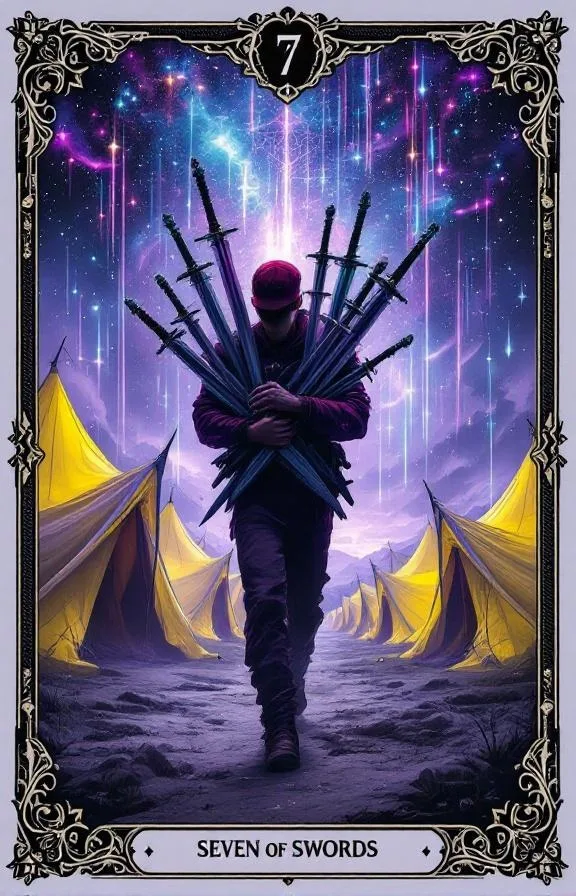
Watch their eyes during a group conversation. While everyone else is tracking the speaker, the Seven of Swords person is tracking the room — who is aligned with whom, what information is being withheld, which version of events is being performed and which is true. They are not malicious. They are just operating on a layer of social reality that most people do not even know exists.
The personality profile
The Seven of Swords person is the trickster archetype brought to life: clever, independent, morally flexible, and fundamentally uncomfortable with rules they did not write. They are not villains. Calling them villains is the lazy interpretation. They are people who learned early that the direct path is often guarded, that asking permission is often a trap, and that the clever approach — the one nobody expects — is frequently the only approach that works for someone without institutional power.
Every trickster has an origin story, and it almost always involves powerlessness. The Seven of Swords person grew up in a system they could not change through legitimate means — a rigid household, an unfair school environment, a community where the rules protected the powerful and punished the creative. They adapted by going sideways. While others banged on the front door, they found the window. While others argued for access, they simply took what they needed and dealt with the consequences later. Or, ideally, avoided consequences altogether.
Lewis Hyde's scholarship on trickster figures across cultures — Hermes, Coyote, Anansi, Loki — reveals a consistent thread: the trickster is the one who crosses boundaries that others accept as fixed. The Seven of Swords person lives this principle. They do not see rules as moral absolutes. They see rules as other people's strategies, and they reserve the right to deploy strategies of their own.
Seven of Swords upright as a person
Upright, their cunning serves creative problem-solving rather than self-serving deception. This person is the entrepreneur who finds the loophole in an oppressive regulation, the activist who outmaneuvers a corrupt system, the artist who subverts expectations in ways that reveal truth rather than concealing it.
They are exceptional at unconventional thinking. When a room full of people is stuck on a problem, the Seven of Swords person offers the solution nobody considered — not because they are smarter, but because they are willing to think in directions other people have ruled out as inappropriate or impossible. Their lateral thinking is genuine intellectual gift.
They also tend to be self-reliant to a fault. They do not delegate because delegation requires trust, and trust, for the Seven of Swords person, is offered sparingly and revoked quickly. They prefer to carry the swords themselves.
Seven of Swords reversed as a person
Reversed, the trickster loses control of their own game. Their deceptions catch up with them. Lies they told three years ago collide with lies they told last week, and the resulting collapse exposes the entire structure — every half-truth, every omission, every time they presented a curated version of events as the whole story.
The reversed Seven of Swords person is exhausting to deal with. You never quite know which version of them you are getting. They adjust their personality to the audience so fluidly that the question "who are they really?" becomes genuinely difficult to answer. Even they may have lost track.
Confronted, they deflect. Always. They reframe the conversation, question your motives for questioning them, or produce a counter-accusation so specific and well-timed that suddenly you are the one defending yourself. This pattern works remarkably well against people who are conflict-averse. It fails spectacularly against people who simply refuse to be redirected.
The deepest irony of the reversed Seven of Swords person is that their deceptions are usually unnecessary. They have enough talent, enough intelligence, enough genuine capability to succeed honestly. But they do not believe that. Somewhere along the way, they decided that their authentic self was insufficient and that survival required performance. That belief, more than any specific lie, is the real deception.
Seven of Swords as a person in love
This is where the Seven of Swords person is most dangerous and most vulnerable. In love, their instinct for self-protection collides directly with the radical transparency that intimacy demands. They want closeness. They also want to control what their partner sees. These desires are fundamentally incompatible, and the tension between them produces relationships that feel simultaneously intense and incomplete.
They are brilliant at the early stages of romance — at presenting a version of themselves that is genuinely attractive because it is genuinely true, just not complete. The parts they hide are not usually dramatic secrets. They are vulnerabilities, insecurities, failures, the unglamorous machinery of a self that has never felt safe enough to be seen fully.
A relationship with a Seven of Swords person either breaks through to honesty or breaks apart from the weight of everything unspoken. There is rarely a middle ground.
Seven of Swords as a person at work
Professionally, they are the person who gets things done through channels that do not officially exist. They know the workaround. They know the shortcut. They know whose assistant actually runs the department and who is just a title on an org chart.
In entrepreneurial contexts, this makes them invaluable. In bureaucratic contexts, it makes them dangerous. The organization's relationship with the Seven of Swords person depends entirely on whether their cleverness is pointed outward (toward competitors, toward problems) or inward (toward colleagues, toward the system itself).
Seven of Swords as someone in your life
If you have a Seven of Swords person in your life, pay attention to patterns rather than individual incidents. Any single instance of their behavior can be explained, rationalized, contextualized. The pattern is what tells the truth. And the pattern almost always reveals someone who is more afraid than they appear — afraid of being caught, yes, but more fundamentally afraid of being seen as they actually are and found lacking.
The most transformative thing you can do for a Seven of Swords person is create a context where honesty has no penalty. They have spent so long navigating systems that punish transparency that they may have forgotten such contexts exist. When they test the water with a small truth, receive it without drama. They are watching. They are always watching to see if it is safe.
Frequently asked questions
What kind of person does the Seven of Swords represent?
The Seven of Swords represents a trickster — someone whose intelligence expresses itself through unconventional strategies, boundary-crossing, and a deep skepticism toward rules and systems they did not choose.
Is the Seven of Swords as a person positive or negative?
Neither, inherently. Their cunning can serve creative problem-solving and social justice, or it can serve self-interested manipulation. The distinction lies in whether their cleverness is directed toward outcomes that benefit only themselves or toward outcomes that benefit the broader situation. Most Seven of Swords people oscillate between both.
How do you recognize a Seven of Swords person?
They have stories about bending rules that they tell with obvious relish. They are unusually observant in social situations. They give different people different amounts of information. They are charming in a way that occasionally makes you wonder what the charm is designed to accomplish.