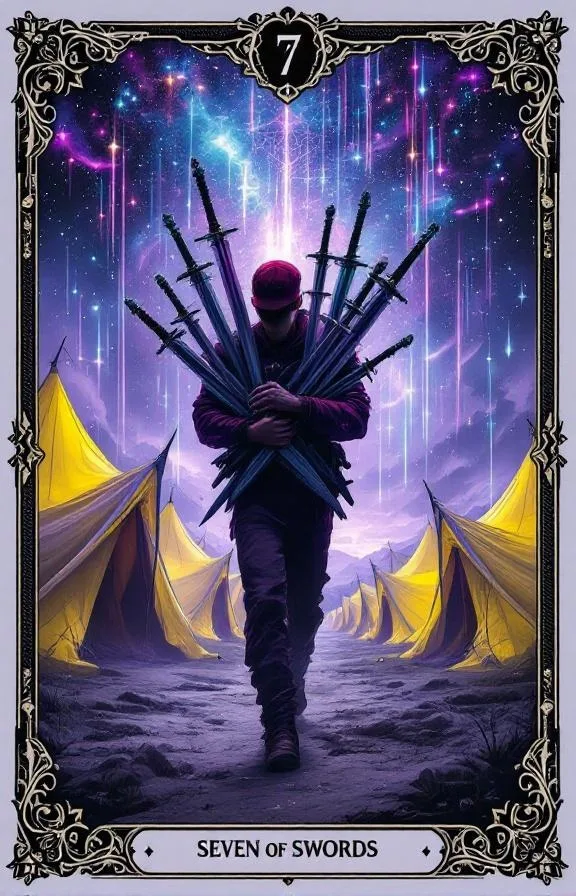
The figure in the card is sneaking away with an armful of stolen swords, glancing back to see if anyone noticed. But when the Seven of Swords shows up as feelings, the question is less about theft and more about what happens to a person's emotional landscape when trust has been shattered — their trust in someone else, someone's trust in them, or most insidiously, their trust in their own judgment.
The core feeling
Distrust rewires a person. It changes what they notice, what they assume, what they prepare for. Before distrust, a missed call is just a missed call. After distrust, a missed call is evidence. The Seven of Swords as feelings represents the exhausting hypervigilance of someone who has learned, through painful experience, that people are not always what they seem.
This is not paranoia in the clinical sense. It is adaptive suspicion — the brain doing exactly what evolution designed it to do after encountering deception. The problem is that this adaptation, while protective, also prevents connection. You cannot simultaneously guard yourself against betrayal and open yourself to intimacy. The Seven of Swords person knows this. They just cannot figure out how to stop.
Researcher John Gottman, who studied relationship dynamics for over four decades, identified what he called "negative sentiment override" — the state where even neutral or positive actions from a partner get interpreted through a negative filter. The Seven of Swords embodies this override in its purest form. The flowers are suspicious. The compliment has an angle. The apology is strategic. Everything is decoded for hidden motives because once you have been deceived, the world becomes a text you can never stop analyzing.
Seven of Swords upright as feelings
Upright, the Seven of Swords indicates feelings shaped by active deception — either the person is being deceptive or they strongly suspect someone else is. The emotional experience differs depending on which side they are on, but both sides share a common element: loneliness.
The deceiver feels isolated by their own secret. Whatever they are hiding — an affair, a lie, a plan to leave — it creates a partition inside them. One version of themselves faces the world; another version knows the truth. Maintaining this division is mentally and emotionally draining. They cannot fully relax, cannot fully connect, because connection requires the kind of honesty that would expose what they are doing.
The deceived person — or the person who suspects deception — feels a different kind of isolation. They are scanning constantly. Checking stories for inconsistencies. Monitoring phone screens and body language. This is not living. This is surveillance. And the worst part is the self-doubt: am I seeing something real, or am I manufacturing threats because I have been hurt before?
Seven of Swords reversed as feelings
Reversed, the Seven of Swords often signals the moment deception collapses. Secrets surface. Lies unravel. The truth that was being carefully managed breaks containment, and the emotional fallout is immediate and chaotic. For the person who was hiding something, there is a paradoxical relief mixed with the dread — at least the exhausting performance is over. For the person who was being deceived, there is the sick validation of "I knew it" competing with the devastation of being right.
The reversed Seven can also indicate someone who is choosing transparency after a period of dishonesty. The swords are being returned. It takes a specific kind of courage to confess — not the dramatic courage of grand gestures but the quiet, humiliating courage of admitting to someone's face that you lied. The feelings here are shame-heavy but purposeful.
Less commonly, the reversal represents someone whose distrust is beginning to soften. They have been guarded for so long that they forgot what unguarded feels like, and something — a consistently honest partner, a therapist's gentle persistence, simple exhaustion with their own hypervigilance — is starting to pry the armor loose.
Seven of Swords as feelings in love
In romantic readings, the Seven of Swords as feelings is a red flag that demands careful interpretation. It can indicate actual infidelity — someone maintaining a secret relationship, hiding communications, or carrying on a deception that would end the partnership if discovered. But it can also indicate the emotional aftermath of past betrayal contaminating a current relationship that does not deserve the suspicion.
When this card represents someone's feelings toward you, proceed carefully. They do not fully trust you. This may be because you have given them reason not to, in which case the distrust is earned and the path back to trust requires accountability, not reassurance. Or it may be because someone before you burned them so thoroughly that their default setting is now suspicion. In this case, your patience has limits, and you are allowed to name them.
The hardest version of Seven of Swords in love is when someone distrusts their own feelings. They are attracted to you. They suspect the attraction. They enjoy your company. They analyze the enjoyment for traps. Every impulse toward vulnerability gets intercepted by an internal security system that treats openness as a threat.
Seven of Swords as feelings about you
When the Seven of Swords describes someone's feelings about you, they are watching you carefully — not with admiration but with calculation. They are trying to determine whether you are trustworthy, and the standard of proof they require is impossibly high because it was set by someone who is not you.
You may feel like you are being tested. You are. Not maliciously, but relentlessly. The tests may be small — will you follow through on what you promised, will your story stay consistent, will you react to provocation with honesty or evasion. Passing these tests does not always produce trust. Sometimes it just produces harder tests.
Seven of Swords as feelings in career
Professionally, the Seven of Swords indicates feelings of suspicion about colleagues' motives, anxiety about intellectual property theft, or the moral weight of one's own strategic maneuvering. Office environments with Seven of Swords energy are ones where people cc managers on routine emails, lock their screens when they step away, and never say what they actually think in meetings.
The person feeling this card's energy in a career context has either been burned professionally — credit stolen, ideas poached, confidence betrayed — or is operating in an environment where such behavior is the norm. Their distrust is pragmatic. It is also hollowing them out.
Frequently asked questions
What does Seven of Swords mean as feelings?
The Seven of Swords represents distrust — the emotional hypervigilance that follows deception, whether the person was the one deceived or the one doing the deceiving. The feelings are guarded, suspicious, and exhausting to maintain, characterized by constant scanning for hidden motives and an inability to take anything at face value.
Does Seven of Swords represent positive or negative feelings?
Predominantly negative. Distrust is corrosive to both the person experiencing it and the relationships around them. Reversed, there can be a positive dimension when the card signals the beginning of transparency, confession, or the gradual rebuilding of trust — but even these positive shifts emerge from painful circumstances.
What does Seven of Swords reversed mean as someone's feelings?
Someone feeling the reversed Seven of Swords is at a turning point: either their deception is unraveling and they are dealing with the emotional chaos of exposure, or they are making a conscious choice to be honest after a period of dishonesty. There may be shame, relief, or both. The common thread is that the secret-keeping phase is ending, voluntarily or not.
Curious what Seven of Swords means as feelings in YOUR situation? Try a free AI tarot reading and explore the emotional landscape of your cards.