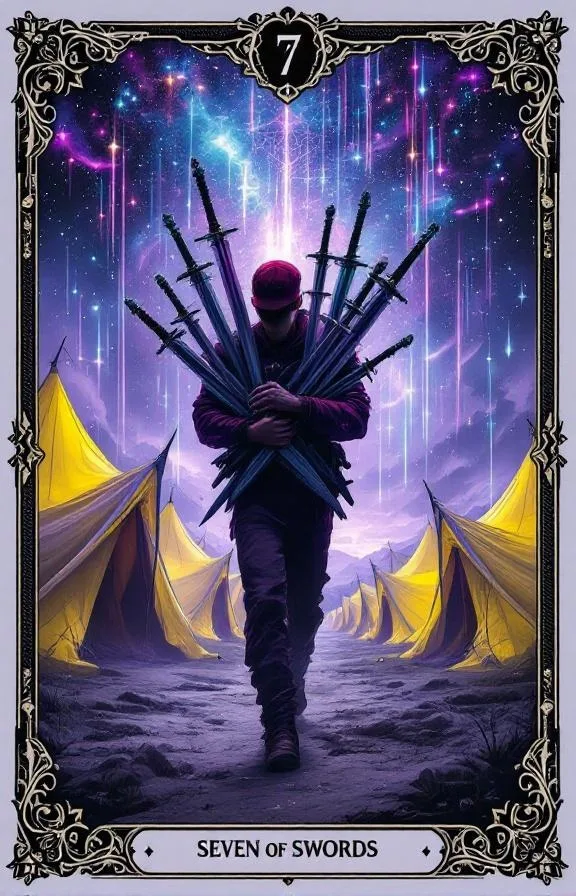
Somebody is not being straight with you. It might be the person you are asking about. It might be the situation itself. It might be you. The Seven of Swords shows a figure sneaking away from camp with stolen swords, looking over their shoulder, hoping nobody notices. When this card turns up in a yes or no reading, the answer has a hole in it — and that hole is made of missing information.
The quick answer
No. Deception, hidden agendas, or a strategy that depends on dishonesty to work. Even if the approach seems effective short-term, the foundation is rotten and will eventually be exposed. The Seven of Swords warns that someone in this situation — and you need to be honest about whether that someone is you — is not playing it straight. Plans that require secrecy to survive are not plans worth building on.
What the Seven of Swords means upright in a yes or no reading
Everyone manages their image to some degree. The Seven of Swords marks the line where impression management crosses into manipulation. That line is thinner than most people admit.
If you drew this card, examine the situation with uncomfortable honesty. Is there information being deliberately withheld? Is someone counting on ignorance — yours or theirs — to keep the arrangement functioning? Would the plan you are considering survive full transparency? If every detail were made public tomorrow, would you still feel good about it?
The most dangerous form of deception this card represents is not the dramatic lie. It is the lie of omission. The half-truth. The carefully worded statement that is technically accurate while concealing the part that actually matters. These deceptions survive because they are hard to detect and easy to rationalize.
This card also shows up when someone is trying to skip steps, cut corners, or hope that nobody notices a gap in the preparation. Those shortcuts occasionally work elsewhere. The Seven of Swords says this is not one of those times.
What the Seven of Swords reversed means for yes or no
The sneaking figure gets caught. Hidden information surfaces. The scheme that depended on secrecy falls apart.
This does not flip the answer to yes. It shifts the energy from active deception to the consequences of deception. If you have been dishonest, the truth is coming out. If someone has been dishonest with you, you are about to learn what was hidden.
A more constructive reading of the reversal: someone is wrestling with the impulse to come clean. Return what was taken. Abandon the dishonest plan before it causes damage. If that impulse exists — in you or in someone else — the card strongly says follow it. The relief of honesty outweighs the short-term cost of admission almost without exception.
Seven of Swords yes or no in love
This card in a love reading makes people uncomfortable because it says what they do not want confirmed: somebody is keeping significant secrets. Not always infidelity in the dramatic sense. Sometimes the corrosion is quieter — pretending to agree to avoid conflict, hiding spending, maintaining contact with an ex while downplaying it, saying "I'm fine" when the truth is something far more complicated.
Asking about someone new? Look past the curated presentation. Everyone puts their best self forward early on. The Seven of Swords says the gap between presentation and reality is wider than normal in this case. That is not paranoia. It is appropriate caution when you do not yet have enough data to extend full trust.
Reversed: secrets surface. A partner's hidden behavior comes to light, or you find the courage to be honest about something you have been concealing. The truth changes the dynamic. Whether it breaks it or heals it depends on what was hidden.
Seven of Swords yes or no in career and finances
A colleague taking credit for your work. A company misrepresenting a role during hiring. A competitive situation where someone is willing to bend ethics to get ahead. The Seven of Swords covers all of it.
If you asked about a specific opportunity: conduct thorough due diligence. What questions are being deflected instead of answered? What does the turnover rate tell you about what happens after the initial enthusiasm fades?
Financially, this card warns against schemes promising unusually high returns, deals with suspicious urgency, and arrangements that depend on you not asking too many questions. If an investment requires trust-on-faith instead of trust-from-evidence, your skepticism is doing its job.
The card can also point at your own financial behavior. Tax strategies that are one audit away from becoming evasion. Record-keeping that is selectively accurate. If you have been cutting corners with your own finances, the Seven of Swords says this is the wrong time to bet that nobody will look closely.
Reversed: the dishonesty is getting uncovered. An investigation, an audit, or a simple conversation exposes what was hidden. Voluntary correction beats getting caught — dramatically.
Tips for reading the Seven of Swords in yes or no questions
Trust your gut. If something feels off, this card confirms it. Do not let a smooth explanation override your instinct that information is missing. Examine your own honesty too — the Seven of Swords points at you just as easily as at someone else. Remember the difference between strategy and deception: being strategic is healthy, being deceptive requires other people's ignorance to work. And consider the two swords left behind in the image. The figure could not carry all seven. Whatever shortcut tempts you, something important gets left behind.
Frequently asked questions
Does the Seven of Swords always mean someone is lying?
Not always in the movie-villain sense. But deception in some form is nearly always present. Self-deception — convincing yourself of something convenient. Social deception — maintaining a false impression. Strategic deception — withholding information for advantage. The card asks you to identify which version is operating in your situation.
Can the Seven of Swords represent a necessary deception, like protecting someone?
The card does not draw clean lines between benign and malicious deception. A "white lie" feels justified in the moment, but the Seven of Swords reminds you that even well-intentioned deception carries risks. The person you are protecting might prefer the truth. The secret might be discovered and damage trust more than the truth would have. The card does not judge motives. It warns about consequences.
What should I do if the Seven of Swords appears in response to my yes or no question?
Pause and investigate. Do not proceed on the information you currently have, because that information is likely incomplete or distorted. Ask direct questions. Verify claims independently. Pay attention to inconsistencies you have been dismissing. If after thorough examination the situation turns out to be genuinely transparent, revisit your question then. Right now, something important is hidden — and decisions built on hidden information produce hidden problems.