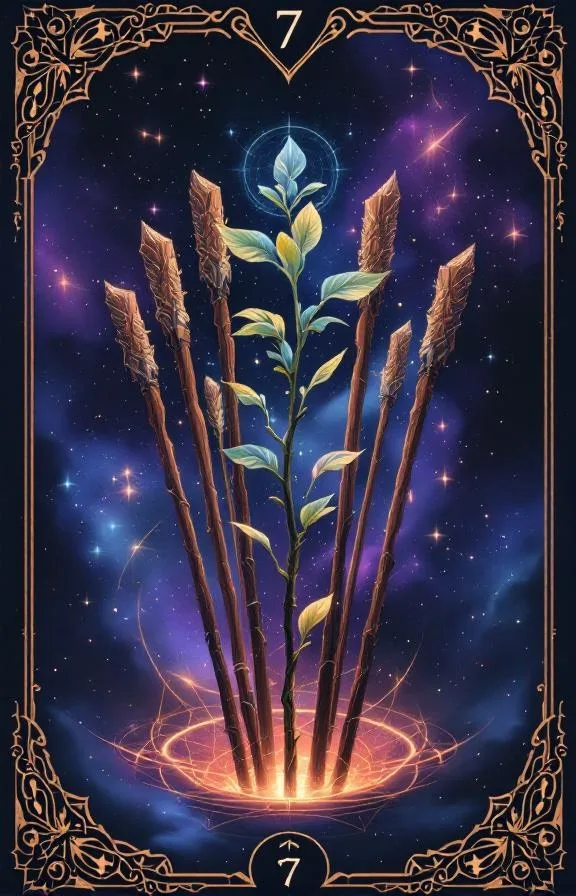
One person on high ground, six wands rising from below. The figure is not attacking — they are defending. And they are doing it alone, with unmatched shoes and a stance that looks more desperate than heroic.
The Seven of Wands is the tarot's most honest portrait of what it feels like to stand your ground when everyone seems to want you to move.
The advice
Hold your ground. Not because it is easy. Not because you are guaranteed to win. Because the position you are defending is worth defending, and you are the only person who can do it.
The Seven of Wands appears at moments of challenge — when your success has attracted opposition, when your ideas have drawn criticism, or when your boundaries have provoked pushback from people who preferred you compliant. The card does not pretend this is comfortable. The figure's mismatched shoes tell you they dressed in a hurry. They were not expecting a fight. But the fight arrived, and the card says: fight it anyway.
The critical distinction this card makes is between stubbornness and conviction. Stubbornness defends positions that no longer make sense. Conviction defends positions that matter. Before you dig in, make sure you know which one you are doing.
Seven of Wands upright advice
Upright, the Seven of Wands says you are being challenged and the correct response is to stand firm. The opposition is real — people questioning your decisions, competitors encroaching on your territory, circumstances testing your resolve — but your position is strong. You have the high ground.
The upright card acknowledges something important: being right does not mean being comfortable. You may feel outnumbered. You may feel unprepared. The figure's defensive posture is not confident — it is committed, which is different and more valuable. Confidence is a feeling. Commitment is a choice.
The practical advice is to stop trying to make everyone happy and instead focus on making the right decision. The moment you achieved something worth defending, you guaranteed that some people would want to take it from you. That is the price of the high ground. The Seven says: pay it. The view from up here is worth the cost.
Seven of Wands reversed advice
Reversed, the figure is either stepping down from the hill or being overwhelmed by the opposition. The reversed Seven asks: have you stopped fighting because the battle is over, or because you gave up?
If you surrendered a position that mattered to you because the pressure was too intense, the reversed card says that decision will cost you more than the fight would have. Not every retreat is strategic. Sometimes it is just exhaustion disguised as wisdom. The advice is to evaluate honestly: did you step back because the position was wrong, or because defending it was hard?
If the battle is genuinely over — if the opposition won or the issue resolved — then the reversed Seven advises recovery. You have been in defensive mode too long. Your nervous system is still scanning for threats that no longer exist. Put the wand down. Take care of yourself. Learn what you can from the experience, and stop reliving a fight that has already ended.
Seven of Wands advice in love
In love, the Seven of Wands advises defending your relationship boundaries. Someone — an ex, a family member, a social circle — is pressuring you or your partnership, and the card says: do not yield.
For couples, this often appears when external opinions are threatening the relationship. Parents who disapprove. Friends who criticize. Social pressure to conform to a version of partnership that does not fit you. The Seven of Wands says your relationship belongs to you and your partner, and defending it against external interference is not just acceptable — it is necessary.
For singles, the card advises defending your standards. If people tell you your expectations are too high, the Seven of Wands says those people are wrong. Knowing what you want and refusing to settle for less is not stubbornness. It is self-respect. The figure on the hill is not fighting for ego — they are fighting for a position they earned the right to hold.
There is a harder version of this advice too. Sometimes the Seven of Wands in love means defending yourself within the relationship — holding a boundary your partner keeps pushing against. If that resonates, the card says: hold it. A boundary that collapses under pressure was never a boundary. It was a suggestion.
Seven of Wands advice in career
Professionally, the Seven of Wands is the competition card turned defensive. You have achieved something — a position, a reputation, a territory — and now others want it. The advice is not to retreat into modesty but to defend what you built.
This shows up frequently after promotions, successful project launches, or moments of visibility. Success makes you a target. The Seven says that is normal, not personal, and the response is to keep performing at the level that got you here. Do not shrink to make others comfortable. Do not apologize for being good at what you do.
The card also advises choosing your battles at work with precision. You cannot defend every hill. If you try to fight on every front — every meeting, every email chain, every political skirmish — you will exhaust yourself before the real battle arrives. Identify the position that matters most to your career and fortify that. Let the rest go.
Action steps
- Identify the one position you are unwilling to surrender. The relationship boundary. The professional standard. The creative vision. Name it clearly, because clarity of purpose is the difference between defensive fighting and aimless arguing.
- Communicate your position once, clearly, without apologizing for it. The Seven of Wands does not repeat itself endlessly. State your stance. Explain your reasoning. Then hold the line without re-explaining every time someone pushes back.
- Stop defending positions that no longer matter to you. Energy is finite. If you are fighting on five fronts, three of them probably do not need you. Withdraw from the battles that have become habit rather than necessity, and redirect that energy toward the one that counts.
FAQ
Is the Seven of Wands telling me I am being attacked?
Not exactly attacked — challenged. The card describes opposition to your position, which can take many forms: competition, criticism, boundary violations, or simply people who disagree with your choices. The key distinction is that the figure in the card holds the high ground. You are not being overpowered. You are being tested. The card says the correct response is to maintain your position, because it is strong enough to withstand what is coming — provided you do not abandon it voluntarily.
How long should I keep defending my position?
Until the position no longer serves you or the opposition genuinely proves you wrong. The Seven of Wands does not advocate indefinite stubbornness. It advocates holding firm when your position is sound and the challenge is external pressure rather than internal doubt. If new information genuinely changes the calculus, adjusting is wisdom. If you are just tired of being challenged, that is not a reason to move. Rest, regroup, and return to the hill.
What if I am the one challenging someone else's position?
Then the Seven of Wands is a warning: the person you are challenging has the high ground, and you may be underestimating the strength of their position. Before you press harder, ask yourself whether your opposition is driven by genuine conviction or by frustration that they will not yield. If your challenge is valid, the card says you will need to bring overwhelming evidence or find a different approach — frontal assault on someone who holds the Seven of Wands position rarely works.
