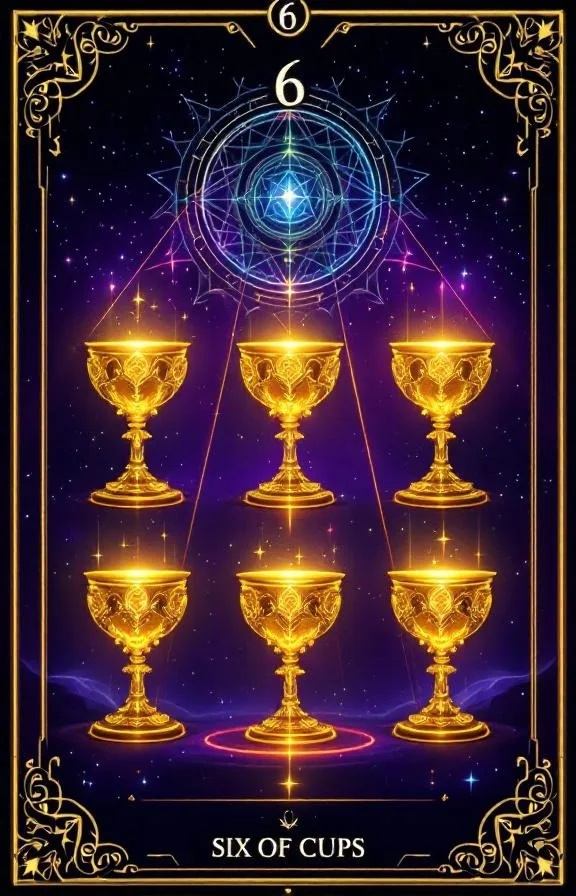
A child offering a cup of flowers to another child. Something pure being exchanged in a setting that feels like memory — familiar, golden-edged, slightly too perfect to be the present. The Six of Cups showed up because your past has something to teach you right now, and you have been either ignoring it or drowning in it.
The advice
Honor the past. Not worship it. Not replicate it. Honor it — which means acknowledging its influence, extracting its lessons, and then letting it inform the present without controlling it.
Most people have one of two relationships with their history: they idealize it or they reject it entirely. The person who says "things were better before" and the person who says "I have moved on from all of that" are making the same mistake from opposite directions. Both are refusing to engage with the past as it actually was — complicated, formative, and permanently unfinished.
The Six of Cups says the past is not behind you. It is inside you. The way you love, the things you fear, the moments that make you feel safe — all of these were shaped by experiences you may have stopped thinking about but never stopped carrying. The card's advice is to look at that inheritance consciously rather than letting it operate in the background.
This is genuinely difficult work. It requires admitting that the present version of you was assembled, not born. Psychologist Dan McAdams spent his career studying how people construct "narrative identity" — the story you tell yourself about who you are — and found that the stories people tell about their past predict their behavior more reliably than personality tests. The Six of Cups says examine your story. Is it accurate? Is it serving you?
Six of Cups upright advice
Upright, the card leans toward warmth. The past it points to holds genuine value — kindness you received, innocence that was real, connections that shaped you for the better.
The specific advice is to reconnect with something or someone from your history. An old friend you lost touch with. A hobby that made you happy before adult responsibilities crowded it out. A place that felt like home. The card is not suggesting nostalgia tourism — it is saying that something from your past contains a key to something you need now.
Maybe you were more creative as a child and you need that creative energy back. Maybe a friendship from ten years ago modeled something your current relationships lack. Maybe the person you were before the career, the relationship, the move, or the loss had a quality you have been missing.
The upright Six of Cups also advises generosity — specifically, the uncalculated kind. The child in the card is not offering flowers as a transaction. There is no expectation of return. When was the last time you gave something — attention, time, a gift — without keeping score? The card says that kind of giving is both its own reward and its own medicine.
Six of Cups reversed advice
Reversed, the past is not informing the present. It is haunting it.
The reversed Six of Cups shows up when nostalgia has become a prison. You are comparing every current experience to a golden version of the past that probably was not as golden as you remember. Or you are trapped in painful memories — cycling through old hurts, replaying conversations, maintaining resentments that served their purpose years ago and now just drain energy.
The advice is direct: put it down. Not forget it. Not pretend it did not happen. But stop carrying it as an active weight in your daily life.
If the reversal points to childhood specifically — difficult family dynamics, wounds that predate your adult vocabulary — the card advises professional support. Some pasts are too heavy to sort through alone, and the reversed Six acknowledges that without judgment. Therapy is not a sign of weakness in this context. It is a sign of taking the card's advice seriously.
There is also a gentler reversed reading: you may be ready to outgrow a chapter. The reversed Six of Cups sometimes appears when staying connected to the past — even a good past — is preventing forward movement. Graduation from your own history. Bittersweet but necessary.
Six of Cups advice in love
In love, the Six of Cups often addresses reconnection. An ex appearing. A childhood sweetheart resurfacing. An old pattern repeating in a new relationship.
The advice depends entirely on context. If an old love is re-entering your life, the card says approach with open eyes. The person you remember and the person who exists now may be very different. Reconnection based on who someone used to be is built on a fantasy. Reconnection based on who they are now — informed by who they were — has real potential. Figure out which one you are pursuing before you pursue it.
For couples, the Six of Cups advises revisiting the early days. Not to recapture them — that is impossible and attempting it creates pressure — but to remember why you chose each other. The qualities that attracted you initially are probably still there, buried under years of routine and accumulated small irritations. Dig for them.
If childhood patterns are influencing your romantic relationships — and they always are — the card says look at them honestly. The partner you chose, the conflicts that recur, the attachment style you default to — all of these have roots in experiences that happened before you could drive a car. Understanding those roots does not erase them but it stops them from running the show without your knowledge.
Six of Cups advice in career
Professionally, the Six of Cups points backward to move you forward.
There was something you wanted to be before the practical considerations took over. Before the mortgage, the resume optimization, the LinkedIn algorithm. The Six of Cups says that original impulse — the thing that interested you when interest was not yet contaminated by obligation — still contains information worth considering.
This does not mean quitting your accounting job to become a marine biologist. It means examining what specifically excited you about that early dream and finding ways to incorporate that quality into your current work. The kid who wanted to be a marine biologist might actually want discovery, autonomy, or contact with the natural world. All of these can be integrated into an existing career without burning it down.
For networking, the card advises looking backward. Former colleagues, old mentors, classmates you have not spoken to in years. These dormant connections are often more valuable than new ones because they come with built-in trust and shared history. Reach out.
If you have been in the same field for a long time and feel stale, the Six of Cups suggests returning to the basics of your craft. The foundational skills and enthusiasms that drew you in originally. Sometimes career reinvigoration is not about moving forward but about reconnecting with why you started.
Action steps
- Contact someone from your past. Not with an agenda. Just to reconnect. The person who crosses your mind first while reading this is probably the right one.
- Revisit an abandoned interest. Something you used to love doing before life got in the way. Give it thirty minutes this week. Not as a commitment. As an experiment.
- Write down three gifts your past gave you. Qualities, skills, or perspectives that you carry because of where you came from. Acknowledge them out loud.
- Release one old resentment. Pick the smallest one. Not the big ones — those take more work. Find a grudge that has outlived its purpose and consciously decide to stop feeding it.
FAQ
Does the Six of Cups mean an ex will come back?
It can indicate reconnection with someone from your past, but the card is not a prediction — it is advice. If an ex does reappear, the Six of Cups tells you to evaluate the reconnection based on present reality, not shared history. Nostalgia makes terrible relationship counselors. The fact that you once loved someone is not sufficient reason to love them again. The question is whether the issues that ended the relationship have actually been addressed or whether you are both just lonely enough to pretend they have.
How do I honor my past if my past was painful?
Honoring does not mean celebrating. A painful past can be honored by acknowledging its impact honestly, recognizing the survival skills it taught you, and refusing to let it define your future without your consent. The Six of Cups in this context is asking you to own your history rather than running from it — not because the pain was acceptable, but because pretending it did not happen gives it more power than facing it does.
Is the Six of Cups about having children?
Sometimes. The card's imagery of children can literally point to parenthood, younger family members, or working with children. More often, though, it points to the childlike qualities within you — spontaneity, wonder, unguarded emotion, the ability to be fully present without performance. The card asks whether you have maintained access to those qualities or whether adulthood has armored them over. Both readings are valid and they are not mutually exclusive.
