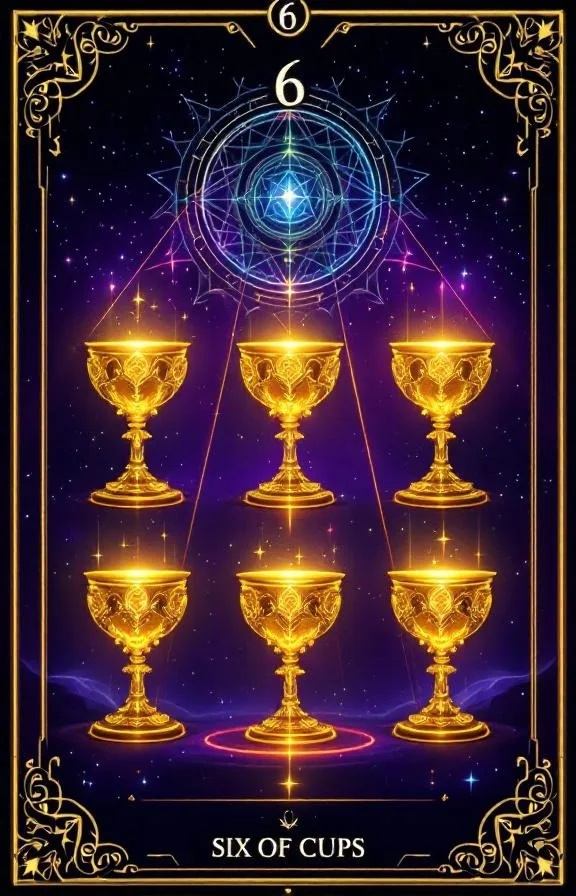
A song plays and suddenly you are sixteen again. Standing in a kitchen that no longer exists, smelling something baking that you will never taste exactly that way again. The memory is not accurate — you know this — but its emotional signature is more real than the room you are actually sitting in. The Six of Cups as feelings is that bittersweet pull backward, the heart reaching for a time when things felt simpler, whether or not they actually were.
The core feeling
Nostalgia spent most of the 20th century classified as a medical condition — literally a form of homesickness that Swiss physicians treated as pathology. Psychologist Constantine Sedikides rehabilitated the emotion in the early 2000s, demonstrating through dozens of studies that nostalgic reflection actually strengthens social bonds, increases self-continuity, and counteracts existential anxiety. The Six of Cups captures nostalgia at its most potent: not a passive drift into memory but an active emotional engagement with a version of yourself that felt more whole.
The card shows a child offering flowers to another child in what appears to be a garden or courtyard. The scene is deliberately innocent — uncontaminated by adult complexity, adult compromise, adult awareness that things end. The feeling it represents is not simply remembering the past but longing for the emotional quality the past contained. The safety. The trust. The assumption that people mean what they say and the world operates on comprehensible rules.
Six of Cups upright as feelings
Upright, the Six of Cups represents feelings saturated with warm memory. The person is experiencing the present through the filter of the past, and the filter is generous — softening edges, brightening colors, erasing the complications that were actually present at the time. This is not delusion. It is the heart's way of maintaining continuity with earlier versions of itself.
The emotional texture is distinctive: tenderness mixed with loss. Sweetness that aches. The person feels connected to something they cannot return to, and the inability to return makes the connection feel more precious rather than less. They may be thinking about a specific person — a childhood friend, a first love, a parent when that parent was younger — or they may be mourning a general condition of innocence that adulthood has stripped away.
Here is the thing about nostalgia that most people get wrong: it is not primarily about the past. It is about the present. People become nostalgic when something in their current life feels insufficient, and the memory of a time when things felt sufficient provides temporary relief. The Six of Cups upright is that relief — genuine, soothing, and ultimately unable to solve the problem it is responding to.
Six of Cups reversed as feelings
Reversed, nostalgia curdles. The warm memories are still accessible, but instead of providing comfort they have become a trap — a past so idealized that the present cannot compete with it. The person is not visiting their memories occasionally. They are living there. Using the past as evidence that the present is a downgrade, that their best days are behind them, that nothing will ever feel as good as it once did.
This reversal can also indicate someone confronting the falseness of their own nostalgia. The childhood that seemed golden was actually complicated. The first relationship that felt perfect ended for real reasons that memory has selectively deleted. The reversed Six of Cups is the uncomfortable moment when the filter drops and the past appears as it actually was — less simple, less innocent, less different from the present than the person needed to believe.
Sometimes the reversed card points to someone who is being held hostage by another person's nostalgia. A partner who constantly references "how things used to be." A parent who treats every change as decline. The person feeling the reversed Six is tired of living in someone else's museum.
Six of Cups as feelings in love
In romantic contexts, the Six of Cups as feelings frequently indicates a connection rooted in shared history. The person feels bonded to their partner not primarily through present-day passion but through accumulated memory — the years of private jokes, survived crises, and small daily intimacies that create a relationship's particular texture. They love their partner partly because their partner is the only other person who was there for all of it.
When this card appears regarding a new romantic interest, it often signals that the person sees echoes of someone from their past in the new person. Familiar mannerisms. A similar laugh. The way they hold a cup or tilt their head when listening. The attraction is genuine but partially borrowed from a previous emotional attachment, and the person may or may not be aware of the borrowing.
The Six of Cups also shows up consistently in readings about ex-partners. Someone is thinking about going back. The memory of how things were is exerting gravitational pull, and the person is confusing missing someone with wanting to be with them again — two very different things that feel identical from the inside.
Six of Cups as feelings about you
When the Six of Cups represents someone's feelings about you, you evoke their past. Something about you — your personality, your appearance, the way you make them feel — connects them to a time they associate with emotional safety. Being around you is like returning to a place they thought no longer existed.
This is powerful but complicated. You are being valued partly for what you represent rather than who you are. The affection is real, but it carries a weight of projection that you did not ask for and may not be able to sustain once the nostalgic filter fades and they begin seeing you in the flat light of the present.
Six of Cups as feelings in career
Professionally, the Six of Cups indicates someone longing for a previous professional identity. The job they loved five years ago. The team that worked. The company before the merger changed everything. They measure every current professional experience against a golden period that may or may not have been as golden as they remember, and the measurement always comes out unfavorable.
This nostalgia can be productive if it clarifies what the person actually values in a professional environment — collaboration, autonomy, meaningful work, a specific kind of culture. It becomes destructive when it prevents them from engaging with present opportunities because nothing will ever match the legend they have built around their past.
Frequently asked questions
What does Six of Cups mean as feelings?
The Six of Cups represents nostalgia — the bittersweet emotional pull toward the past, toward simpler times, toward relationships and experiences that carry the glow of memory. It signals someone whose feelings are strongly influenced by what was rather than what is.
Does Six of Cups represent positive or negative feelings?
Both simultaneously, which is what makes it distinctive. Upright, nostalgia provides genuine emotional comfort and a sense of continuity with happier times, but it also signals that something in the present feels lacking. Reversed, the warmth of memory has become a barrier to present engagement. The feelings are never hostile — they are tender and wistful regardless of position.
What does Six of Cups reversed mean as someone's feelings?
Someone feeling the reversed Six of Cups is trapped in idealized memories of the past. They may be comparing you or their current situation unfavorably to a romanticized version of what came before, or they may be starting to recognize that their nostalgic memories were not as accurate as they believed. Either way, they are processing a complicated relationship between past and present that is affecting their ability to be fully emotionally available now.
Curious what Six of Cups means as feelings in YOUR situation? Try a free AI tarot reading and explore the emotional landscape of your cards.