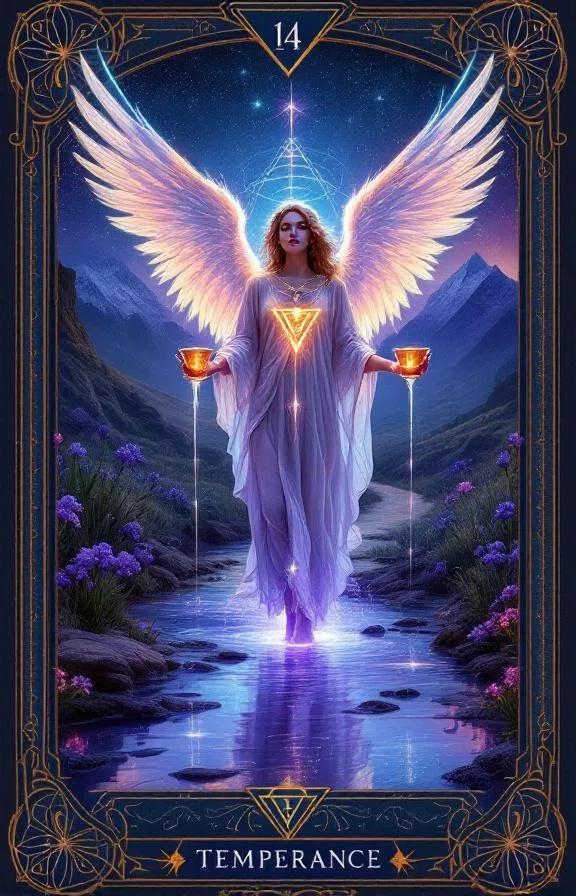
Patience is not the absence of urgency. That is a common misreading, and it is wrong. Real patience — the kind Temperance represents as feelings — exists alongside urgency. You want something. You want it badly. And you have made the deliberate, sometimes agonizing choice to let it arrive in its own time rather than dragging it into being prematurely. The feeling has weight to it. There is nothing passive about a person who could force an outcome and chooses not to.
The core feeling
Temperance carries the emotional quality of skilled mixing. Think of a bartender who has made ten thousand cocktails — the movements are precise, the proportions intuitive, the timing instinctive. The emotion this card represents is not just patience but calibrated patience. The person feels their way toward balance rather than calculating it. They sense when to push and when to wait, when to speak and when silence serves better, when their own intensity needs diluting with restraint.
This is an emotional intelligence that develops through experience, usually painful experience. Nobody arrives at Temperance's equanimity naturally. It is built on a foundation of past overcorrections — relationships where they gave too much, confrontations where they came on too strong, situations where their inability to modulate their emotional intensity burned something down. The patience Temperance represents is earned patience, and it carries the quiet confidence of a lesson that finally stuck.
What distinguishes this from suppression — and this distinction matters — is that the person is not hiding their feelings. They are blending them. Combining passion with pragmatism. Mixing desire with discernment. The emotions are all present and fully felt. They are just being held in proportions that serve the situation rather than overwhelming it.
Temperance upright as feelings
When Temperance appears upright as someone's feelings, they are in a state of emotional equilibrium that took real work to achieve. The inner turbulence has settled. Not disappeared — settled. Like sediment in a glass of water that has been left to stand, the clarity emerged because they stopped stirring.
The person feels centered in a way that allows them to hold complexity. They can love someone and recognize that person's flaws simultaneously, without either truth canceling the other. They can want something intensely and accept that it may not happen, without the acceptance diminishing the want. This is sophisticated emotional territory. Most people live at the extremes — all in or all out, total hope or total cynicism. Temperance occupies the rich middle space where contradictions coexist.
There is also a spiritual dimension to upright Temperance feelings. The person often senses that they are participating in something larger than their individual timeline. Their patience is not just strategic — it has a quality of trust. Trust that the timing is not arbitrary. Trust that what is meant for them cannot miss them if they do not obstruct it by forcing it to arrive on their schedule.
Temperance reversed as feelings
Reversed, Temperance's patience fractures into impatience that the person usually knows is counterproductive but cannot control. The careful calibration is gone. Emotional responses arrive too hot, too fast, too raw. The person who was mixing with precision is now dumping ingredients in without measuring, and the result is chaos they create while simultaneously hating themselves for creating it.
The reversed position often indicates someone who maintained their composure for an impressively long time and has finally hit their limit. The patience was real. It was also exhausting. And now the reserve is depleted and every small frustration triggers a disproportionate response because the tolerance budget has been spent.
Self-medication behaviors cluster around reversed Temperance. Not necessarily substances, though sometimes. More often it is the emotional equivalent: binge-watching instead of having the conversation, doom-scrolling instead of sitting with discomfort, serial dating instead of processing the last relationship. The moderation has collapsed, and the person is reaching for anything that offers immediate relief from the tension of being out of balance.
Temperance as feelings in love
In romantic readings, Temperance as feelings is the emotional signature of mature love. Not the fireworks-and-obsession variety — the kind that emerges after you have already seen each other at your worst and decided to stay anyway. The person feeling Temperance energy toward a partner has integrated the fantasy and the reality into a single, sustainable emotion. They are not in love with a projection. They are in love with a whole person, imperfections included, and their patience extends to the imperfections because they recognize their own.
For new connections, Temperance as feelings suggests someone approaching the relationship with unusual intentionality. They are attracted but not rushing. Interested but pacing themselves. This can read as lukewarm to someone expecting grand romantic gestures, and that misread causes genuine problems. The Temperance-feeling person is not lukewarm. They are managing their own emotional temperature so the relationship has a chance to develop at a pace that creates real foundation rather than spectacular early intensity followed by collapse.
Here is the opinionated take most tarot readers avoid: Temperance as romantic feelings is often a better indicator of lasting love than The Lovers, which gets all the credit. Temperance is what remains after passion has been tested. The Lovers is the ignition. Temperance is the engine running clean at cruising altitude.
Temperance as feelings about you
When Temperance represents how someone feels about you, you are a stabilizing presence in their emotional world. Being around you helps them find their center. Not because you calm them down — you might actually challenge them — but because your presence creates conditions where they can access their own equilibrium.
They see you as someone who operates with a kind of emotional integrity they admire and possibly envy. The way you hold your ground without aggression. The way you accommodate without losing yourself. They are paying close attention to how you navigate complexity, because they are trying to learn it.
Temperance as feelings in career
Professionally, Temperance as feelings indicates someone who has found — or is actively seeking — sustainable rhythm in their work. They have moved past the hustle-and-burn mentality and are looking for a way to be productive without being consumed. The feeling is one of calibration: figuring out how much they can give without depleting themselves, and how much they can hold back without underperforming.
This emotional state produces consistently high-quality work without the dramatic peaks and crashes that characterize more intense professional energy. The person is not the one pulling all-nighters before a deadline. They finished three days early because they paced themselves. Nobody notices this, which is both the strength and the frustration of Temperance energy in a workplace that often rewards visible intensity over quiet competence.
Frequently asked questions
What does Temperance mean as feelings?
Temperance represents patient, balanced, and carefully modulated emotional energy. The person feeling this card has achieved — through experience rather than theory — the ability to hold their desires and their restraint in productive tension. They feel steady, centered, and willing to let things unfold at their natural pace.
Does Temperance represent positive or negative feelings?
Upright, the feelings are deeply positive — equilibrium, emotional maturity, and sustainable patience that comes from genuine inner work. Reversed, the balance tips and the person feels impatient, excess-seeking, and frustrated by their own inability to maintain the composure they know serves them best. Even reversed, though, the desire for balance is still the underlying drive — it has just temporarily overwhelmed itself.
What does Temperance reversed mean as someone's feelings?
Someone feeling reversed Temperance has run out of patience, usually after maintaining it for longer than was reasonable. Their emotional responses have become disproportionate — too intense, too reactive, too unfiltered. They know they are out of balance and this awareness adds frustration on top of frustration, creating a feedback loop that is difficult to interrupt without deliberate intervention or a genuine break from whatever is draining them.
Curious what Temperance means as feelings in YOUR situation? Try a free AI tarot reading and explore the emotional landscape of your cards.