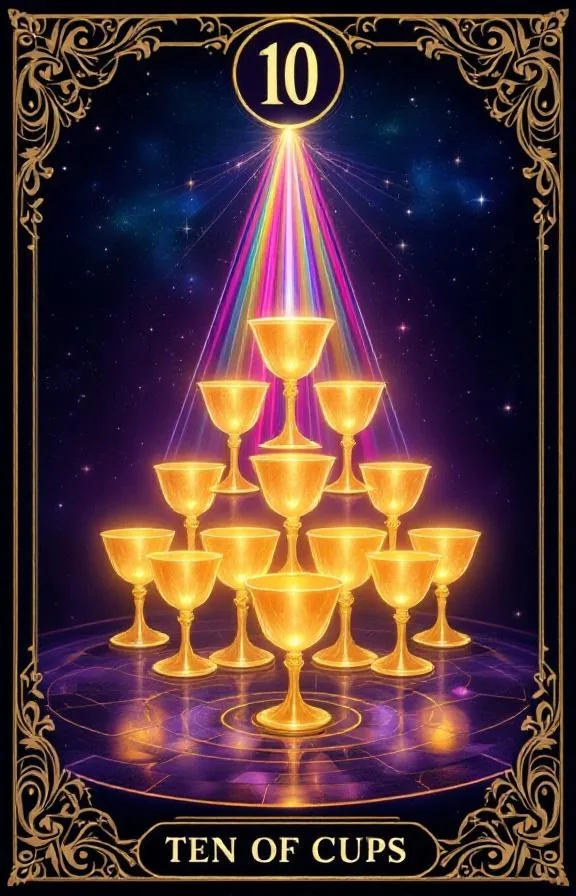
Their kitchen table always has extra chairs. There is always enough food for whoever shows up. The door is always open — not metaphorically, sometimes literally. The Ten of Cups person builds a life that other people want to be part of, and the building is the point. Not the house. Not the career. Not the achievement. The togetherness.
The personality profile
"Family builder" does not necessarily mean biological family, though it often includes that. The Ten of Cups person constructs chosen families, found communities, circles of belonging wherever they go. They are architects of emotional safety. They create the conditions under which people feel held, loved, and home — and they do it with such consistency that the people around them start to take it for granted, which is both a compliment and a risk.
Their orientation is fundamentally communal. While most people operate from an individual center — what do I need, what do I want, how do I feel — the Ten of Cups person operates from a relational center. Every decision filters through the question: how does this affect us? The "us" may be a family, a friend group, a neighborhood, a team. The specific configuration matters less than the principle. They think in plurals.
This communal orientation is not selflessness, though it looks like it from the outside. The Ten of Cups person derives their deepest satisfaction from collective wellbeing. They are happiest when the people they love are happy. This is not martyrdom — it is genuinely how they experience joy. Their fulfillment is structurally dependent on the fulfillment of their people.
Ten of Cups upright as a person
Upright, this is the person who creates Thanksgiving. Not the holiday — the feeling. The warmth of being gathered. The sense that right now, in this moment, everyone who matters is in the same room, and the room is safe, and the food is good, and the conversation is real, and nothing outside these walls can touch us.
They remember everyone's dietary restrictions. They know which relatives cannot sit next to each other. They mediate the tensions that have been simmering since 1997 with a grace that makes it look effortless even though it absolutely is not. They absorb the logistical and emotional labor of keeping a group functional, and they do it willingly because the alternative — fragmentation, disconnection, people drifting apart — is genuinely intolerable to them.
The upright Ten of Cups person also has an unusual capacity for contentment within ordinary life. They do not need exotic vacations or professional accolades to feel fulfilled. A Saturday morning with coffee and the people they love is enough. A dinner where everyone laughs until they cry. A walk with the dog while the kids argue about something irrelevant in the background. They find the sacred in the mundane, and that ability is far rarer than it should be.
Ten of Cups reversed as a person
Reversed, the family builder becomes a family controller. The warm home becomes a gilded cage where everyone is expected to perform harmony whether they feel it or not. Conflict is suppressed rather than resolved. Problems are papered over with forced togetherness. The question shifts from "are we happy?" to "do we look happy?"
The reversed Ten of Cups person can become tyrannical about their vision of family life. Holidays must be perfect. Traditions must be maintained. Everyone must attend. The pressure to conform to an idealized image of collective happiness creates the exact opposite: resentment, suffocation, quiet rebellion.
Codependency takes on a group dimension. The Ten of Cups person reversed cannot allow any member of their circle to be unhappy without experiencing it as a personal failure. Their child's bad grade, their partner's rough week, their friend's breakup — all of it becomes their crisis, their problem to fix. They fuse their identity so completely with the group's wellbeing that they have no individual self left. Ask them what they want — just them, separate from everyone else — and they genuinely cannot answer.
There can also be a dark possessiveness. The people in their circle are not free to leave, to grow apart, to change in ways that disrupt the established dynamic. The adult child who moves across the country is made to feel guilty. The friend who gets busy with a new relationship is subjected to passive aggression. The Ten of Cups person reversed treats their community as a possession rather than a living system, and living systems need room to breathe.
Ten of Cups as a person in love
In romantic relationships, the Ten of Cups person is building from day one. They are not dating for fun — they are dating for forever. They are evaluating you as a co-parent, a co-host, a co-architect of the life they have been mentally constructing since they were old enough to know they wanted one.
This earnestness is either deeply attractive or deeply terrifying, depending on your own relationship with commitment. There is no casual mode. They are invested. They introduce you to their family early. They start saying "when we" instead of "if we" by the third month. They are all in.
The love they offer is structured and dependable. They show up. Every day. Not with grand gestures but with the accumulated weight of ten thousand small ones — the lunch packed, the appointment remembered, the blanket adjusted while you sleep. Their love is architectural. It is load-bearing.
Ten of Cups as a person at work
At work, the Ten of Cups person is the culture builder. They organize team lunches, advocate for parental leave policies, push back against overtime culture, and generally treat the workplace as a community that deserves the same care as a family. They thrive in organizations that value people over profit and struggle in ones that treat employees as expendable resources. HR, community organizing, teaching, social work, and nonprofit leadership are natural fits.
Ten of Cups as someone in your life
If you are lucky enough to be inside a Ten of Cups person's circle, you already know: there is nowhere warmer. They make you feel claimed in the best sense — included, wanted, accounted for. Your birthday will be celebrated. Your crises will be shared. Your victories will be cheered.
What they need in return is presence. Show up. For the dinners, the gatherings, the ordinary Tuesday evenings when nothing special is happening except that everyone is together. That is the whole point for them. And when you drift — because you will, everyone does — come back. They will always leave the door open. Always. That is who they are.
Frequently asked questions
What kind of person does Ten of Cups represent?
The Ten of Cups represents someone who finds their deepest fulfillment through creating and maintaining loving communities — whether biological family, chosen family, or tight-knit friend groups. They are nurturing, communally oriented, and skilled at building emotional safety.
Is Ten of Cups as a person positive or negative?
One of the most positive archetypes in the deck. Their capacity for creating genuine belonging is extraordinary. The reversed expression — controlling, codependent, intolerant of conflict — represents a distortion of their love, not its absence. Even at their worst, the underlying motivation is a desire for togetherness.
How do you recognize a Ten of Cups person?
Their home is the gathering place. There are always extra plates. People gravitate there on holidays, after bad days, for no reason at all. The Ten of Cups person is the one who maintains the group chat, organizes the annual trip, and remembers what you said about your childhood dreams four years ago. They make you feel like you belong somewhere, and that feeling is consistent, not performative.
